
Ruins of a lost medieval village have been revealed after the ongoing drought depleted the water levels of a reservoir.
Nether Hambleton was demolished in the 1970s so the surrounding 3,000-acres could be flooded to form Rutland Water, in the East Midlands.
Relics of a medieval settlement were found at the site of the village when it was knocked down, and for 50 years have lain submerged alongside the modern material.
But now, the stonework and rubble have emerged once again – after roasting temperatures and an extraordinary lack of rain shrank Rutland Water significantly.
Slabs of brickwork and the footprints of buildings can be seen pockmarking parched, brown land that is usually the reservoir bed.
Residents of the hamlet, along with other small villages including Middle Hambleton, were relocated from 1973 to clear the way for Rutland Water, which supplies around half a million people in the East Midlands.
The creation of the reservoir, which involved damming the Gwash valley near Empingham, was finished in 1976 – and flooding took a further three years to create what was then Europe’s largest man-made lake.
At its maximum, the reservoir is 34m deep.
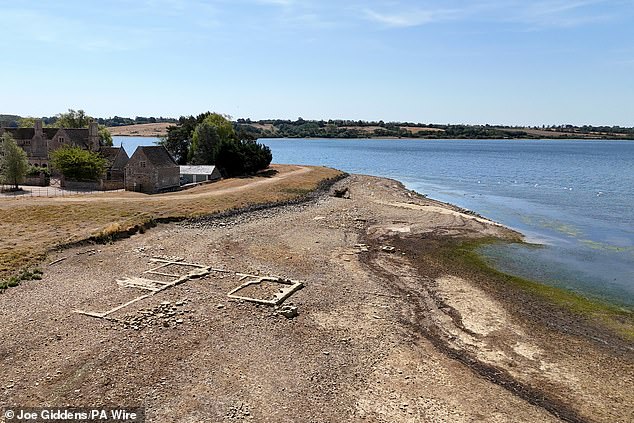
Stonework and rubble that once formed the village of Nether Hambleton has been exposed
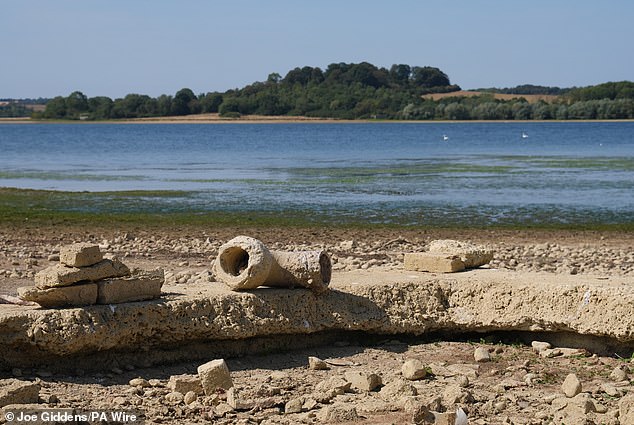
The village was demolished 50 years ago and flooded in order to create the Rutland Water reservoir
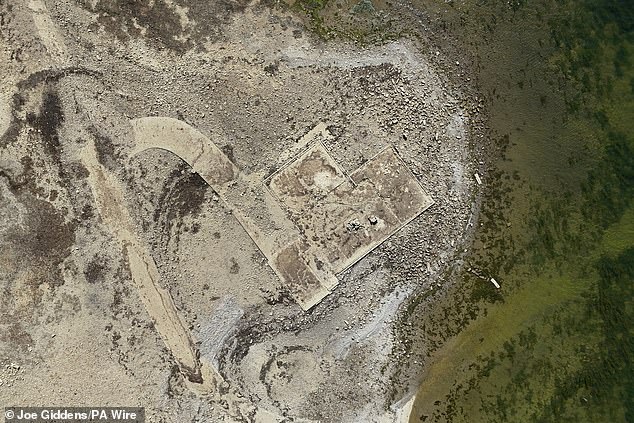
The ongoing drought has made the reservoir shrink back and expose the old ruins
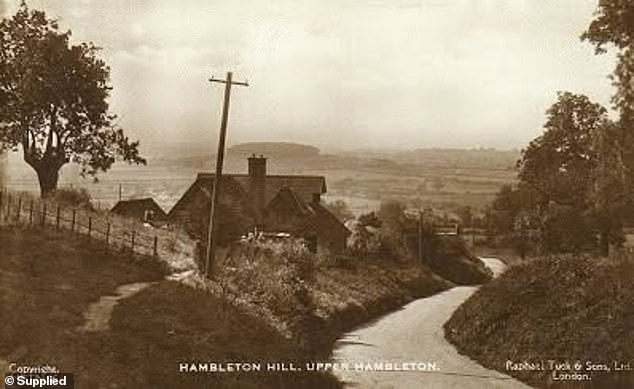
Homes and farmhouses were among the buildings demolished, and their inhabitants were rehoused elsewhere
Among the lost buildings were 18th-century homes and farmland growing barley to be sold to Germany for brewing lager, and wheat that Hovis bought for breadmaking.
The remains of Nether Hambleton were left in the bottom of a valley between what is now the Hambleton peninsula in the north and the hamlet of Lyndon to the south.
It was in the early 1970s, after the village was earmarked for demolition, that archaeologists came across evidence of a medieval settlement at the site.
They discovered old house platforms, an area that had been a village green or a street, and plot boundaries.
Under time pressure from the impending flood, teams fully excavated one of the medieval house platforms to expose substantial stone walls, fireplaces, an oven and a yard.
Volunteers pulled thousands of artefacts including pottery shards, medieval coins and horseshoes from the ground.
But most of the ruins remained underground because the excavation had to end after three years, when the site was flooded.
The East Midlands was among the latest regions where drought was declared this week.
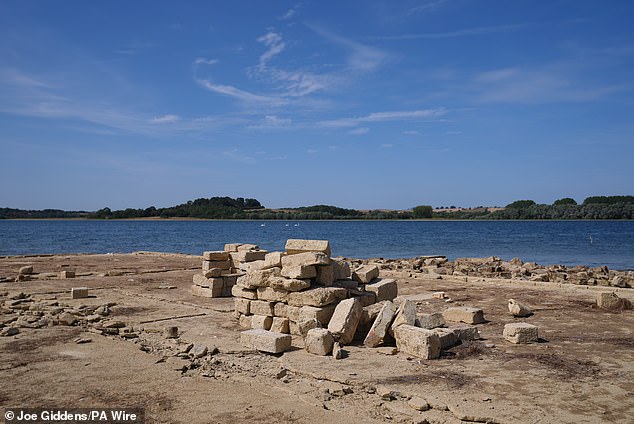
Slabs of brickwork can now be seen on parched, dry land that is usually the reservoir bed
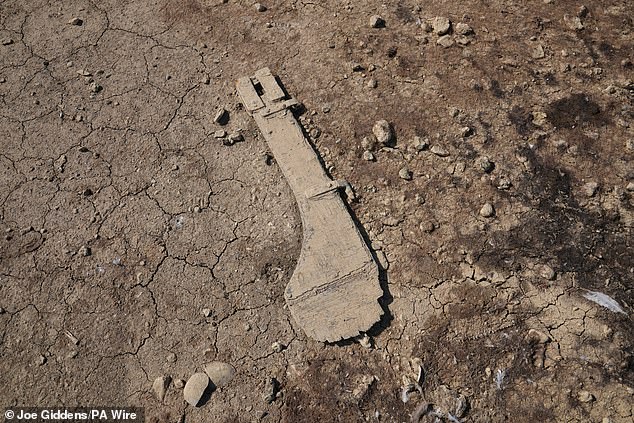
A rudder from a boat is among the objects to have been revealed

Some parts of the East Midlands received just one per cent of their expected rainfall in July, hence the significant shrinkage of the reservoir
Lincolnshire and Northamptonshire, Kent and East Sussex, and the Solent and South Downs also moved into drought – meaning almost three quarters of England is now under the designation.
Parts of the East Midlands received just 1 per cent of their expected rainfall in July, with the region’s rainfall below average for five consecutive months.
Meanwhile, the Met Office announced on Tuesday that the UK is on course for its hottest summer ever – with only average temperatures needed for the rest of August to beat the record.
The mean temperature for the summer so far, from June 1 to yesterday, stands at 16.48C – which is 1.88C above the 1991 to 2020 average, provisional data shows.
To equal the 16.12C seen only last year – the UK’s warmest summer on record – the rest of August would need to be just 0.21C below the long-term average, and any warmer than this would establish a new record for the country, meteorologists confirmed.
For England and Wales, which have seen temperatures more than 2C above average so far this summer, it is even more likely that this summer will be record-breaking.
The record looks on course to be beaten after an amber warning for extreme heat was issued by the Met Office for Thursday, when temperatures are expected to soar to 38C in parts of England.
The forecaster has issued the warning for London and parts of the South East, East Midlands, East of England, West Midlands and South Yorkshire from 9am to midnight on Thursday as temperatures are to climb to 37C or 38C in some places.

People stand on the exposed, cracked and dried mud bed of Hollow Pond in east London today

Parched conditions leave the usually green landscape brown on Hayling Island in Hampshire

Golfing greens on Hayling Island stand out against the rest of the dry landscape today
Tony Grayling, the strategic drought lead at the EA and chairman of the National Drought Group, said: ‘Drought conditions are worsening and will continue to do so until we see significant and sustained rainfall.
‘We know the hot and dry weather is taking a real toll on farming and there will be long-lasting impacts on our environment.
‘We want everyone to stay safe and hydrated over the summer, but we need everyone’s help in using a little less water to make sure our current water reserves last.
‘Every drop we can save is a drop more for your local farmers, local wildlife and local rivers.’