
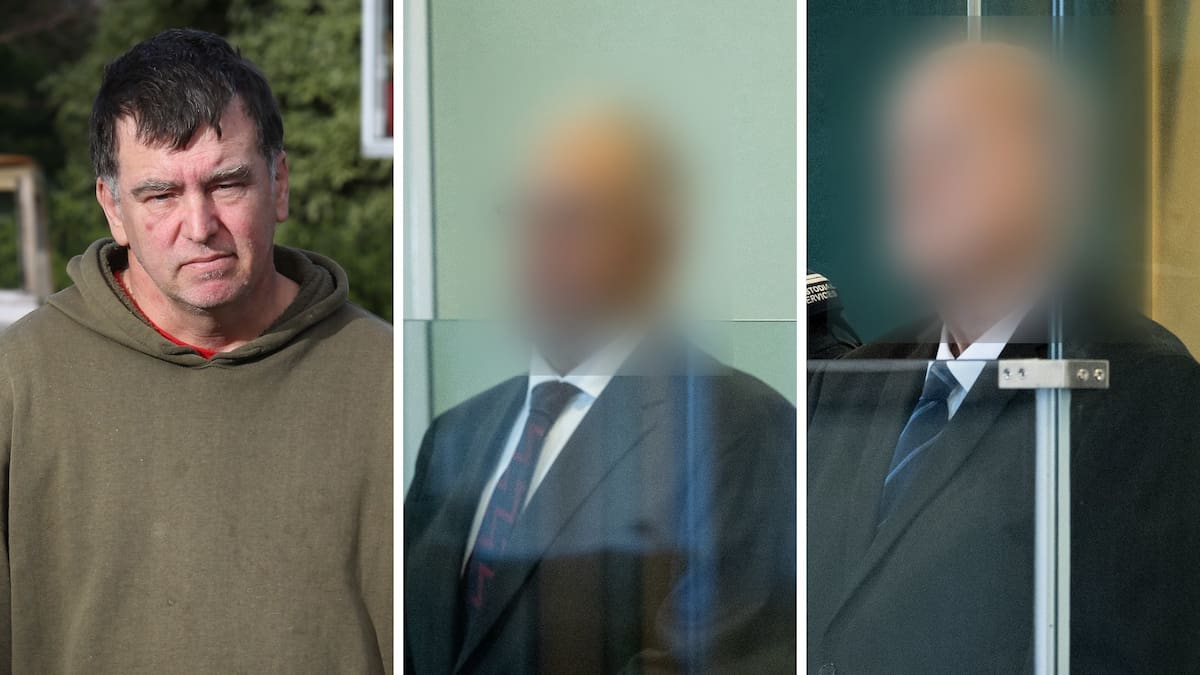
Hall, who is autistic but was not diagnosed at the time of his arrest, took today’s decision in stride as he left the courthouse with his brothers.
“I can only give you an honest answer: F*** me dead, we got the bastards, put them in trial,” he said. “They were found not guilty but I’d like to say to those two police officers, $4.9 million not bad for a f*** up they did, and you can bloody well quote me on that too.”
In a prepared statement, the brothers said they respected the court’s decision even though it was difficult to accept.
“While the verdict did not result in a criminal conviction, some of the facts presented during the trial raised important questions about transparency and fairness,” Greg Hall said. “Every person deserves the right to a fair trial. That right relies on the absolute assurance that all witness evidence presented in court is strictly maintained in its original, unedited state, fully consistent with established evidentiary standards.”
Exonerated former murder defendant Alan Hall (foreground) and brother Geoff Hall speak with the media outside the High Court at Auckland following the acquittal of two police officers involved in the 1985 murder investigation. Photo / Craig Kapitan
Having not yet read the reasons for the judge’s decision, Geoff Hall said they had to trust the process. His eyes welled as he recalled the hard work their mother had done over the decades to get his brother’s conviction overturned.
“It’s been explained to me by a lot of people that our road came to an end at the Supreme Court – that was our journey,” he added. “This was a side road that the justice system had been abused, and so we were here in support of that and Alan, as a victim. And to an extent, everybody was a victim of what happened in Alan’s trial. We needed to be part of that.”
Geoff Hall added that his heart goes out to the family of homicide victim Arthur Easton.
“They still don’t have answers, and that’s not right,” he said.
During his closing address last month, prosecutor John Billington, KC, noted that multiple expert witnesses over the course of the current trial described the witness statements of Ronald Turner as potentially “critical” to Hall’s defence in his 1986 murder trial.
Turner was at an intersection in a Papakura neighbourhood on the night of October 13, 1985, when he said he saw a pedestrian run across the street and act suspiciously, looking over his shoulder.
Around that same time, Easton had been stabbed to death inside his nearby home with a bayonet that was abandoned at the scene. Police would months later trace the bayonet back to Hall, and the following year he was charged with murder.
But the case had a potential flaw: Hall is a light-skinned Pākehā, and Turner insisted to police on three separate occasions that the apparently fleeing pedestrian was a dark-skinned Māori. The victim’s sons had also initially described the intruder as Māori, although they later recanted and said they couldn’t see the person’s skin tone.
A written version of Turner’s statement, omitting the word Māori, was presented at a pre-trial hearing and again at the trial. The defence was not given his original statements before the trial or during the first appeal process, during which defence lawyers specifically asked for any information from the police file relating to racial identification.
As the 1986 trial concluded, jurors were told by the Crown: “The circumstantial evidence is such as to exclude every reasonable possibility that it was anyone other than the accused, Alan Hall.”
Turner’s statements wouldn’t be seen by a New Zealand court until the Supreme Court reviewed the case 37 years after the homicide.
Two elderly former police officers are on trial in the High Court at Auckland accused of perverting the course of justice during the 1986 murder trial of Alan Hall. Photo / Dean Purcell
By omitting the Māori reference from the original court document then withholding Turner’s original statements throughout the trial and appeal process, the defendants “enhanced the prosecution case to a significant degree”, Billington argued.
It’s unknown if a jury would have still found Hall guilty or acquitted him had they been presented with all the evidence, Billington said. But by withholding the evidence, the defendants effectively put the final decision “in the hands of … the police and not in the hands of the court where it belongs”.
However, defence lawyers David Jones, KC, and Paul Wicks, KC, suggested the case against their clients was built on false premises that started with the Supreme Court decision.
They warned against “reverse engineering” a verdict to match the Supreme Court’s decision.
Jones argued it was the responsibility of the Crown, not police, to decide what constitutes “evidence” and what is shared with the defence. His client did his duty by participating in the investigation with “great integrity and professionalism”, he said.
A decision was made above the officers’ heads that the racial evidence was inadmissible, Jones said. Even if it was an incorrect decision, it can’t be illegal because it was a genuinely held belief and not a nefarious attempt to sway the outcome of the case, he said.
Both lawyers also suggested the Supreme Court had been too rigid in its portrayal of how disclosure was treated in the mid-1980s.
“It was fundamentally different from today,” Wicks said. “There was not statutory framework guaranteeing pre-trial disclosure.”
Justice Ian Gault. Photo / Dean Purcell
Ongoing suppression continues to limit the way in which the media can report the trial and the judge’s findings.
Both acquitted defendants have indicated they will be seeking permanent suppression.
In a statement issued directly after the verdict, Assistant Commissioner Investigations Corrie Parnell said police stood by the decision to put the case against the two officers before the courts in light of the Supreme Court decision.
“The onus was on the wider justice system to understand how this was able to occur over many decades,” Parnell said. “It is our view after a thorough investigation decades later that there was an end-to-end justice system failure, but we also recognised that individuals responsible for key steps in the case played a critical role and that needed to be answered in the courts.
“Police accept that we had a part to play in this failure occurring.”
Further comments will be made after the Independent Police Conduct Authority’s report into this matter is released, the assistant commissioner said.
Both of the former officers on trial declined to immediately speak with the media following the verdicts.
More to come …
Craig Kapitan is an Auckland-based journalist covering courts and justice. He joined the Herald in 2021 and has reported on courts since 2002 in three newsrooms in the US and New Zealand.
Tags:
- 2022
- accused
- acquits
- alan
- attempting
- auckland
- been
- case
- convicted
- cops
- corruption
- course
- court
- decades
- earlier
- either
- elderly
- excops
- excoriated
- found
- getting
- guilty
- hall
- have
- Headlines
- help
- in
- ineptitude
- judge
- Justice
- Miscarriage
- murder
- News
- of
- pervert
- retired
- supreme
- their
- Top News
- Top Stories
- TopNews
- TopStories
- trial
- were
- wrongdoing
- wrongly