
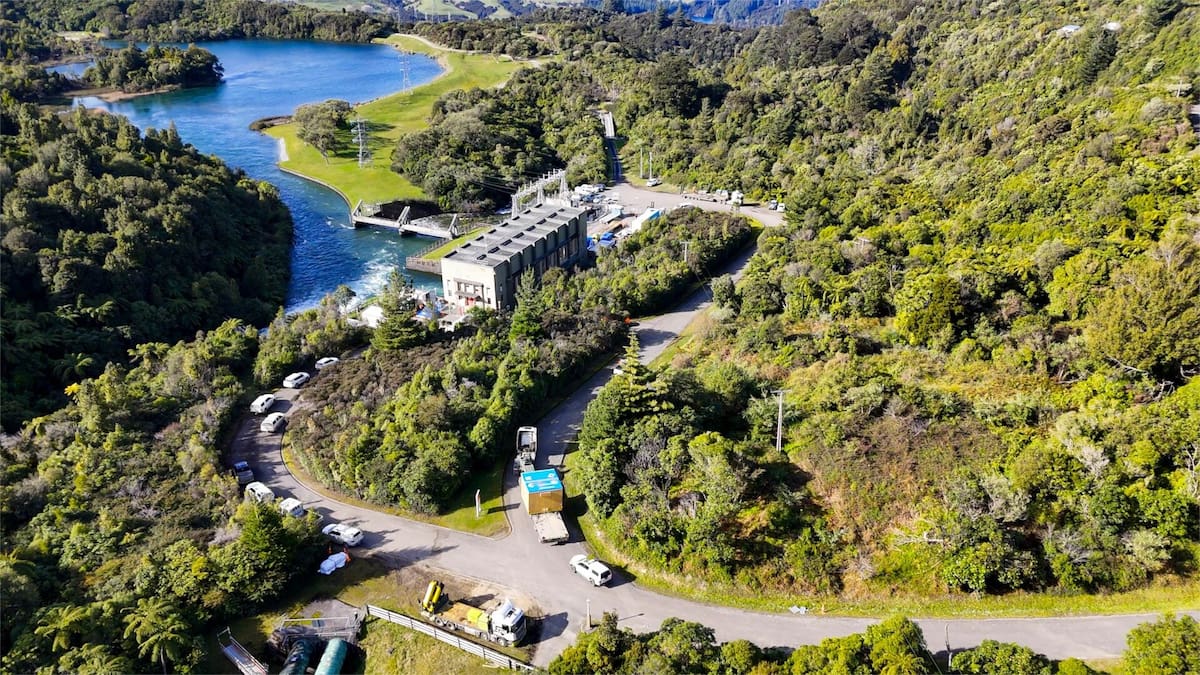
Its arrival signals the next phase of work at what is the final power station to be refurbished as part of a decade-long investment in one of New Zealand’s oldest hydro power schemes.
Kaitawa is the last of the Waikaremoana scheme’s three power stations to undergo refurbishment.
Generator works were done at the Piripaua station in 2022 and the Tuai station’s three generators were replaced in 2024.
When work at Kaitawa is finished next year, it will complete a decade of planning and installation to ensure the scheme continues.
Genesis outage manager Chantelle Coates said the Kaitawa phase of the project had planned for four years.
“The first time we see a lot of these components is when they get unboxed on site, so it’s very exciting.”
Getting the stator to Kaitawa was a project in itself.
Manufactured across Europe by engineering partner ANDRITZ and its subcontractors, the bespoke generator component was transported to Auckland and made the final journey on the back of a truck up a narrow, winding road.
The team then faced another challenge.
“We had to widen the door of the power station to actually get the new stator through,” Coates said.
“The stator will be lifted by a specialised gantry system sitting on the outside of the door, put on to blocks and transported inside the power station to be stored while we take out the old generator.”
For Coates, the project is not just about replacing ageing machinery; it is also about preserving some of New Zealand’s engineering history.
“The engineering that went into this scheme in the 1920s and 1940s is amazing. These machines are still going today. It’s very impressive and it’s quite an honour to be working on them, giving some parts a bit more life to keep generating.”
Kaitawa, Tuai and Piripaua generate enough renewable electricity to power more than 63,000 homes on average each year, with water flowing from Lake Waikaremoana through each station in sequence before returning to the Waikaretāheke River, the release said.
The new generator will improve Kaitawa’s efficiency and increase flexibility. The upgrade is expected to lift the station’s efficiency by around 2.8%, generating an additional 2-2.5 GWh of renewable electricity each year – enough to power around 350 homes.
Genesis general manager of engineering and projects Jane Bydder said the scheme’s refurbishment was an example of the company’s commitment to increase the amount of sustainable generation available to the national grid.
“New Zealand is going to need more renewable electricity as the country progresses toward net zero 2050.
“In addition to building new renewable generation in the form of solar farms and batteries to store electricity, Genesis is also extending the life of our existing hydro stations, making them even more productive and efficient in the process.”
The project also carries a connection to the station’s past. The original turbine technology installed at Kaitawa in 1948 was supplied by a predecessor of ANDRITZ.
Work at Kaitawa will continue next year when the second generator is replaced.