
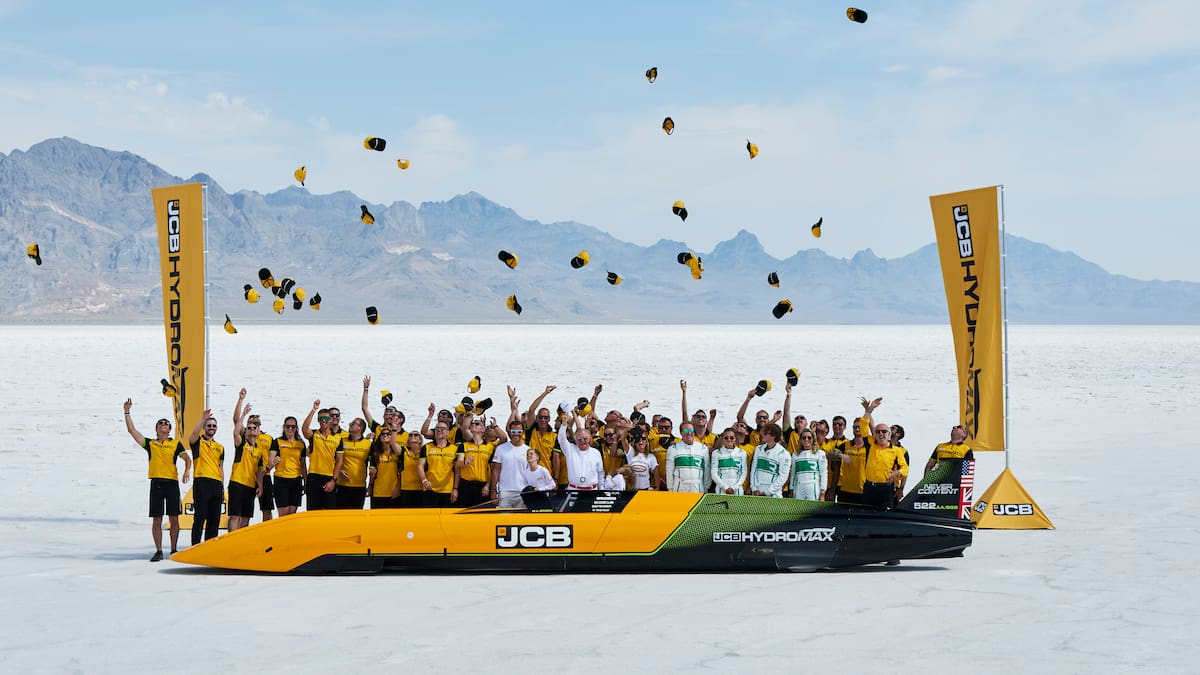
According to JCB, a British construction equipment manufacturer, the Hydromax recorded an average speed of 644km/h on its first run and 663km/h on its second. Under the rules, land speed records are based on the average of two runs in opposite directions completed within one hour.
The resulting average of 653.87km/h surpassed the previous hydrogen internal-combustion record of 298.5km/h set by BMW’s H2R in 2004, Forbes reported.
A hydrogen-powered streamliner driven by land speed legend Andy Green has set a new hydrogen vehicle record of 653.87km/h at Utah’s Bonneville Salt Flats. Photo / JCB
While the new benchmark is a significant milestone for hydrogen-powered transport, it remains well short of the outright world land speed record, according to the Guardian.
That’s no disappointment to Green.
He claimed that title almost 30 years ago when he drove the jet-powered Thrust SSC to 1227.985km/h in Nevada’s Black Rock Desert in 1997, becoming the first person to officially break the sound barrier on land, the Associated Press reported.
Andy Green after a test run of the JCB Dieselmax Challenger at RAF Wittering, Cambridgeshire, in 2006. Photo / Getty Images
The vehicle bears little resemblance to a conventional road car. Measuring nearly 10m in length, it is powered by two hydrogen combustion engines producing a combined 1600 horsepower, with one mounted ahead of the driver and the other behind, according to JCB.
“It’s magic to be able to showcase this technology and to showcase how good the engineering is on the best racing surface in the world, Bonneville Salt Flats,” Green told the Associated Press after the run.