
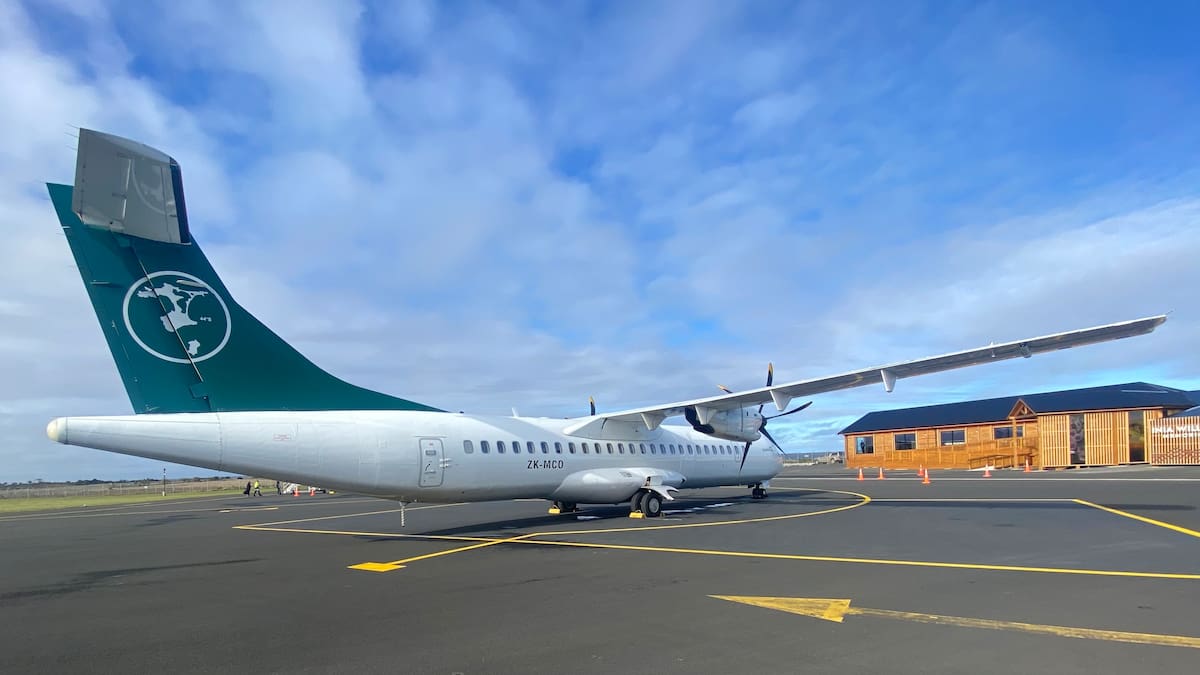
Air New Zealand and Air Chathams might think so, and today announced an expansion of their partnership.
It’s a progression of the interlining deal signed last October that started with journeys between Whakatāne and Auckland.
It also comes amid broader debate around the future of regional air travel.
Interlining broadly means allowing airlines to sell services another airline provides.
Guests including Air New Zealand chief executive Nikhil Ravishankar were on Chatham Island for ceremonies today.
James Meager, Associate Minister of Transport, was about to join the group flying yesterday from Christchurch.
However, Meager and other National Party caucus members were called to an urgent in-person meeting after party leader Christopher Luxon said speculation about his leadership had to be addressed.
Today, the airlines said the deal would let travellers to and from the islands book a single journey connecting them with Air New Zealand’s domestic network.
The expanded partnership will also bring Whanganui into the network.
“The growing complexity and economics of regional aviation highlight why airlines and the wider sector need to work together in new ways,” Ravishankar said.
He said both airlines shared a commitment to finding practical ways to strengthen the country’s aviation links.
“Seamless connections into our network make a real difference.”
Air Chathams chief executive Duane Emeny said the expansion was an important milestone for the airline and the communities it served.
He started out with the family-run airline as a boy aged 12 working in the airline office, which was then a shed next to the family home.
“For the first time, customers will be able to book a single ticket connecting them with destinations across New Zealand,” Emeny said today.
“It simplifies travel for residents, opens up new opportunities for local businesses and tourism, and makes it much easier for more people to experience one of New Zealand’s most unique destinations.”
Air Chathams, founded in 1984, provides passenger and freight services.
Freight demand and supply fluctuates. If the local weather has had a bad run and the fishermen can’t go out to sea, that limits what the islanders can export, in turn making it harder to justify flying an aircraft off to New Zealand (as locals call the North and South Islands).
Chatham Island and its neighbour Pitt Island are sparsely populated, and locals refer to the mainland as “New Zealand”. Photo / Gisborne Herald
Demand for freight tends to surge in the warmer months, which is also when more people visit the islands.
The islands have had a patchy history of air connectivity, with at some times multiple operators and at others periods of limited contact.
Commercial services to the island started in 1950 with a flying boat on Air NZ forerunner Teal (Tasman Empire Airways Ltd).
Later that decade, aircraft flew to a grass airstrip and Robert Muldoon opened the current airport a generation later.
But islanders grew frustrated at a lack of frequent services and the Government reviewed the situation in the mid-1980s.
Under the Aviation Action Plan unveiled last year, the Government was urged to support vulnerable regional routes by using the regional infrastructure fund to enable interlining arrangements.
Meager, in remarks prepared before the Wellington caucus meeting, said the partnership was a good example of businesses working together to strengthen regional connectivity.
The announcement coincided with development of the new terminal at Inia William Tuuta Memorial Airport.
The airport on the 900sq km island is on land the local Tuuta family gifted to the Chathams.
The airlines said the expanded network connectivity between Air New Zealand and Air Chathams would start from tomorrow.
The expanded network would include Auckland-Whanganui, Auckland-Chatham Islands, Wellington-Chatham Islands, and Christchurch-Chatham Islands.
Travellers can book eligible connecting journeys through Air New Zealand and participating travel agents with baggage checked through to their final destination.
“The Chatham Islands may be one of New Zealand’s most remote communities, but we are an important part of New Zealand’s social and economic fabric,” Chatham Islands Mayor Greg Horler said.
Port Hutt on Chatham Island. Photo / John Weekes
“This partnership makes it easier for residents to access services, education, healthcare and opportunities on the mainland, while making it simpler for visitors to experience everything the Chatham Islands have to offer.”
Whanganui Mayor Andrew Tripe said he’d been advocating for stronger regional connectivity for some time.
“It is a practical improvement that will make a real difference for residents, visitors and businesses, while helping Whanganui remain accessible, connected and open to new opportunities.”
Air Chathams said it would have a sale for flights from the island to Auckland, Wellington and Christchurch from $199 each way.
Meanwhile, Regional Development Minister Shane Jones and Associate Regional Development Minister Mark Patterson said funding for wharf and fuel infrastructure upgrades would strengthen connections.
Jones and Patterson said Regional Infrastructure Fund investment comprised $9.4 million for a wharf upgrade, $5.6m to upgrade the islands’ fuel storage and distribution and $465,000 to support the Air Chathams-Air NZ partnership.
Jones said the work included expanding livestock infrastructure to improve freight handling and support marine operations.
He said fuel infrastructure projects included relocation and upgrade of fuel storage and distribution facilities at Waitangi Wharf.
That would support a new Government-backed Chatham Islands supply vessel, he said.
The Herald travelled to Chatham Island courtesy of Air New Zealand.
John Weekes is a business journalist covering aviation. He previously covered consumer affairs, crime, politics and courts.
Stay ahead with the latest market moves, corporate updates, and economic insights by subscribing to our Business newsletter – your essential weekly round-up of all the business news you need.