
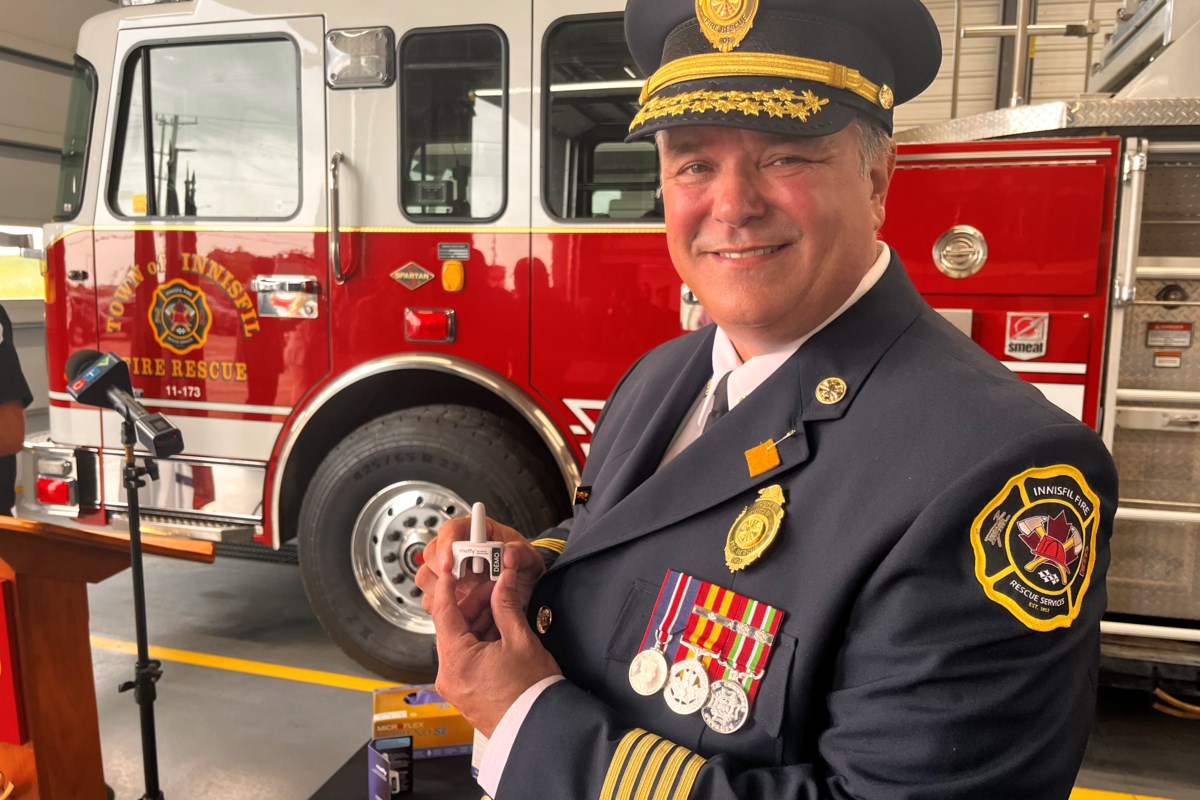
‘Every second counts,’ official says of epinephrine spray, which will be used to treat life-threatening allergic reactions. ‘This allows a sense of security for families’
Residents in Innisfil susceptible to severe allergic reactions now have more peace of mind after the town’s fire service became the first in Canada last week to introduce an epinephrine nasal spray to its medical kits.
The spray, known as neffy, is designed to provide fast absorption of epinephrine, the first-line of treatment for anaphylaxis, a life-threatening allergic reaction that can escalate within minutes of exposure to triggers such as food, insect venom, or medication.
Fire chief Brent Thomas said the nasal spray will give Innisfil firefighters an alternative to the EpiPen auto-injector, a needle-style device, that will still be part of the medical kits.
“I’ve been asked, why Innisfil Fire and Rescue first? We’re proud of that accomplishment, but being first was never our goal,” Thomas said. “Our goal was simple: to provide the best possible care for our community, period.”
Thomas, formerly fire chief in Orillia, said quick response is critical when dealing with anaphylaxis, making the nasal spray an effective, easy-to-use option.
“This is supported by real-world use internationally,” Thomas said. “We saw an opportunity to strengthen our response.”
Francesca Passudetti, director of marketing for ALK Canada, said the company’s nasal spray can save precious seconds in high-stress situations.
“Having more than one option is best when there is anxiety and hesitation around needles. It’s more approachable,” she said. “When a severe allergic reaction strikes, every second counts. This allows a sense of security for families living with severe allergies.”
The product had to clear several regulatory hurdles before it could be used by Innisfil Fire and Rescue Services, including approvals from Health Canada.
Passudetti said the fire department approached her company about introducing the spray here.
“They were embracing a progressive approach,” she said. “This fire department is very advanced and out front of innovation and new technologies and we were really excited to partner with them.”
The department trained 40 career and 20 volunteer firefighters on how to use the neffy nasal spray.
“Epinephrine remains the cornerstone of the early management of anaphylaxis, and every effort should be made to reduce barriers to its prompt administration,” said Dr. Ian Young, the fire service’s medical director.
“(It’s) another evidence-based option that may reduce hesitation, increase confidence for responders, and improve patient acceptance of life-saving treatment.”