
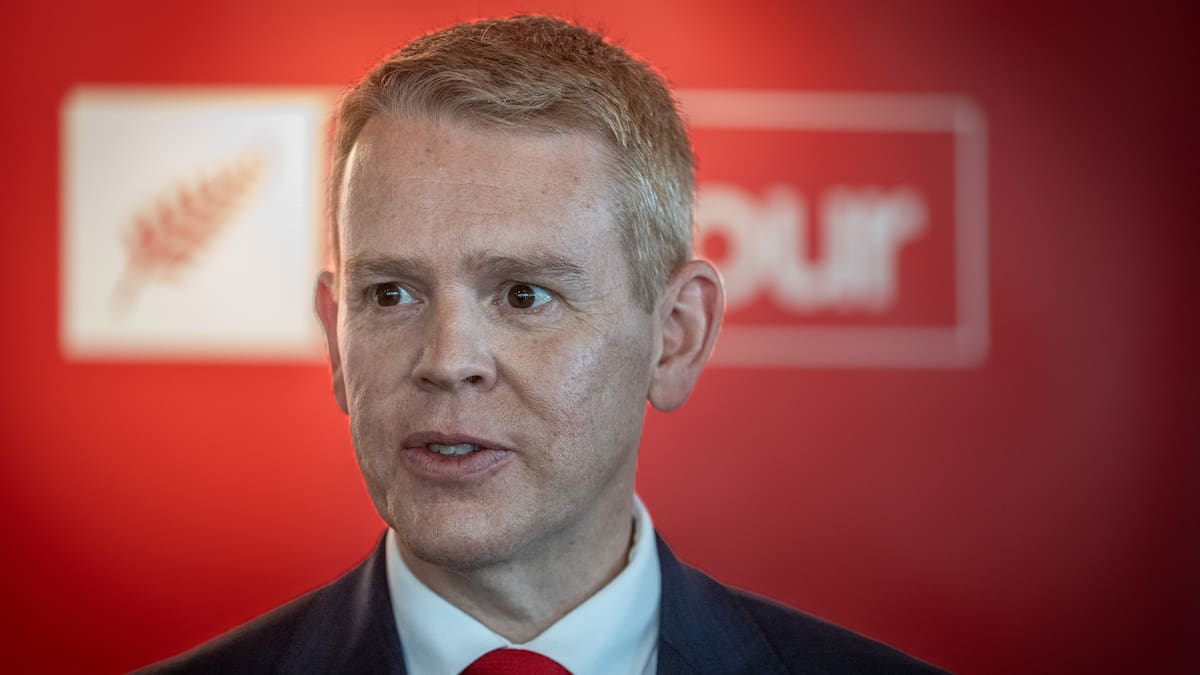
Hipkins on Wednesday afternoon spoke to reporters, criticising Luxon and National for focusing on themselves and not important issues such as the cost of living and unemployment.
He was then asked when he would establish which parties Labour could work with after the election, given Hipkins had already ruled out Labour working with New Zealand First.
For months, Hipkins has deflected questions about potential coalitions, namely with respect to Te Pāti Māori and Opportunity, by saying he would detail what parties Labour could and couldn’t work with before the official election campaign.
However, Hipkins today claimed he had “made it clear” what parties Labour couldn’t work with and the rest was “up to New Zealanders”.
Labour leader Chris Hipkins (second right) was quizzed about possible coalition arrangements after November’s election while reacting yesterday to Christopher Luxon remaining as National leader. Photo / Mark Mitchell
Asked if he would establish how Labour could work with the Green Party, Te Pāti Māori or Opportunity before the election, Hipkins replied: “Well, that will be up to the voters. Ultimately the New Zealand public decides the make-up of the next Parliament.
“I’ve been very clear about who we can’t work with and the rest is up to the voters.”
Hipkins wouldn’t respond directly when asked if he could work with Opportunity, saying, “That’s up to the voters”, and later adding he wasn’t ruling out working with either Opportunity or Te Pāti Māori.
In last week’s Taxpayers’ Union Curia poll, Labour tumbled to 27.8% while Opportunity had risen to its highest vote share in mainstream public polling with 6.1%. Wednesday’s 1News-Verian poll had Opportunity at 8% while Labour was on 30%.
Asked if he was worried about Labour bleeding votes to Opportunity by confirming it could work with the Qiulae Wong-led party, Hipkins did not address the question and said Luxon’s second confidence vote proved “only the Labour Party can lead a strong, stable government”.
After being questioned by the Herald, Labour supplied a statement at 2.55pm from Hipkins that read: “I won’t work with any of the parties in the Government right now. I am open to working with anyone who isn’t part of that coalition. I will set out further details when further policy is released.”
However, at 4.57pm, Labour sent another statement that included Hipkins’ admission his earlier comments could have been clearer.
“We recognise that under MMP it is voters who will determine the shape of the next Parliament. As I said today, my focus is on getting as many votes for Labour as possible so we can lead a strong, stable, and united Government.”
“I have previously undertaken to set out how Labour will approach post-election negotiations in more detail, and it is still my intention to do that before the election.
“As policies continue to be released, Labour’s door is open to [Opportunity], and we will of course continue our working relationship with the Greens. I could have been clearer about that in my answers today.”
National this month ruled out working with Opportunity Party leader Qiulae Wong. Photo / Mark Mitchell
Hipkins’ 4.57pm statement did not feature any comment related to Te Pāti Māori.
But at 6.33pm, the Herald received a third additional statement that was specific to Te Pāti Māori and read: “While we could work with Te Pāti Māori should they be part of the next Parliament, senior roles for them in Government are unlikely”.
According to the latest NZ Herald-Motu Research Poll of Polls modelling, which analyses a range of public and private polls, the probability of a combination of Labour, the Greens and Te Pāti Māori being able to form a Government was 3.2%.
The probability of Labour being able to form a Government with just the Greens was 1.2%. However, if you add Opportunity, that increases to 12.9%.
Putting the four parties together, the probability based on current polling reaches 30.8%. The probability of the current coalition parties being able to form a Government after November 7 was 61%.
In September last year, amid controversial comments from a then-Te Pāti Māori MP, Hipkins said: “Before the next election, we will set out very clearly which parties we can and can’t work with.”
In December last year, Hipkins committed to outlining “well before the election so in time for people to digest it and consider it” where Labour had common ground with other parties and what areas were a “no-go zone”.
On Tuesday last week, Hipkins promised to “set out a more detailed position on who we can and can’t work with post-election, before voting gets underway, before the campaign itself gets underway”.
Adam Pearse is the Deputy Political Editor and part of the NZ Herald’s Press Gallery team based at Parliament in Wellington. He has worked for NZME since 2018, reporting for the Northern Advocate in Whangārei and the Herald in Auckland.