
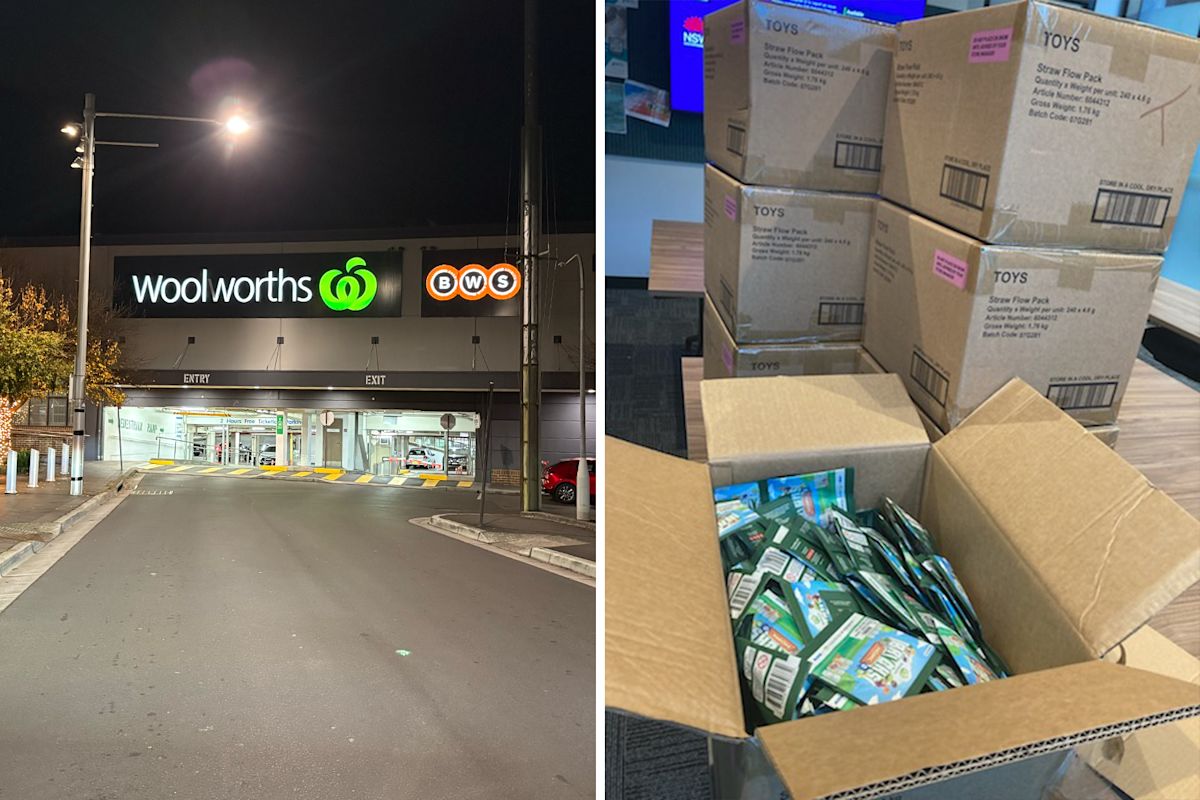
Woolworths Ooshies are incredibly popular with kids and collectors, but some shoppers have raised concerns about the amount of plastic being generated.
Reverse Garbage, a Sydney-based not-for-profit group that promotes reuse over recycling, is still grappling with what to do with a pallet of unwanted toys from a previous supermarket promotion.
Its chief executive, Kirsten Junor, explained that a pallet of Woolworths Bricks, a Lego-like toy, was left at the warehouse.
“They were an anonymous donation, and that’s the truth,” she told Yahoo News.
“Someone had found them and said they did not want to see them go into landfill.”

Kirsten Junor (left) has called on Woolworths to stop producing Ooshies. Her Reverse Garbage non-profit is grappling with what to do with a pallet of Woolworths Bricks that were left at its warehouse.
(Reverse Garbage)Mystery behind Woolworths Bricks delivery
Like Ooshies, the Woolworths Bricks are recyclable.
To help prevent them from going into the wrong bin, each customer service counter has a designated collection point for recycling toys that kids didn’t want.
When the Bricks promotion ended, Woolworths organised to send all unused stock to a recycling company so the toys would not go to landfill.
How some ended up being diverted to Reverse Garbage instead remains a mystery, and the supermarket is investigating what occurred.
Woolworths was unable to immediately disclose whether it monitored what happened to the toys after they were sent to the recycler.
Is there anything wrong with recycled plastic toys?
The supermarket makes strong environmental claims about its Ooshies being made from 97 per cent recycled plastic and their paper packaging being Forest Stewardship Council (FSC) Certified.
Do you have an opinion about plastic toys? Contact newsroomau@yahoonews.com

The Reverse Garbage team are considering what to do with the unwanted Bricks that were left at their warehouse.
(Reverse Garbage)
But according to Junor, a self-confessed Woolworths shopper, the idea of producing plastic toys and promotional items is problematic in itself.
Even if every piece of plastic is recycled, it requires a large amount of energy. Shipping them from their point of manufacture requires more.
“Those Bricks are so tiny, if a kid drops one, it can get washed into the gutter, and down the drain, or if a mum vacuums one up, it will go in the bin,” she said.
“And there are so many. It’s why I don’t take polystyrene balls for beanbags anymore, those things should be banned as well.”
Similar concerns were raised about Ooshies in 2019 and 2020 after claims they were being discarded and washing up on beaches.
What’s going to happen to the pallet of Bricks?
The plastic Bricks are wrapped in paper packets, and Junor and her team are considering unpacking them all so they can be distributed to kids.
“I don’t know if that’s the correct solution,” she said.
“Someone brought them to us, and now I’m left to deal with a problem Woolworths created.”
‘We’re at breaking point’
Although toys like Ooshies can be fun for kids, Junor argues that the problem is that too many unnecessary products are being produced.
“It’s not just the Woolworths toys, it’s the gimmicks, the promotions, the Uber handouts I saw on the ground when I got off the bus this morning,” Junor said.
“One might not seem significant, but when you think about millions of items we generate in Australia, then the world, they do have an impact.”
RELATED:
The world produces around 460 million tonnes of plastic every year, and production is predicted to more than double by 2050 to over 1,000 million tonnes.
“We’re at breaking point,” Junor said.
“The oil used to create plastic spends millions of years in the ground, and then a nanosecond in your hand, and we should be treating it as a special resource.”
You can also follow us on Facebook, Instagram, TikTok, X and YouTube.