
LISTEN | Hiding in plain sight, Clara Peeters painting discovered in a museum’s storage:
As It Happens6:42Hiding in plain sight: A lost masterpiece by an overlooked female artist discovered in a museum’s storage
When art historian and curator Cynthia Osiecki stumbled upon an unattributed still-life painting in an Oslo museum storeroom in 2022, she couldn’t shake the feeling that she knew exactly who created it.
“We were trying to buy a work by Clara Peeters, like many museums are trying to purchase women artists at the moment,” said Osiecki, who had been studying the work of the pioneering 17th-century Flemish Baroque artist.
When she spotted the painting, Osiecki wondered if it could be a long-lost work by Peeters.
“I mean, it’s almost too good to be true to have a Clara Peeters hanging right in your storage while the museum was actively looking for women artists on the art market,” Osiecki said. “Instead of having to purchase one, we might have had one all this time and right under our nose and didn’t even know it.”
Despite her groundbreaking work, the enigmatic artist remains relatively unknown to the wider public, a fate shared by many female artists of her time, Osiecki says.
That’s part of the reason why the National Museum of Norway is putting a spotlight on historic female artists, with Woman Painter opening in Oslo on Oct. 8. The show will feature works by 19 female artists who worked across northern Europe and Italy between 1550 and 1650, including Judith Leyster, Lavinia Fontana, Artemisia Gentileschi, and, of course, Peeters.
Painstaking work to attribute painting
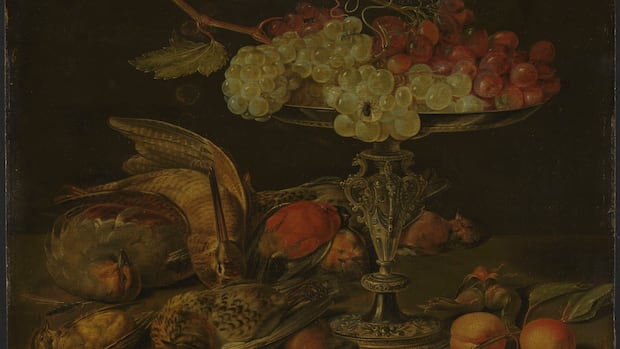
The piece Osiecki discovered, titled Still Life with Small Game and Grapes on a Gilded Tazza, had once been believed to be the work of Ambrosius Brueghel, a member of a famous family of artists in Antwerp, Belgium. It was later reclassified as “anonymous” and sent to storage.
Earlier this year, however, it was officially reattributed to Peeters, a painstaking journey spanning several years, Osiecki says.
A journey that wouldn’t have begun if not for her keen eye.
When she first discovered painting, Osiecki found some telltale clues.
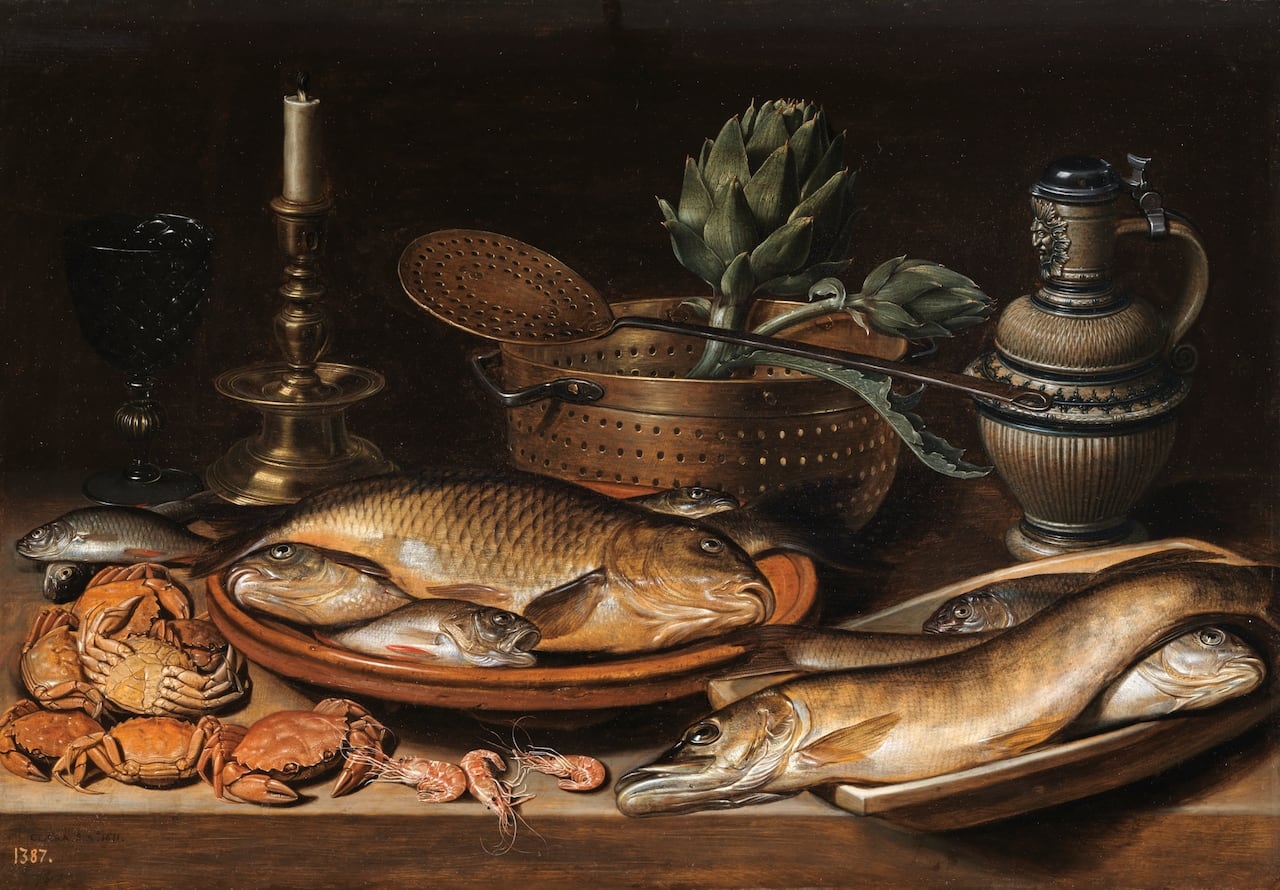 Another piece by Clara Peeters, created in 1621, called Still Life with fish, a candle, artichokes, crab and prawns that hangs in the Prado. (Museo del Prado)
Along with being one of the earliest specialists of still-life painting of her era, Peeters was known for embedding her own likeness into everyday objects in her works. She did this by painting tiny self-portraits in the shiny surfaces of pewter jugs, fruits or vegetables — subtly claiming ownership and asserting her own professional identity in a male-dominated world, Osiecki says.
The Oslo painting features nine dead birds — considered a delicacy in the 17th-century, Osiecki says — freshly-picked hazelnuts and apricots.
The grapes, in particular, stood out to Osiecki.
“In our grapes, there is a reflection of a person, but it’s not in any way as detailed as those silhouettes are on other paintings by [Peeters’] hand,” said Osiecki.
Then there were other details that caught her eye — the tazza, a saucer-like drinking vessel from the period that Peeters frequently featured in her paintings — as well as the distinctive positioning of the birds within the composition, Osiecki says.
WATCH | Why he’s scouring the art world for his great-great-grandfather’s lost paintings:
Why he’s scouring the art world for his great-great-grandfather’s lost paintings
Jonathan Wener has spent half a century searching for his great-great-grandfather William Raphael’s lost artworks. The 19th-century Montreal artist made paintings depicting life in Quebec during that time, but Wener says his ancestor didn’t get the recognition he deserved.
“I also knew that many of her contemporaries were using the same objects in Antwerp [Belgium] at the time,” she said. “So I had to tread very, very carefully to make sure it really was Clara Peeters and not me wanting it to be Clara Peeters.”
There was also another hitch: woodworms had eaten away at the bottom edge of the painting where Peeters would have typically signed her name.
Despite this, Osiecki remained determined to ferret out the true artist behind the piece. She and her colleagues spent several years studying and comparing other works by Peeters and her contemporaries, she says. The museum’s conservator cleaned the Oslo piece and took better pictures, she adds. Slowly, but steadily, the process confirmed the attribution: Peeters was the painter.
Now the painting is set to take centre stage at the Oct. 8 show.
Nora Ceciliedatter, director of collections and exhibitions and the National Museum of Norway, says the Woman Painter exhibition is part of a “broader effort to bring visibility to artistic careers and perspectives that have been historically underrepresented at the museum.”
For Osiecki, the painting’s long journey back to Peeters’ name demonstrates how much work remains to be done to uncover female artists whose contributions have been overlooked, misattributed or simply forgotten.
“We have to continue doing this because there are so many paintings out there that are either anonymous or attributed to male artists,” she said. “The more research we do to women artists, the more works we find by them, and this is really time and effort well-spent.”