
I
n the new study, zebrafish larvae lived in V-shaped channels with either horizontal or vertical black and white stripes on the walls for the first five days after fertilization.
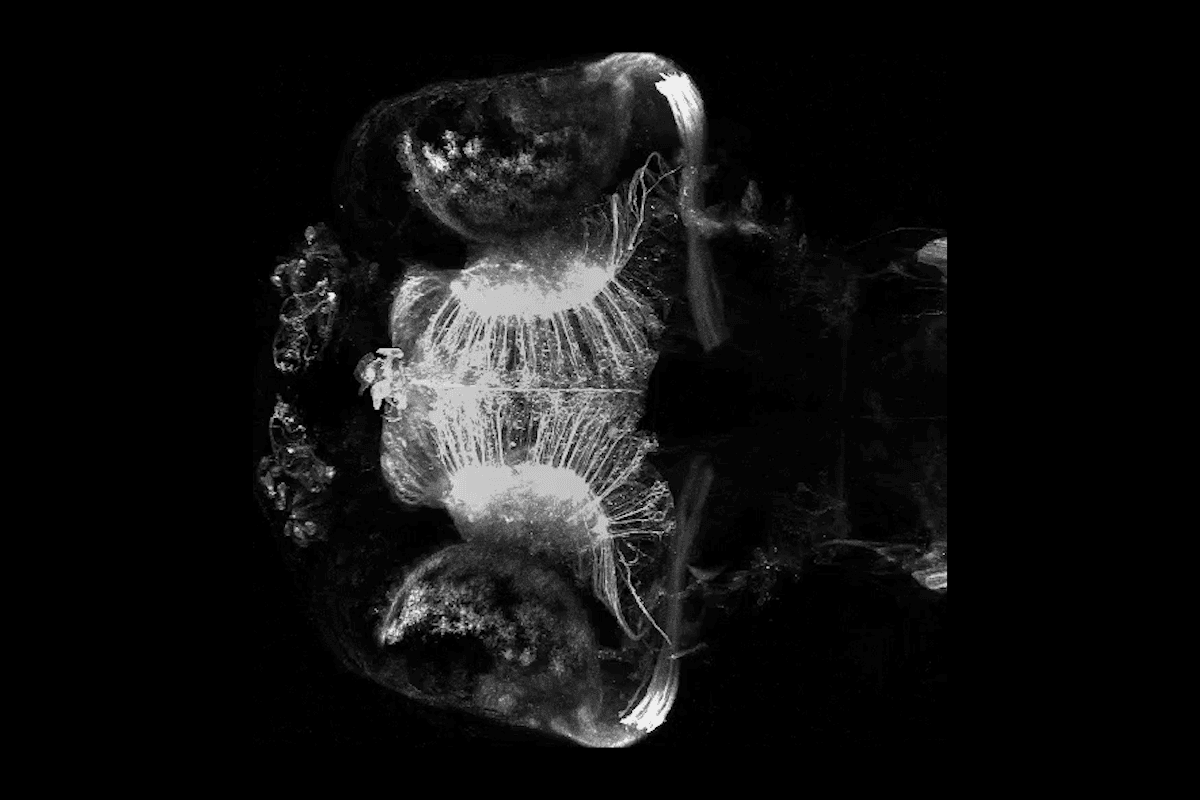
Amacrine cells oriented parallel to the stripes became more elongated than usual, while others became rounder. Since these cells are distributed evenly across the retina, shape changes suggest that some occupy more space than others, says study investigator Phoebe Reynolds, postdoctoral fellow at the Friedrich Miescher Institute for Biomedical Research.
At this stage, orientation-selective retinal output to the optic tectum was biased towards the stripe orientation the fish saw, the researchers found, and the bias persisted for at least two days after the animals were moved to a neutral environment.
The field in general doesn’t think that activity has any effect on the retina, and it’s always [acting] downstream.
—
—
Marla Feller
In another series of experiments, freely swimming fish given a choice between stripes of different angles preferred swimming towards stripes that ran parallel to their bodies, but those raised in a horizontal environment showed no preference. Fish lacking the TENEURIN-3 gene and raised in a horizontal environment, however, behaved normally, which suggests the animals can see the stimuli, but the loss of the gene “disturbs the cells in a way that they lose the ability to show plasticity,” Hindges says.
It is unclear why only the zebrafish raised in a vertical stripe environment prefer parallel-oriented stripes, he says. In addition to exploring the behavior further, Hindges says he is interested in looking at how “the changed amacrine cells” connect differently to ganglion cells.
The study is novel because it shows that “you can raise animals in a very specific environment, and their retinal circuits have now changed so that they’re better for that environment,” says Alexandre Tiriac, assistant professor of biological sciences at Vanderbilt University. But this may be more important in fish than in other animals because they “begin exploring their environment very early in their development,” he adds.
In mice, the effects of spontaneous retinal waves are known, but the existing evidence had not explained how activity shapes development and function, Tiriac says. By linking morphology, function and behavior, this study fills a much-needed gap in the field, he says.
Feller says the shape changes to the amacrine cells are particularly intriguing. It means it is now possible to study “what in the cell reads out that activity pattern and changes either synaptic strength or morphology,” she says. “We all want to understand what all of these things mean in terms of interpreting the natural world.”