
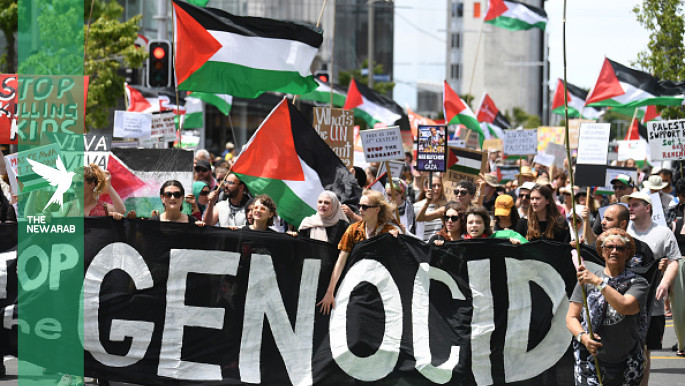
The New Zealand Electoral Commission announced its approval of the registration of the “Free Palestine” party as a political party after examining its registration application in accordance with the provisions of the Electoral Act 1993. [Getty]
“Free Palestine” party has become an officially registered political party in New Zealand and will appear on ballot papers in the general election scheduled for 7 November.
The party’s founder and leader, Paul Hopkinson, told The New Arab on Thursday, 13 August, “The party secretary sent me a message informing me that we had been officially registered after receiving an email from the Electoral Commission.”
“I knew that there was enormous external pressure being exerted on them not to register the party. The commission received 207 objections from Zionists and Zionist organisations against recognising us as an official party,” he added.
The New Zealand Electoral Commission announced its approval of the registration of the “Free Palestine” party as a political party after examining its registration application in accordance with the provisions of the Electoral Act 1993.
The decision followed a public consultation during which the commission received 207 submissions opposing the application.
The commission concluded that the party had met the legal requirements, including providing evidence that it had at least 500 current financial members who were eligible to enroll as voters.
It also found no legal grounds requiring it to reject the registration.
The commission said it had carefully considered objections concerning the name “Free Palestine” party and whether it was offensive or likely to cause anger or disgust in a reasonable person.
“The phrase, while highly sensitive and the subject of widespread political disagreement”, it noted, was not in itself “offensive” under the legal standard set out in the legislation.
It said supporters viewed it as a call for human rights, freedom and an end to occupation, while opponents considered it offensive or antisemitic or an implicit call for hostility towards Israel and Jewish communities.
The commission stressed that it was required to assess the party’s name itself, rather than its positions, slogans or campaign material.
The commission, however, rejected registration of the party’s logo, which includes the Palestinian flag and the words “Free Palestine” party, because it could confuse or mislead voters.
This was particularly because they might believe the party officially represented a Palestinian political entity or international movement, or that it had the support or control of Palestinian institutions.
It said the decision was also based on similar electoral precedents.
As a result, the “Free Palestine” party will be able to contest the upcoming general election, compete for party-list votes and nominate candidates in electoral districts.
However, its logo will not appear beside the name of the party or its candidates on the ballot paper, as the legal deadline for submitting an alternative logo has expired.
The party leader said to TNA that the party’s official registration had multiple benefits for the Palestine solidarity movement in New Zealand.
“It gives us government funding of $82,000 to help raise awareness of the Palestinian cause, allowing us to increase pressure on any incoming government to listen to more than 60% of the New Zealand public who, according to opinion polls, are calling for action to impose sanctions on Israel,” he added. “Most importantly, this registration makes it extremely difficult for any New Zealand government to restrict freedom of expression or the activities of Palestine supporters.”
In the first official reaction opposing the party’s registration, the Coalition of Ministers Supporting Israel (COMS), which comprises 136 Protestant Christian clergy in New Zealand from Pentecostal, Baptist, Brethren, Presbyterian, Anglican and Methodist churches and others, who support the right of the State of Israel to protect itself, issued a statement.
“The Coalition of Ministers Supporting Israel is concerned about the Electoral Commission’s decision to register the “Free Palestine” party as a political party in the general election scheduled for November,” it said.
“New Zealand’s electoral system has been hijacked by foreign interests and influence seeking to use the electoral process in our country to promote the twisted ideology of those who call for the elimination of Israel,” the statement continued.
Next steps for “Free Palestine”
Commenting on this, Hopkinson described the statement, in remarks to TNA, as “shameful” for its support of an apartheid state and the ongoing genocide of the Palestinian people.
He stressed that “calling for the downfall of the Israeli apartheid state is something we are proud to stand in solidarity with, just as many veteran Palestine supporters and activists in New Zealand were proud to support the struggle that ended the apartheid state in South Africa”.
Asked about the next steps the party intends to take after its official registration, he said the party “will hold a launch event in the city of Christchurch, and we hope it will be before mid-September, followed by the launch of the campaign at a national level”.
“Planning to contest this election is still under way; however, we are of course considering putting forward candidates on the party list, as well as candidates in electoral districts for key single-member seats,” he added.
“We hope to be able to bring this issue to the heart of New Zealand politics, where it should be. It is time for New Zealand and its people to be leaders in the struggle against Zionism and Israel, just as we were leaders in the anti-nuclear weapons and anti-apartheid movements,” he continued.
For his part, Maher Nazzal, head of the Palestine Forum in New Zealand, told The New Arab that “registering a party to participate in the upcoming general election is a very important step, not only for Palestinians in New Zealand but also for everyone who believes in justice, human rights and accountability”.
He stressed that “this registration means that the voice calling for justice for Palestine now has a clear democratic political framework capable of addressing voters directly and raising issues that traditional parties have ignored”.
He added that “this step represents the beginning of the road, not its end; the challenge now is to build a strong and organised campaign, reach as many voters as possible, explain the party’s programme to people, and not only talk about Palestine but also about issues that matter to all New Zealanders”.
Regarding the forum’s mechanisms for helping the newly formed party, Nazzal said that “there are several ways, including joining, volunteering and donating within electoral laws, helping the campaign communicate with different communities, spreading the party’s messages, and organising meetings and events across the country”.
“The most important thing is to show that supporting Palestine does not conflict with being New Zealanders; rather, defending human rights, justice and equality is a fundamental part of the democratic society in which we live,” he added.
The New Zealand-Palestinian activist considered that “we are facing a historic opportunity. It will not be easy, but if we work together in an organised and professional manner, we will succeed in turning this registration from a mere announcement into an influential political voice inside the New Zealand Parliament”.
He noted that “small parties, under New Zealand‘s mixed-member proportional representation system, have a real opportunity to exert influence if they manage to reach the required electoral threshold or win an electorate seat”.
Article translated from Arabic by Afrah Almatwari. To read the original, click here.