
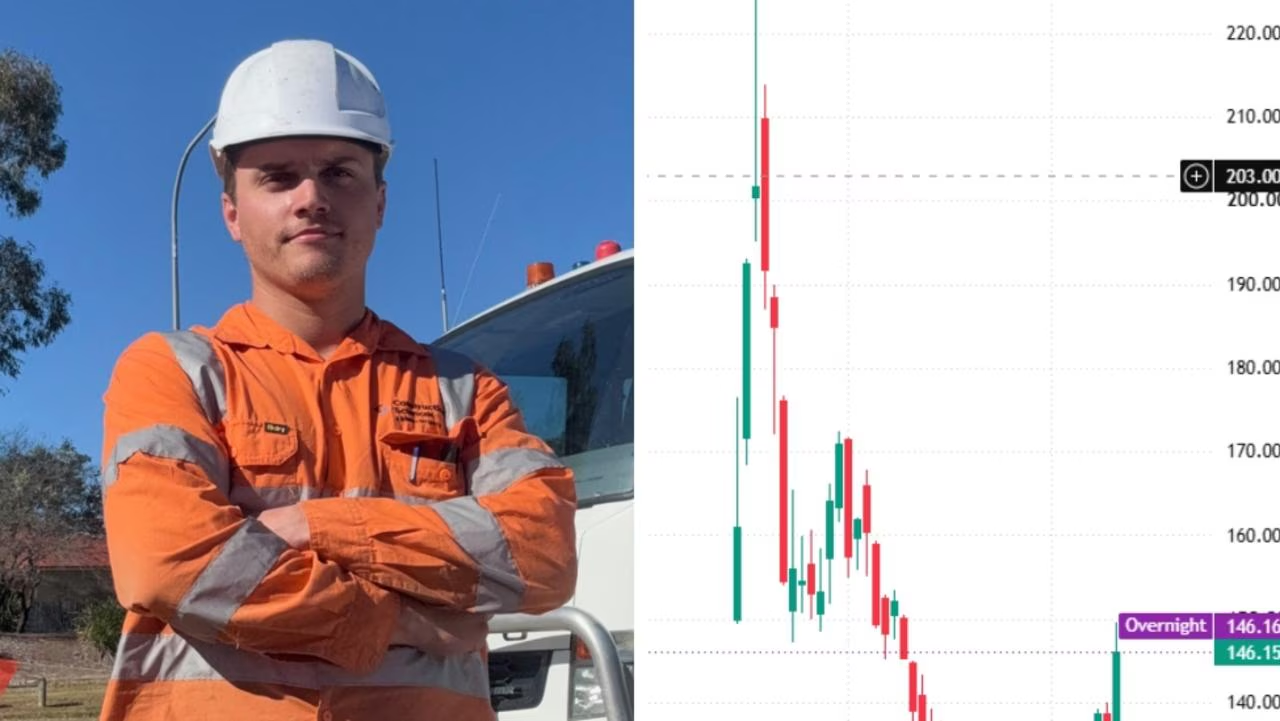
Elon Musk’s SpaceX has wiped billions of dollars in market value since making its high-profile public debut. But that hasn’t scared off some Aussie investors from still wanting to get in on the action.
Gold Coast construction worker Kaleb Schofield invested around $5,000 in a space-themed ETF, which includes exposure to rocket and artificial intelligence giant SpaceX, the day the fund launched on the Australian Stock Exchange in May.

“It’s not just because space companies are cool. It’s more the growth that there potentially still is in that sector. It’s the infrastructure and launching rockets, but you’ve also got communications and satellites as well,” he told news.com.au.
The space ETF makes up just a small percentage of Mr Schofield’s overall portfolio, around 3.5 per cent, which is primarily invested in broad-based ETFs.
At just 25, he already has four investment properties under his belt and a share portfolio worth $142,000.
He began investing when he was 16 and is hoping to grow his wealth so he can be “work optional” by the time he hits 40.
ETF giants jump on SpaceX hype
Betashares launched the first ASX-listed space ETF in early May ahead of the SpaceX IPO, with the fund attracting roughly $64 million in net inflows. It added SpaceX to the fund two sessions after the company’s float, meaning it missed out on the initial surge.
Fellow ETF provider GlobalX also launched a space ETF on the Aussie sharemarket in May, a day before the SpaceX IPO, attracting $6 million of inflows in its first week. It also missed out on the initial SpaceX spike.
Meanwhile, CommSec, the lead retail broker in Australia, revealed more than 28,000 applied for shares in SpaceX, which was four times the volume received for the biggest IPO previously made through the platform.
While Betashare’s offering rose more than 25 per cent after its launching, it’s since dropped nearly 50 per cent from its high.
Like GlobalX’s offering, SpaceX makes up roughly 25 per cent of the fund with Betashares investment strategist Hugh Lam noting this had weighed on the fund’s performance.
“We’ve seen sort of a flurry of different earnings results, notably from SpaceX last week. We actually saw SpaceX shares fall about 7 per cent when they reported earnings,” Mr Lam told news.com.au.
“That was really due to them announcing higher capital expenditures. And we’ve been saying that the space industry is fundamentally capital intensive. So it’s not really a surprise for us that they’re spending more.
“They do have to launch new satellites into space and all that requires a lot of money. But the
market reaction was naturally a bit negative.”
SpaceX shares initially jumped by up to 67 per cent above the $US135 IPO price in June hitting a peak of $US225.64, but plummeted more than 22 per cent below its debut price in August sliding to reach a low last week of $US104.83.
On Wednesday, SpaceX shares climbed past $US140 for the first time in nearly a month, after SpaceX released Grok 4.6 and Mr Musk outlined plans for AI to become a bigger part of the company’s business.
SpaceX’s market cap hit $US2.64 trillion at its peak shortly after its market debut, but this has now dropped to $US1.92 trillion.
It has proved to be a divisive stock, with Morningstar putting a fair value estimated of $US62 on the stock, while others have ascribed a value of $US800.
Research by Betashares found 39 per cent of Aussies were likely to consider investing in the space industry. This rose to 54 per cent for those under 40, compared to just 22 per cent for those aged 55 and over.
Mr Lam said he expects continued demand for the space sector moving forward.
“This is a new, exciting opportunity. But there are actually strong trends to believe that profitability or the pathway towards profitability is coming,” he said.
“We did see that with SpaceX’s results where their operating margins or operating losses did compress and revenues were growing at a pretty fast rate. Starlink, their revenues were growing at a 66 per cent rate. So clearly, there’s a bit of momentum there.”
Mr Schofield said he wasn’t worried about the current downswing as he plans to hold the ETF for a minimum of five years and will potentially add more to his holdings.
Mr Lam said investors should generally take a long-term approach to space investments and have thematic exposure form a “relatively small portion” of a diversified portfolio.
Aussies piling into ETFs
The Betashares and GlobalX space themed ETFs are among the 72 new ETFs that flooded the ASX last financial year, up from 50 listings in the previous year.
According to Betashares, the Aussie ETF industry as a whole received a record breaking $6.8 billion in net inflows in July and now has nearly $371 billion in total assets.
Income was a key theme for investors in July, with net inflows to fixed income and equity income ETFs reaching a record $1.63 billion.
Mr Lam said popularity of ETFs came down to a few factors: diversification, lower costs and them generally being more tax effective compared to traditional alternatives like managed funds.
“We’ve seen continued inflows throughout late May when the tax reforms were announced,” he said.
Mr Schofield said ETFs appealed to him because it gave him exposure to “more than just one idea or one company that’s going to win”.
“For all of the other niches and things that are up and coming, it’s just so much simpler to go and get into ETFs to get back into the widespread trend and also it’s a little bit less risky,” he said.
He is hoping to build up a $1.5 million share portfolio generating $40,000 to $50,000 in income to allow him to become “work optional”, or essentially be able to retire, by the time he is 40.
Read related topics:Elon Musk