
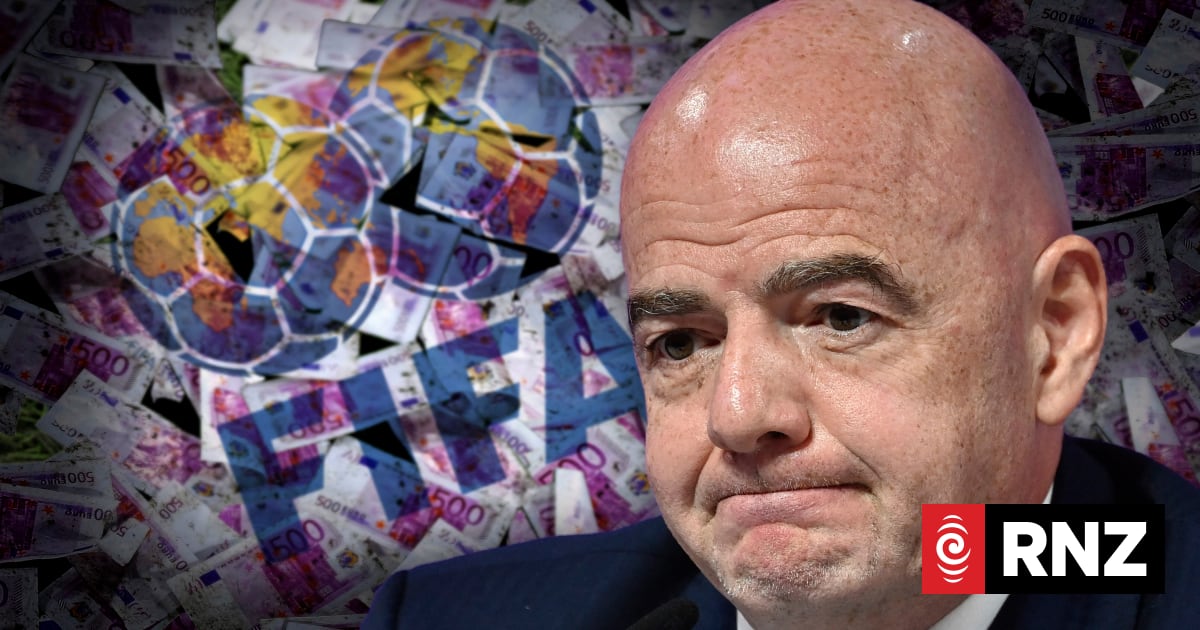
New Zealand Football has formally withdrawn its support for the candidature of Gianni Infantino as Fifa president at the 2027 Fifa Congress.
The under fire Fifa president is seeking re-election next year after proposing carving off the commercial rights to the World Cup and selling 20 percent to private investors to raise about US$7.2 billion (NZ$12.3b) before a U-turn following the furore.
New Zealand Football (NZF) said in a statement it was also seeking an independent review of the steps undertaken to develop the Fifa Forward Enterprise (FFE) scheme.
“After careful consideration, NZF has formed the view that decisions and actions within Fifa have contributed to a breakdown in trust and increased division within international football, and that an independent review is required to restore confidence and trust,” the statement read.
“NZF believes this point in time represents an opportunity for all Fifa member associations to advocate for stronger governance, accountability and transparency which are fundamental in maintaining confidence of the administration of the global game.”
NZF chief executive officer Andrew Pragnell told RNZ it was “an important, values-based decision”.
“Everyone who’s connected to the game around the globe deserves to know where we stand.
“New Zealand is a country that’s always led based on its values, and we’re really proud to put those first and put the fans and the football community first, because I think right now there are some pretty strong calls for change.”
Pragnell acknowledged NZF had benefited from hosting the Women’s World Cup, a Fifa Series, “increased revenue generation at Fifa and greater distribution to football associations”.
“But that is down to the work of many,” he said.
“There are an incredible group of hardworking professionals at that organisation who’ve been amazing to work with and actually our thoughts are with them at this time, because it’s a difficult time for them to be in this situation as well, and that’s concerning for us.
“So, while we reflect on a lot of positives that have come out of the organisation, ultimately, this type of proposal should never have emerged in the way it did.”
The Oceania Football Confederation (OFC) executive committee considered recent developments concerning the FFE this week and said it “welcomes Fifa’s decision to withdraw the FFE proposal and its commitment to review the issues surrounding the project”.
In a statement OFC said it “recognises the progress achieved over the last decade in advancing football development in Oceania”.
“Good governance, transparency and respect for established institutional processes are fundamental to the effective administration and sustainable development of football. These principles are essential at every level of the game and should be upheld consistently by all football stakeholders.
“The development of football remains OFC’s priority. The Confederation will continue to support initiatives that strengthen the game and create meaningful, sustainable opportunities for football development across Oceania and globally.
“In that spirit, OFC remains committed to constructive dialogue and close collaboration with its Member Associations, Fifa, fellow Confederations and all football stakeholders, ensuring that football continues to thrive in all corners of the world.”
Pragnell said during the meetings with the OFC they had worked collaboratively.
“We made really clear at the meetings that we would need to take a stance based on our own position, but we’ll respect the opinions of others as well.”
What would NZF want from the next Fifa president?
“I think back in 2016 the reforms that took place post-Sepp Blatter set out to make a Fifa that was going to be more transparent, have accountable governance, and delegate the appropriate operational decisions to the secretariat, but also ensure that the council and the members, the Fifa congress, have oversight of the critical strategic decisions that take place,” Pragnell said.
“So when we look back at those reforms, I think we would probably say there’s been some really positive change since then but it hasn’t necessarily gone far enough.
“We don’t want to see the power concentrated in the hands of one person in such a way.
This is a global game, it’s the game for everybody and actually one person making executive decisions is likely to eventually lead to poor decision-making. So ultimately, we want to see a game in which there’s just quite simply greater transparency and stronger governance that reflects the needs of the members and the needs of the whole game.”