
Five industrial-scale turbines are operating 12 miles off the coast of Scotland in the North Sea. Instead of the standard pylons that mount them to the seafloor, they float on platforms anchored by cables.
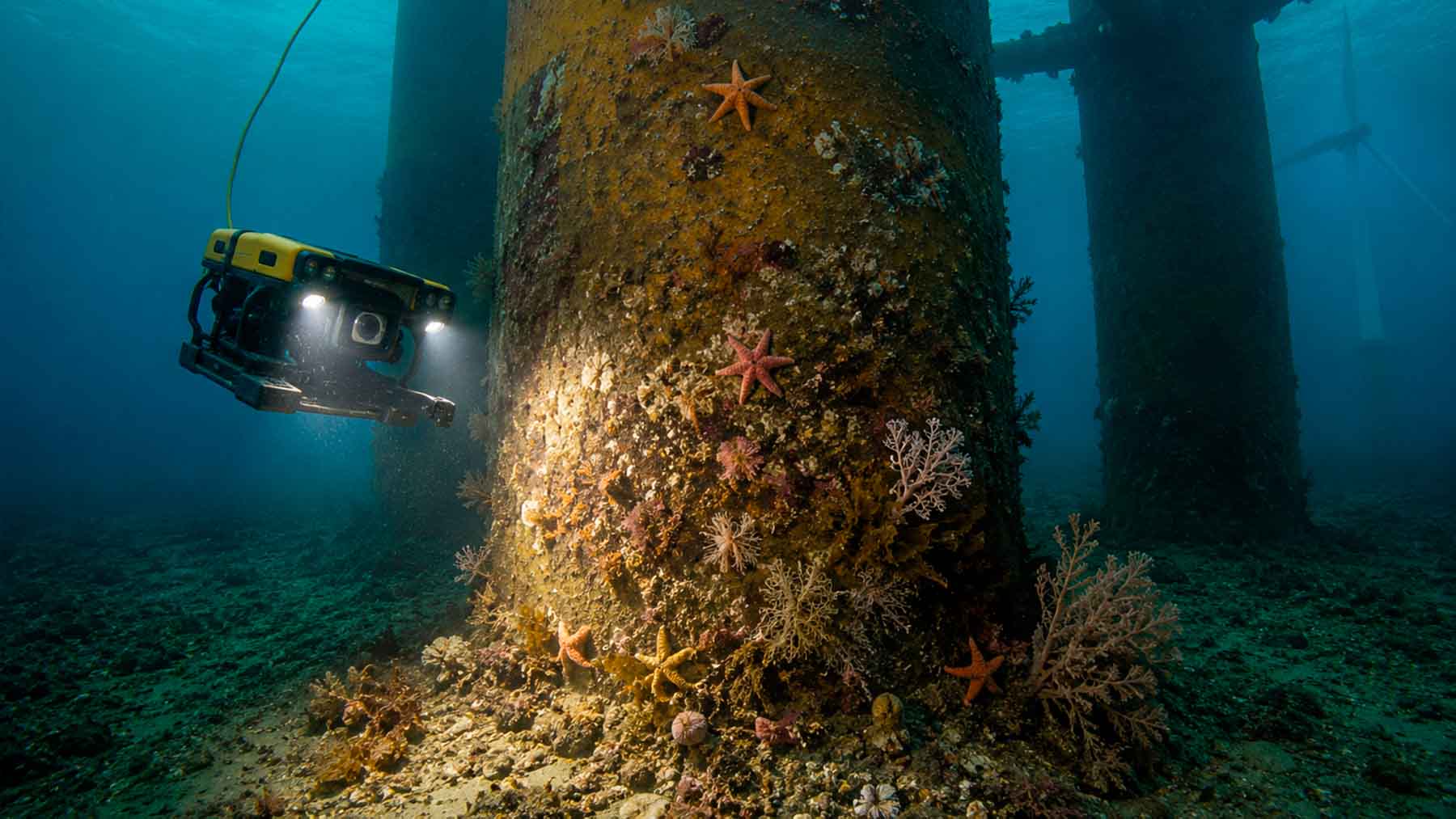
Energy researchers recently sent a robotic submersible down to check on the submerged equipment. High-definition footage recorded a thriving ecosystem on and around the steel infrastructure.
Which droves of sea creatures transformed this industrial setup into a layered, deep-water reef?
What makes robots ideal for ultra-deep surveying
The boom in the wind energy sector means more and more space is being occupied for giant turbine installations. This also means that offshore units are moving into increasingly deeper waters.
Traditional pylons cannot be installed here; it is too deep. Floating steel platforms are the next best thing. They get attached with mooring lines and heavy-duty suction anchors to withstand the intense surface waves and ocean currents.
It is vital for marine scientists to track how ocean ecosystems are affected by the expansion of offshore wind farming.
The submerged sections of the platform hulls reach hundreds of feet underwater, adding hard surfaces to sandy environments with no cover for marine life.
Oceanographers captured video via a remote-controlled submersible robot during recent routine maintenance inspections of Equinor’s Hywind Scotland Pilot Park. Changes needed to be tracked across the 41 underwater components of five turbines.
Related
Biological researchers got involved, logging every creature spotted on the mooring lines, steel frames, and anchors. The goal was to map how sea life establishes itself on man-made infrastructure. The result is a baseline for the planning and maintenance of future developments.
How artificial reefs form in deep offshore waters
Biological growth begins almost immediately as steel is added to open water. Early colonizing species are the first to attach to the metal, creating a layer of life that attracts larger predators and scavengers.
This process has consequences for energy operators and conservationists. On the negative side, heavy marine growth adds weight to platforms and cables, which adds to engineering loads over time. For conservationists, it is good news. The turbine installations stand in the way of bottom-trawling boats, where unintended sea-life sanctuaries are left to grow undisturbed.
The robot data showed that growth varies by depth. Equipment closer to the surface supported fast-growing species that need some sunlight, while deeper sections were home to cold-water species that have adapted to the darkness.
The combination of submerged structures formed an artificial reef reaching down 400 feet. The data proves that industrial arrays have a significant effect on marine biodiversity and species distribution. In this case, the range of organisms that colonized the Hywind Scotland Pilot Park was notable in its diversity.
Five turbines, 121 distinct forms of life
The robotic survey identified 121 distinct forms of sea life across the five turbine setups.
Near the surface, cameras spotted massive clusters of orange starfish, spiny sea urchins, and thick mats of plumose sea anemones coating the upper cables.
Related
Deeper down near the suction anchors, squat lobsters, brown crabs, and large fish hid in steel crevices.
Researchers discovered coral and celebrated
Most notably, researchers documented delicate soft corals and potential deep-sea stony corals growing on the frame. Finding slow-growing corals shows that floating platforms can host sensitive, long-lived marine organisms.
These visual records prove that floating turbines act as artificial reefs while blocking destructive bottom trawling. However, these findings come from a single five-turbine site off Scotland. Multi-year studies are still needed to confirm whether these platforms generate new marine life or simply pull in existing regional populations.
Seeing creatures thrive on underwater steel gives engineers real baseline data for planning ocean energy projects. As offshore energy grows globally, these artificial habitats raise new questions about how buried power cables affect sea life moving across the seafloor.
The full study can be found here: Karlsson, R., Tivefälth, M., Duranović, I., Martinsson, S., Kjølhamar, A., and Murvoll, K. M.: Artificial hard-substrate colonization in the offshore Hywind Scotland Pilot Park, Wind Energ. Sci., 7, 801–814, https://doi.org/10.5194/wes-7-801-2022, 2022.
Read the whole thing?
Get the week’s signal, not the noise
Our sharpest reporting on energy, climate and nature — free, once a week.