
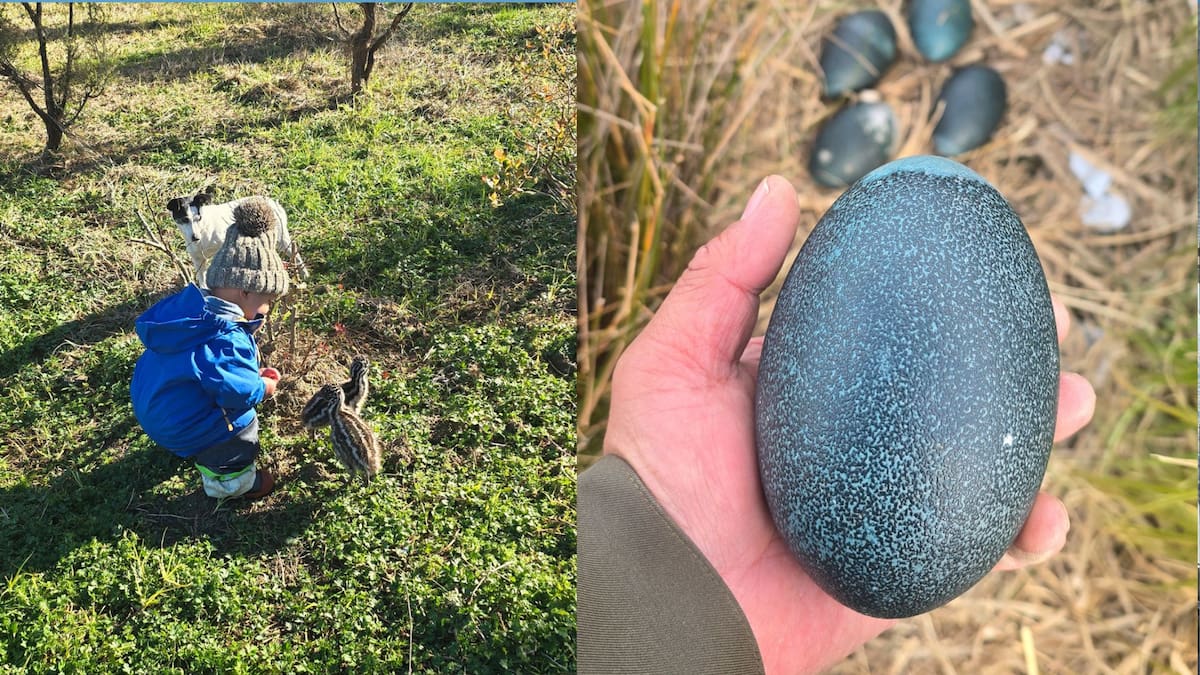
“The farmer thought it could be another income source but didn’t realise how much grass they could eat. Basically, they cleaned his paddocks out, so he realised there wasn’t much money in it – hence the reason he’d got them cheap – so he left the gate open and let them out.”
As a conservationist, Atkins knows there are wild emus breeding in a few locations around the Ruatōria area.
“If you know where those areas are, you can keep an eye out for them, but it looks like they’ve got predators, which are feral cats.”
Atkins’ emu discovery unfolded last weekend when he went to the beach to get more wood while celebrating his 60th birthday with a few quiet ones around the fire.
“Where we turned up, there was a male emu sitting on a nest and he got a fright and took off. Five chicks had already been born and there were probably another six eggs or so.
“I didn’t want to keep him off the nest long and even worse, I didn’t want to risk them imprinting on me.”
Imprinting is when chicks hatch and follow the first thing – animal or human – they see moving.
“Because the father had been scared off and the five chicks were all in a cluster, I moved on pretty quick.”
Atkins worried overnight that the male bird had not returned, leaving the chicks unguarded, so he went back the next day.
“I didn’t want to upset him again but needed to make sure he was there looking after the eggs and the chicks.
“I managed to sneak in close because it’s all gorse and weed down on our beach with plenty of pampas to provide cover. I could hear a couple of the chicks, that ‘peep peep’ noise they make, so I took that as a positive.
“They were still there, but I couldn’t see the parent – the father emu.”
Emus belong to the ratite family, the same as kiwis, and the males raise the brood.
“When I snuck in, I could hear the chicks peeping, then I heard one doing a real loud squeal. I knew that didn’t sound too healthy, so I stood up.
“A feral cat had grabbed one of the surviving chicks. When it saw me, it got a hell of a fright and took off with the chick down through the gorse. I went over to the nest and it was obvious the father hadn’t come back.
“From the five chicks, there were only two left, but I could see where the cat had parked up next to the nest and would keep killing at its leisure.
“I felt pretty stink about it cos it was me who scared the parent bird off of the nest, so I brought them home.”
Crushed emu eggs after a feral cat ate the baby chicks. Photo / Graeme Atkins
Since then, Atkins has sought advice through social media and learned emu chicks should not be on a hard surface that they could slip on because it would affect their leg development and could cause a complication called splayed leg (when the hip turns out and the leg turns slowly out to the side over time).
“So I’ve got them in a bin now, [and] we bought these wool mats. They’ve been sleeping inside these last few nights, near the fire, because it’s been so cold.”
The chicks are a week old now and Atkins’ moko Te Ahupo loves to follow them around.
In six months, the emus will tower over Te Ahupo and Atkins fears they could hurt him with their claws if he is too friendly and plays rough-and-tumble with them.
Adult emus can grow up to 1.9m in height and weigh about 35kg on average.
Atkins said he would release the emus once they were big enough to survive alone.
“I’ll put bright-coloured collars on them so we can keep an eye on them and hope they’ll be okay once they see their own kind in the wild.
“We’re lucky in this part of the world – there’s plenty of cover for them, especially at the Waiapu River mouth, where there are big islands covered in pampas and gorse. It’s like a refuge for them where they can exist and breed.”
Wild emus can be seen on the coastal beach near Ruatōria. Photo / Graeme Atkins
Atkins said his emu-saving actions came from a sense of responsibility “because I’d disturbed the father and it was frightening how quickly the feral cat had found them”.
He and his family live in a bush reserve in Tikapa, northeast of Ruatōria, where he’s been trapping possums, cats, rats and stoats for 30 years.
“It’s never-ending,” he said. “Feral cats are everywhere. They’re a huge problem, killing all bird species indiscriminately.
“Because I come from a conservation background where I do this sort of mahi, I realise it’s forever unless there’s some silver bullet somewhere down the line. Sadly, I don’t think there is.”
Atkins said he wasn’t worried his isolated piece of paradise would appear on the tourist map due to the emus as most people “couldn’t hack” the rough road.
“You have to be committed to get here, so I don’t think we’ll be inundated with visitors as a result of the story.”
The Department of Conservation (DoC) said it was not aware of emu on public conservation land it administers.
“DoC’s work focuses on native species. Emus are legally kept as farmed livestock or novelty animals, and fall under the Ministry for Primary Industries guidelines.”
A Ministry for Primary Industries (MPI) spokesperson said emus were not an unwanted organism and didn’t fall under MPI’s management.
An unwanted organism is any organism that’s capable of causing harm to natural or physical resources, like forests and waterways, or human health, according to MPI.
Discussion of the region’s wild emu population can be found online in various hunting forums as far back as 5-10 years ago.
Sightings of wild emus have also been reported historically in Southland, Waikato and the Waitomo district.
A 2013 Dominion Post article reported a “baby moa” reported in a woman’s garden in Masterton turned out to be a wild emu.