
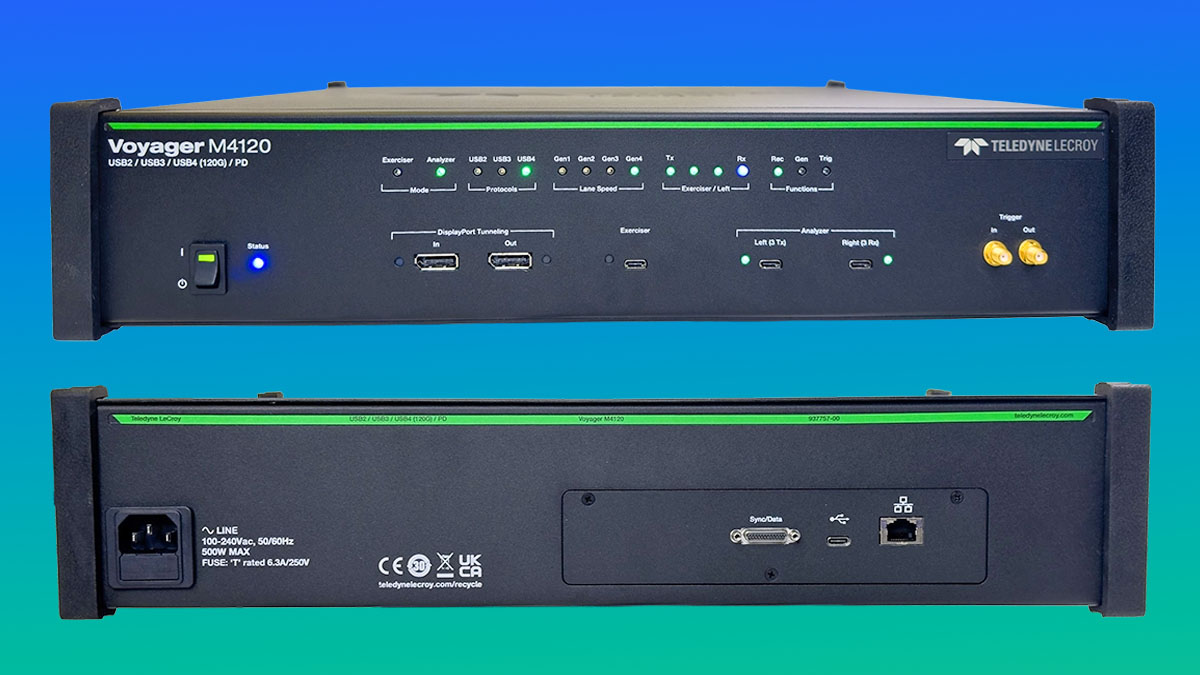
Always updating available solutions for testing the latest protocols, Teledyne LeCroy announced the availability of the Voyager M4120 Protocol Analyzer/Exerciser, at the time the world’s only solution supporting next-generation USB4 Gen 4 120Gb/s Asymmetric Link emulation and analysis. This new flagship system sets a new benchmark for USB protocol analysis with full support for USB4 Version 2.0.
Always updating available solutions for testing the latest protocols, Teledyne LeCroy announced the availability of the Voyager M4120 Protocol Analyzer/Exerciser, at the time the world’s only solution supporting next-generation USB4 Gen 4 120Gb/s Asymmetric Link emulation and analysis. This new flagship system sets a new benchmark for USB protocol analysis with full support for USB4 Version 2.0.

The USB4 Version 2.0 specification introduces a revolutionary new feature in USB technology – Asymmetric Link configurations. In this configuration, the two directions of the connection operate at different lane rates. One direction transmits at the full 120Gb/s over three lanes while the opposite direction transmits a lower rate, such as 40Gb/s on just one lane. This enables systems and devices to dynamically provide more bandwidth for high-throughput applications, such as tunneled Ultra‑High Bit Rate (UHBR) DisplayPort 2.1 real-time video processing workloads.
Even though the USB4 Version 2.0 specification was announced on October 18, 2022 by the USB Implementers Forum (USB-IF) (adding to the 80Gb/s bidirectional implemented earlier with USB4), the configuration has seen little market traction. Intended mainly for high-performance USB4-based displays requiring very high bandwidth in one direction, very few devices actually support USB4 v2.0 in 2026, with most high-end platforms typically stopping at USB4/80Gbps.

This is due to the fact that only two USB4 v2.0 controllers exist at the moment for PCs: one from Apple and one from Intel. USB4 v2.0 and Thunderbolt 5 solutions are shipping in premium laptops and desktops from Apple and Intel-based systems intended for professional and media content creation applications. The Apple MacBook Pro (M4 Pro/Max) with Thunderbolt 5 support was among the first devices to implement this capability. And even though those products advertise Thunderbolt 5 support, there’s hardly any mention of USB4 v2.0.
It is anticipated that a new wave of PCs and motherboards with USB4 v2.0 controllers will reach the market in 2027, making these specifications more common. As this process takes place, more engineering teams need the capabilities to test, debug, analyze, and verify USB4 Gen 4 120Gb/s hosts and devices throughout the product development lifecycle.
“USB4 Version 2.0 represents a major step forward for the industry, delivering higher performance and more dynamic link behavior than previous generations,” says Jeff Ravencraft, President & COO of the USB Implementers Forum (USB-IF). “Tools like the Voyager M4120 give developers the visibility they need to validate Asymmetric Link characteristics and ensure robust interoperability as these advanced capabilities enter the market.”

The new Teledyne LeCroy’s Voyager M4120 Protocol Analyzer provides numerous selectable views allowing the user to quickly and easily identify information of interest and resolve any issues that are contained in the data capture.
The Voyager M4120 is engineered from the ground up to capture and decode USB Gen 4 120Gb/s Asymmetric Links, fully supporting the USB4 Version 2.0 specification. The analyzer reveals what actually happens during Asymmetric Link bring-up and operation — from how devices decide lane roles and rates to how links adapt dynamically under real workloads. Powerful software features, including a hierarchical display, protocol traffic summaries, detailed error reports, and an automation API, enable developers to quickly visualize protocol activity and streamline troubleshooting efforts.
Built on a flexible architecture, the Voyager M4120 is designed to expand with emerging workflows, including asymmetric traffic generation and USB-IF compliance test capabilities as they become available, helping early adopters accelerate development and improve interoperability for the next wave of high-speed USB4 connectivity. Fully backward compatible with legacy Gen 3, Gen 2, and Gen 1 USB links, the Voyager M4120 can seamlessly address the past, present, and future of USB protocol testing.
www.teledynelecroy.com
