
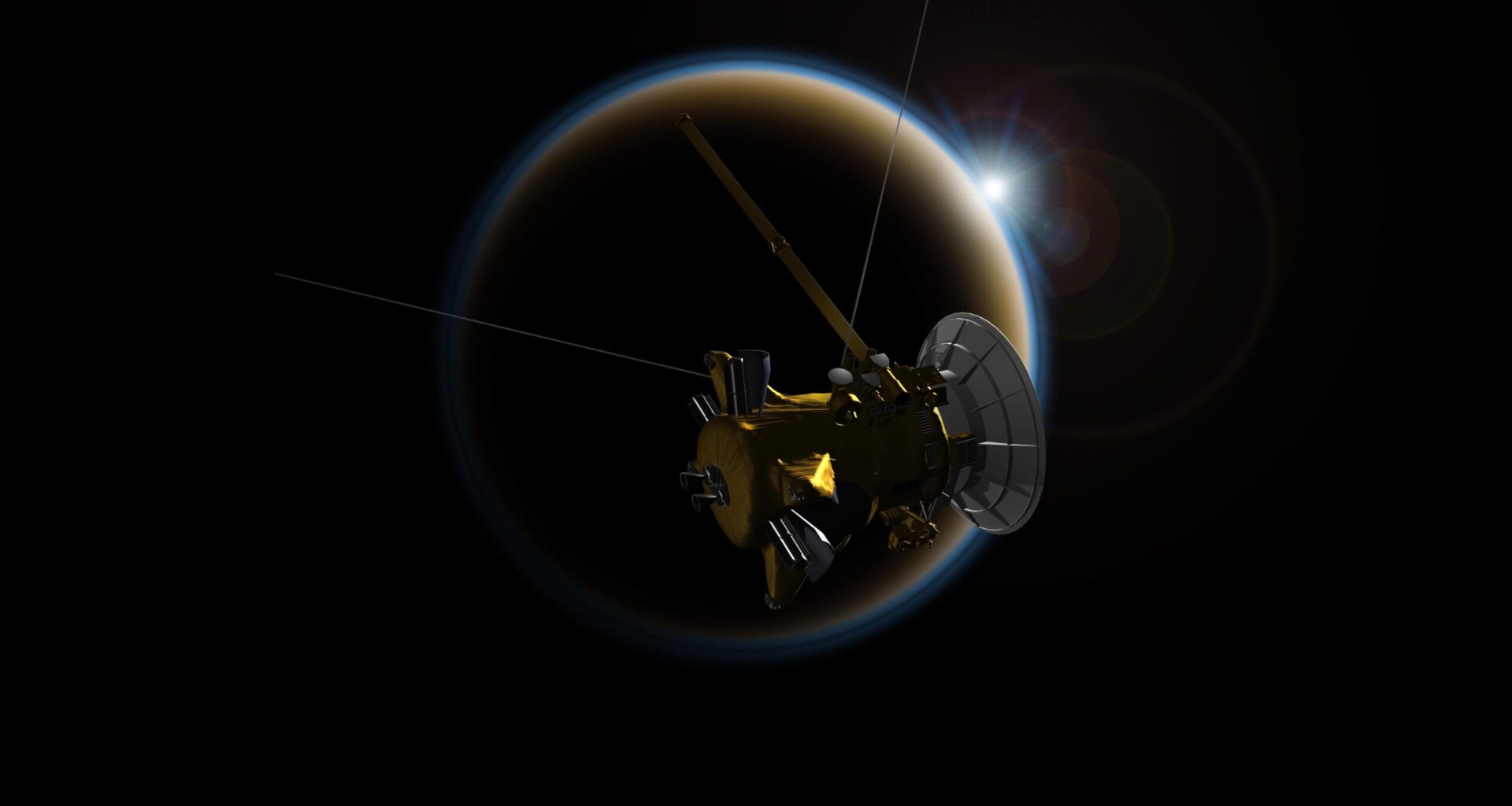
For more than a decade, Titan occupied a secure place on the solar system’s list of ocean worlds. Cassini watched Saturn’s largest moon flex under the planet’s changing gravitational pull, and the size of that response seemed to require a liquid layer beneath the frozen crust.
A reanalysis published in Nature on December 17, 2025, proposes a markedly different interior. In the model that best fits the reprocessed spacecraft data, a thick outer ice shell sits above hundreds of kilometers of high-pressure ice that is hot enough to deform, convect and contain scattered melt pockets.
Cassini did not photograph this slush or sample the water. It measured tiny shifts in a radio signal as Titan’s gravity changed the spacecraft’s speed. The interior structure is an inference from those measurements and a set of physical models. This is one study, not settled consensus.
Why the ocean interpretation made sense
Titan follows a slightly eccentric orbit, moving nearer to and farther from Saturn over 15.9 days. Saturn’s gravity therefore squeezes and stretches the moon by changing amounts. The resulting deformation affects Titan’s gravity field, which in turn minutely accelerates or slows a spacecraft passing nearby.
Researchers describe the size of that tidal response with a value called the Love number k2. A 2012 analysis in Science found a response roughly twice as large as pre-Cassini predictions. A buried global ocean offered a persuasive mechanical explanation: liquid could decouple the outer shell from the deeper interior, allowing the shell to deform more freely.
Large flexing alone was never a unique fingerprint of liquid. A warm, viscoelastic solid can also deform substantially. The proposed test was to measure both how much Titan flexes and how far that response lags behind Saturn’s pull. A liquid ocean should respond differently from a lossy solid in which repeated deformation creates friction and heat.
A faint delay emerged from ten flybys
Flavio Petricca of NASA’s Jet Propulsion Laboratory and colleagues returned to radio tracking from ten Cassini flybys devoted to gravity science. Ground stations had sent radio signals to Cassini and recorded the returned X-band and Ka-band signals. Their Doppler shifts preserved extremely small changes in spacecraft velocity.
The team used open-loop radio data and a phase-averaging method previously applied to Juno and InSight. According to the paper, these techniques reduced noise and parameter uncertainties by about 25 to 30 percent. That was enough to recover the delayed, energy-dissipating part of Titan’s tidal response for the first time directly from its changing gravity field.
In the peer-reviewed Nature paper, the imaginary component of k2 was 0.135 ± 0.035. That is three to four times the maximum value produced by the researchers’ models containing an ocean. It corresponds to a tidal quality factor Q of 4.5 ± 1.1, with a lower Q indicating that a larger share of mechanical energy is dissipated each cycle.
The 380-kilometer figure has wide uncertainty
The researchers combined the tidal measurements with Titan’s mass, moment of inertia, static gravity and rotation. They then used a Bayesian inversion to compare interiors with and without a global ocean.
The preferred ocean-free model has an outer shell of familiar low-pressure ice about 170 ± 17 kilometers thick. Beneath it lies high-pressure ice with a central thickness estimate of 378 kilometers. That layer contains several crystal structures, known as ice III, ice V and ice VI, which form under pressures far beyond those found in an ordinary freezer.
“Roughly 380 kilometers” accurately rounds the central estimate, but it should not be mistaken for a precise measurement. The paper reports a two-sigma uncertainty of minus 150 and plus 151 kilometers, giving a range of about 228 to 529 kilometers. Titan’s entire water-rich hydrosphere is approximately 600 kilometers thick. The headline’s number refers only to the modeled high-pressure layer above the rocky core.
The inferred rocky core has a radius of 2,026 kilometers, again with uncertainty of roughly 150 kilometers in either direction. None of these boundaries has been imaged. They are the internal arrangement that best reconciles several geophysical constraints within the authors’ framework.
What “slushy ice” actually means
The new measurement implies that Titan dissipates about 4 terawatts of orbital energy inside itself. The model places roughly 3.5 terawatts of that heating in the high-pressure ice. Producing so much friction requires the layer to have an average viscosity near 1012 pascal-seconds, close to laboratory estimates for ice V and VI near their melting points.
In that condition, solid ice can convect and small amounts of partial melt can collect between or within crystals. The paper calls this a “slushy” or “mushy” hydrosphere. It is not a single underground sea containing ice fragments. Most of the layer remains solid, while melt pockets may help lower its effective viscosity.
A JPL summary of the work quotes Petricca saying that liquid pockets near the rocky interior could be as warm as 20°C, or 68°F. That is a modeled possible local maximum under immense pressure, not a directly measured temperature and not the average temperature of 378 kilometers of ice. The liquid would also probably contain salts or other dissolved material rather than being pure water.
Convection provides the apparent paradox. The ice is warm enough to move and dissipate energy, yet the model allows heat to escape through the overlying shell quickly enough to prevent the high-pressure layer from becoming one connected ocean.
One archive has supported opposing interiors
The new paper is a strong challenge to the ocean model, but it is not the first modern reanalysis of Cassini’s gravity data. A 2024 study in Nature Astronomy inferred a low-density global ocean and obtained a lower value for the amplitude of Titan’s tidal response. It did not detect the dissipative component now central to Petricca’s argument.
An independent 2025 analysis of Titan’s rotational state had already inferred strong dissipation from a slight offset in the moon’s orientation. Its result is consistent with the newly measured gravity lag, giving the ocean-free model evidence from a second kind of observation.
The Nature team uses the word “precludes” because, within its model suite, an ocean suppresses dissipation in the layers beneath it. Models with a global liquid layer could not reproduce both the measured amplitude and the measured delay; models without one could. That is more specific than saying Cassini detected slush.
The conclusion still depends on assumptions about composition, temperature, convection and the poorly constrained rheology of high-pressure ice. The authors explicitly call for better laboratory measurements. Another model or independent dataset could yet alter the picture.
Dragonfly may provide an independent test
ScienceBlog reported the initial finding when the paper appeared. The important refinement is how indirect each step remains: Cassini recorded motion, researchers extracted a tidal phase lag, and interior models translated that lag into a warm, dissipative layer with partial melt.
NASA’s Dragonfly mission is targeted to launch no earlier than 2028 and reach Titan in the 2030s. Its geophysics package includes a seismometer. If Titan produces suitable seismic events during the mission, differences in wave speed across ice phases could help constrain the hidden layering. Dragonfly is primarily a surface habitability mission, however, and a definitive interior answer is not guaranteed.
The habitability story also becomes less simple, not necessarily less interesting. The paper estimates that even a 0.01 percent melt fraction across Titan’s enormous hydrosphere would equal the Mediterranean Sea’s volume. Separate pockets could concentrate salts and organic molecules, but no evidence shows that they host life or even that all the modeled pockets are connected to material from the surface.
Titan still flexes exactly as Cassini recorded. What changed is the ability to detect how late that flex arrives. That faint delay points to friction where a clean global ocean should have reduced it, turning an apparently simple hidden sea into a much stranger world of hot, slowly moving ice.