
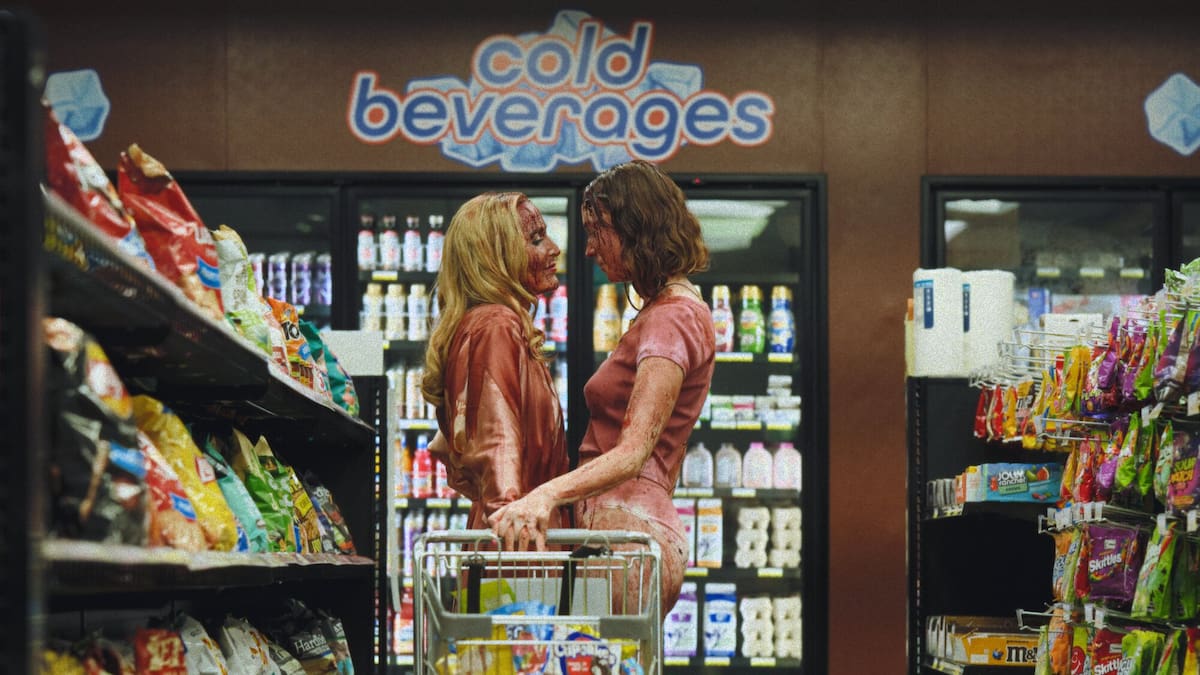
Horror is a key space for transgression – presenting ideas and images that confront our concept of normality and upset the established order of the world.
Notions of gender, like sex, are debated and torn to shreds in horror.
One of the precursors of the slasher, Alfred Hitchcock’s Psycho, was daring in so many ways, not least that its villain Norman Bates was a cross-dresser who committed murders in the guise of his long-dead mother.
The Camp Miasma series is a sibling of sorts to the Friday the 13th franchise, a ground zero for “cabin in the woods” horror that frequently focuses on the tearing and mutilation of young, nubile flesh.
Little Death – the “Jason” of Miasma – is in the throes of gender panic, triggering them into a murderous rage. It’s the kind of monstrous portrayal of transgenderism that’s present not just in Norman Bates, but in The Silence of the Lambs’ Buffalo Bill and Sleepaway Camp’s Angela Baker, a major influence on Schoenbrun’s new film.
Schoenbrun identifies as trans and non-binary, much like the film’s protagonist Kris, who’s been saddled with rebooting the “problematic” franchise for a modern era.
The issue itself isn’t fictional. While societal progress can be tracked through horror, from Night of the Living Dead to Alien to Jennifer’s Body to Get Out, there’s plenty that’s retrograde, too, or has dated terribly.
Slasher-horror Teenage Sex and Death at Camp Miasma is the third feature by director Jane Schoenbrun, a high-profile transgender filmmaker.
It’s something Emmy Award winner Hannah Einbinder from Hacks, who plays Kris, has been mulling over lately.
“I’ve been rewatching some of the comedies I grew up with and they’re just littered with transphobia, specifically: it’s so flippant and so embedded,“ she says.
“It’s caused me to reflect on the way in which this has been the subconscious messaging in culture for years and years and years.”
Starring alongside her is Gillian Anderson as Billy Preston, the original Miasma film’s “final girl” – a common horror trope in which a female character is left to climactically face off with the villain alone, usually in a state of undress.
The X-Files legend says misogyny, racism and fat shaming are “relentless” in so many of the older films.
“Even though, in Miasma, Jane [Schoenbrun] is speaking specifically to transphobia and misogyny, just even having the topic and the difficult reality being addressed in such an emotional way, it starts a conversation.
“And the conversation needs to be had because it’s still out there in subtle and not so subtle ways.”
Teenage Sex and Death at Camp Miasma is Schoenbrun’s third feature and continues their run of inward-looking, pop culture-brained and unsettling exercises in picking apart the subconscious.
In her first feature film, Hacks star Hannah Einbinder plays a queer indie film director.
Where their first two films, We’re All Going to the World’s Fair and I Saw the TV Glow, were far more downbeat and frequently horrifying, Miasma invites its director and two stars to let their hair down.
The film is about sex, first and foremost, and why society seems to have retreated so intensely away from sexual liberation in our films, our television, our culture and especially our own lives.
“[For our] younger generations, it has so much to do with the time spent on screens and how impersonal that is, and therefore how scary it is when there is real-life intimacy that is required to start an actual relationship,” Anderson says.
“Many are terrified to even have a phone conversation … they consider a Snapchat to be a conversation.
“How could those things not have an impact on how one perceives something that is so intense as two human beings touching naked skin?”
Armed with a Southern twang and buckets of fried chicken, Anderson’s Billy Preston initially appears to be something of a femme fatale for Kris, who ventures to the snowbound, hollowed-out set of the first Miasma where Preston now lives, hoping to lure her back for the reboot.
Gillian Anderson as the seductive recluse, Billy Preston, who lives in the hollowed-out film set where she once found cinema stardom.
As Teenage Sex and Death digs deeper into the psychology of Kris (specifically, her sexual frustration and inability to surrender to her urges), Anderson’s performance begins to reflect how the actor herself is viewed by the public – most especially queer audiences, who feel seen by her work.
Billy comes to serve as a kind of sexual guide through the maze of desire for Kris, who is in thrall to her natural magnetism.
“Gillian and I have a similar philosophy, which is that the chemistry is either there or it isn’t,” Einbinder says.
“And we’d done so much individual preparation that by the time we got together, it was … so clear what the movie would be, that it would work.
“I was so nervous because it was my first film and I wanted to do something really different, and with Gillian I was just completely at ease.”
Anderson agrees.
“When we first sat down for that reading, it just fell into place completely. That’s not always the case. It just made it so much more powerful from the beginning.”
In previous interviews, Schoenbrun and Miasma’s two leads have discussed at length the difficulty of making such a fearless and uncompromising film.
Kris (Einbinder) and Billy (Anderson) find their attraction spiralling into psychosexual mania as the line between reality and fiction blurs.
A24, who produced TV Glow, famously passed on the opportunity to sign on for Miasma, leading Schoenbrun to the small distribution label Mubi.
It’s easy to read between the lines as to why major American studios are reluctant to throw their weight behind such an outspoken, transgender artist.
What this reluctance belies, however, is just how hilarious, sexy and fun Schoenbrun’s film actually is.
Where their previous movies were about self-imposed prisons, Miasma is ultimately about liberation, living freely as yourself.
“This is the first movie I’ve made that really feels like it captures the fullness of my personality,” Schoenbrun said recently.
“World’s Fair and TV Glow are both movies that I made right after coming out, reflecting on the intensity of that time in my life.
“And so they were kind of using the screen to talk about dissociation, to talk about not being in one’s body, to talk about living as voyeur.”
Miasma, then, is a strident ode to making sex enjoyable again – an idea shared by other contemporary films from Gregg Araki’s I Want Your Sex to Yorgos Lanthimos’ Poor Things.
“It’s absolutely vital that there are those representations out there,” Anderson says.
“There seem to be a few films over the past few years that have been much bolder [and more] explicit, but from a woman’s perspective … engaging with the [idea of] women having desire.”
Director Jane Schoenbrun on location for Teenage Sex and Death at Camp Miasma, her third feature.
Despite their pronounced differences, Schoenbrun’s two lead characters use their connection to grapple their way to shared freedom.
For Einbinder’s Kris, it’s the freedom to enjoy sex for the first time. For Anderson’s Billy, it’s transcending the role that made them famous and returning to the public eye.
“What I love about the two of them is that they feel at once like complete opposites in their rhythm of talking, their view on life and the world, but their love language is cinema,” says Anderson.
“They find their way to each other through that.
“There’s real romance in it. They really do fall in love.
“They bond on a really deep level, and some of that is related to similar experiences with fear and shame. It’s possible to find kindred spirits in the world, regardless of age or circumstance or life perspective. There’s something beautiful in that.”
One of the great ironies is that horror has always been a no-go for Anderson.
Even during her years playing Dana Scully (The X-Files’ episode, “Home,” is infamous as one of the most disturbing hours of television ever aired), she steered clear of scary movies in her personal life.
“I had a horrible experience watching a horror film way too young, stoned, and have not watched a horror movie since,” she says with a laugh, admitting Miasma may finally have prepared her to journey into the darkness.
“I feel like I’ve learned so much about the genre and its subgenres that it has made me want to investigate it a little more. So I’ll see if I can dare myself to embrace it a little more than I have in the past.”
For Einbinder, an avowed horror fan since seeing the 2006 film Silent Hill at an impressionable age, Miasma invited her to put herself inside the stories she’s treasured for years, in a way that defanged them, and made them safe.
“Toward the end of the film, I’m going through the emotional experience of terror and I’m feeling that legitimately,” she says.
“But the rest of the time we see the cameras, we see the set, we know what goes into the blood. It’s demystified in the process of the making.”
The best way to venture into horror, they both reckon, is one that could be summed up by the iconic tagline for Wes Craven’s The Last House on the Left: “To avoid fainting, keep repeating, ‘It’s only a movie, it’s only a movie’”.
“If you’re ever watching a horror movie, remember that just off screen there’s a guy with a big microphone on a pole, and there’s somebody nearby eating popcorn, and somebody’s over there on a call,” Einbinder says.
Anderson adds, “And the blood tastes like mint!”.
Teenage Sex and Death at Camp Miasma is playing at the New Zealand International Film Festival and opens in cinemas nationwide on August 20.