
“We’re sinking quite quickly because people are so sick.”
Dr Vanessa Thornton, Health New Zealand group director of operations Counties Manukau, confirmed to the Herald that there were “494 presentations to Middlemore’s ED” in the 24 hours from midnight on Monday.
“Counties Manukau has been experiencing some of its busiest days of the year this week, reflecting increased seasonal illness in the community. Monday saw our highest number of emergency department presentations this year.”
Health NZ did not respond to questions over whether Monday’s figure was a record.
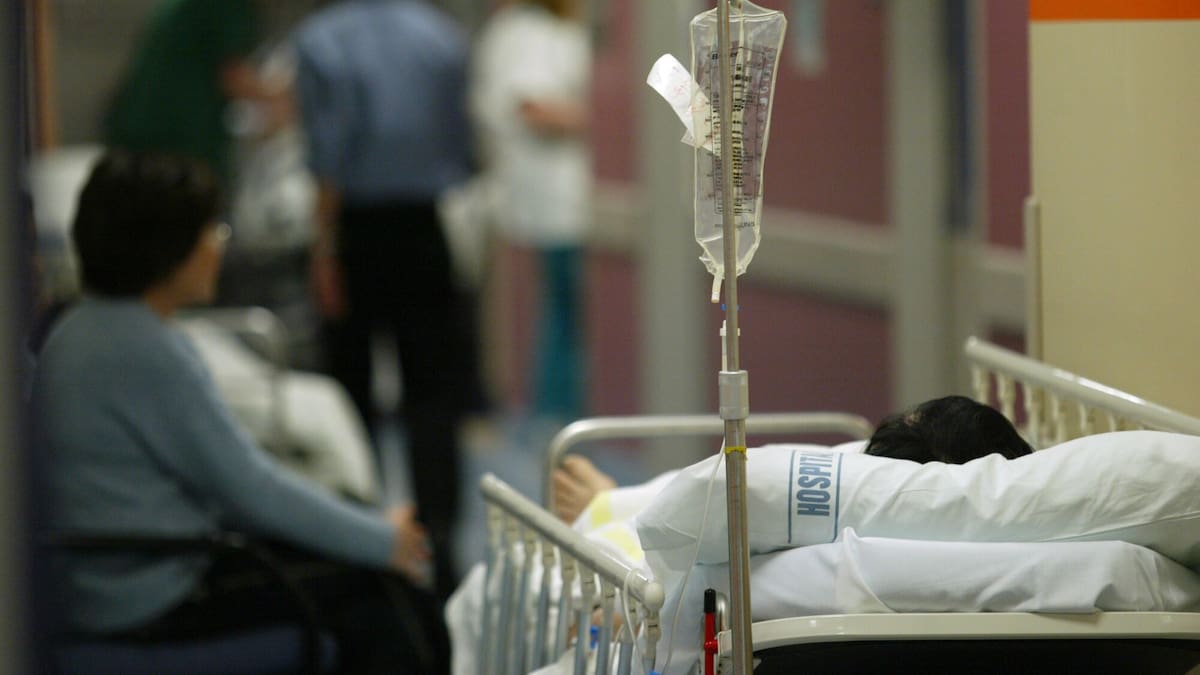
A paramedic told the Herald two ambulance staff members were forced to treat nine patients in a hospital corridor “because the hospital did not have capacity to accept them into the department”.
They said there were 223 patients in the ED that night. The hospital has – and is staffed to service – 145 beds in the department.
The paramedic said some of those patients had to wait three hours in the hallway, where they were given IV analgesia and had their vitals checked, which also made ambulance staff unavailable to respond to other emergencies – further compounding the situation.
Paramedics were forced to treat patients in corridors as Middlemore Hospital’s emergency department reached capacity. Photo / Dean Purcell
“Nine people who were unwell enough to need an ambulance are sitting in a hospital corridor.
“Two paramedics are effectively ‘babysitting’ those patients because there is nowhere for them to go.
“Those paramedics should be available to respond to the next 111 call. Instead, they are stuck inside an overwhelmed hospital because the system has nowhere to put the patients already arriving.”
At one point that night, there were four ambulances that were stuck with patients in the corridor.
“There were just so many people, like, standing room only in the waiting room,” the paramedic said.
“Somebody told me that apparently Kidz First [Middlemore’s children’s hospital] were diverting patients up to Starship [hospital] because they were just overrun.
“All of the staff are amazing, they’re doing the best they can, but we’re just overwhelmed.”
Middlemore Hospital ED hit a record number of patients this week. Photo / Jason Dorday
Thornton said demand at Middlemore’s ED on Monday was “high, particularly with presentations related to winter viral illnesses”.
“Ambulance arrivals were lower than usual, with most patients presenting as walk-ins to either our adult or paediatric emergency departments.
“While demand was higher than usual, patients continued to receive assessment and treatment, with those requiring the most urgent care prioritised first.
“Counties Manukau has implemented plans to deploy additional resources to help manage seasonal demand pressures. These plans are continuously reviewed and updated as demand and operational pressures fluctuate. We work closely with Hato Hone St John to manage pressures on ambulances and EDs through well-established protocols when demand increases.”
The paramedic said they have “never seen it so bad” in their entire career.
“Even during Covid, we weren’t ever waiting so long.”
‘Multifactorial failure within the system’
The nurse said it’s a symptom of larger “systemic” issues in New Zealand’s healthcare system.
“From where I sit and what I see as a nurse, we have a multifactorial failure within the system that’s under-resourcing of both staff and equipment.
“It’s happening all over New Zealand. It’s happening in all our ED departments. It’s just no one’s talking about it. And it happens every winter.”
They said healthcare workers are reaching their limit.
“There’s this whole idea that, you know, coming out of Covid, that healthcare workers are superheroes. We’re actually not superheroes. We’re human.
“We get sick. We’re part of our communities. People come to the hospital and they’re sick. We’re exposed to that sickness. So as quick as our communities get sick, we are getting sick as well. And possibly even sicker, quicker.
“And so the impact is that we then become more short-staffed. Then the call goes out for us to pick up extra shifts or extend shifts. And you become more run down. You then become more exposed to illness. It’s a constant cycle. Staff become burnt out and then they choose to leave or they become desensitised.
“You don’t want to be that person that turns up with no compassion, but the compassion is dulled. And that’s not what any of us nurses or doctors or any of the healthcare staff want to be. But we’re so tired that people forget that we’re human.”
Healthcare workers say they’re reaching their limit. Photo / 123rf
The paramedic added similar concerns.
“As someone working on the frontline, what I am seeing is frightening. We keep talking about the health system being ‘under pressure’, ‘stretched’ or experiencing ‘high demand’.
“Those words no longer adequately describe what is happening. We are on the brink of collapse.”
Thornton thanked staff for their “dedication, professionalism and care as they continue to support patients and whānau during this busy period”.
“Like many healthcare providers across New Zealand, we are also managing increased staff sickness associated with winter illnesses, which can place additional pressure on services.
“Across Health New Zealand hospitals, ED presentations increased by 0.4% between July 2025 and July 2026. Health New Zealand’s hospitals, including Middlemore Hospital, are prepared for seasonal demand and remain open.”
Health NZ’s advice to the public
Thornton asked the public to consider “the range of healthcare options available”.
“We encourage people with non-emergency health concerns to consider the range of healthcare options available, including community pharmacies, GPs, urgent care clinics and Healthline [0800 611 116].
“Anyone requiring emergency care should continue to call 111 or come to ED as usual.
“As flu cases continue to circulate across New Zealand, we are reminding people that it is not too late to get vaccinated and that getting protection against the flu now can still prevent serious illness, reduce hospitalisations and protect vulnerable whānau.”
Health experts are urging the public to get vaccinated as flu cases rise in winter. Photo / 123rf
The nurse said for “lower economic communities such as Middlemore or Northland”, there are “cultural and socioeconomic” and “health literacy” reasons why other healthcare options aren’t utilised.
“We have lots of cultures where the hospital is actually where you go to see doctors back in their country.
“[There are] perceptions where the doctors at the hospital are better than GPs … They actually don’t understand that GPs actually see things like type 2 diabetes and blood pressure and those ongoing issues, asthma, eczema, those sorts of things. The GPs see them all the time, and they’re actually experts in those areas.
“There’s the cost pressures, like people might have outstanding bills at their GPs, so they don’t want to go there, but they’re not going to disclose that to us. Or they have to choose between going to the doctor or paying the power bill or putting food on their table or getting to work.”