
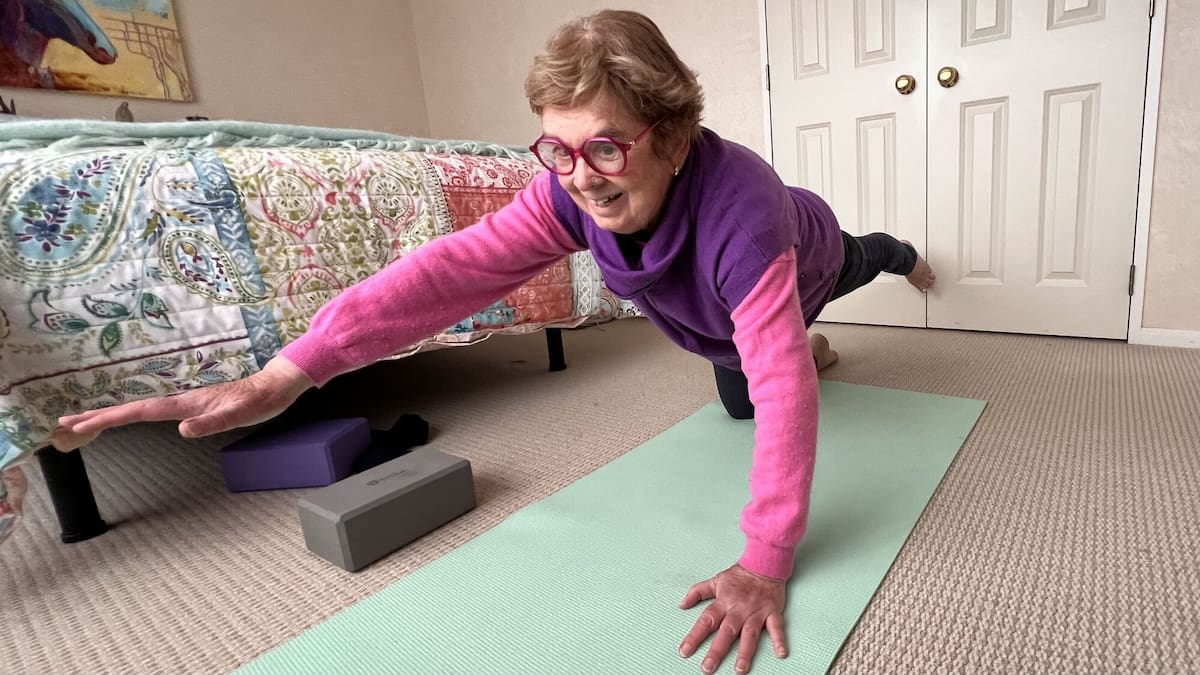
Laura is blind.
Born with a visual impairment, she grew up able to see through one eye, but her remaining vision has deteriorated over the past 15 years.
“I can wash [clothes], but I can’t see whether they’re clean or not.”
For her, maintaining mobility is not simply about fitness. It is about safeguarding her independence.
Home help comes twice a week to assist with cleaning, shopping and mail, while another woman occasionally cooks meat because Laura cannot reliably see when it is properly cooked.
Technology has also become an important part of keeping her connected and independent. Her laptop talks to her. So does her mobile phone.
“Those are two very important parts of my life these days because it fills in a lot of time when you’re on your own.”
But technology could not replace the ability to move.
“I used to go walking with a friend for about 4.5km twice a week, but unfortunately, things changed, and I can’t walk the long distances anymore.”
As her eyesight deteriorated and problems with her leg and hip developed, those long walks became harder.
A heart attack two years ago was another setback.
She noticed her fitness slipping.
“I thought, I’ve got to do something about it.”
Early last year she began working with personal trainer Denise Dahlberg, after a GP’s advice to exercise more.
Laura now sees Denise twice a week and attends a weekly yoga class.
In her bedroom, she uses a yoga mat for stretches and exercises.
Her balance and mobility have improved, and she has progressed to strength work and weights.
Laura said the benefits of exercising go beyond the physical.
“It’s been good for my mental health as well.”
She said losing her mobility was no longer a concern because she had taken steps to protect it.
“That’s why I did something about it.”
Lea Sycamore, 77, exercises daily after spending two years inactive because of health problems. Photo / Rafaella Melo
At 77, Lea Sycamore knows what life feels like to lose her mobility and what it takes to regain it.
For much of her life, she was extremely active, playing netball and squash, swimming and coaching sport.
During Covid, she became ill.
Lea discovered she had only one working lung and lost most of the sight in one eye.
Her active life ground to a halt.
“I sat on the couch for two years,” Lea said.
Her muscles weakened so much that she struggled to stand for extended periods.
One day, after climbing on to a couch to clean photographs, she fell backwards on to the floor.
“I thought, how am I going to get up?”
She had to crawl towards something she could use to pull herself upright.
“I didn’t feel I could do anything much after that, and so I would just sit,” she recalled.
“I would try and prepare a meal, but it would be done in stages because you were afraid that anything else would happen.”
She started living in fear.
What hurt most was being unable to participate fully in family life.
She still watched her granddaughter play football, but had to sit in a chair rather than stand on the sideline.
“I could be there, but was I participating? No,” Lea said.
Her self-belief was “well and truly crushed and gone”, and she worried she would become less useful and more dependent on other people.
Last year, Lea decided she could not live like that anymore.
“I missed life itself,” she said.
“When you’re just sitting, waiting for the day to pass because you’ve allowed yourself to go downhill, which is what I did … that’s not living.”
She completed six months of supervised mobility, stability and strength training.
Today, she can get herself off the floor without holding on to anything.
Lea walks her dog for about 45 minutes daily, then spends another 20 minutes exercising at home, including squats, weights and stretches.
What gets her moving is remembering the alternative.
“I don’t want to visit that place again.”
Lea said becoming stronger had changed the way she carried herself.
“You stand up straighter, you feel stronger, so you look people in the eye more.
“It just changes everything around you and everything about you.”
Her advice to others was to start small and seek help.
“Don’t expect things to happen quickly, but just celebrate each little change,” Lea said.
Lea Sycamore and personal trainer Denise Dahlberg at Peak Fitness in Havelock North.
Denise, who specialises in senior training and rehabilitation, said fear after an injury or fall could itself become a threat to mobility.
People might stop bending, reaching or getting on the floor because they were afraid of falling, creating a cycle in which moving less could further reduce their body’s ability to move.
“You need to be able to get up from the floor if you have a fall, and especially if you’re living on your own,” Denise said.
Simple at-home movements, such as arm raises, small squats, walking, sidestepping, gentle twists and reaching exercises, could help maintain the range of motion needed for everyday life, she said.
“I don’t believe that it’s ever too late.”
For someone already frightened of exercising after a fall, Denise recommended seeking professional guidance rather than attempting unfamiliar exercises alone.
However, personal training was not an option for everyone.
Age Concern Hawke’s Bay manager Dairne Withers said its Steady as You Go programme offered free strength and balance exercise classes aimed at preventing falls at more than 20 locations across Hawke’s Bay.
Dairne said people didn’t need to be Age Concern members to attend.
Classes were held in local communities to make them easier to access, particularly for older people facing transport or cost barriers, she said.