
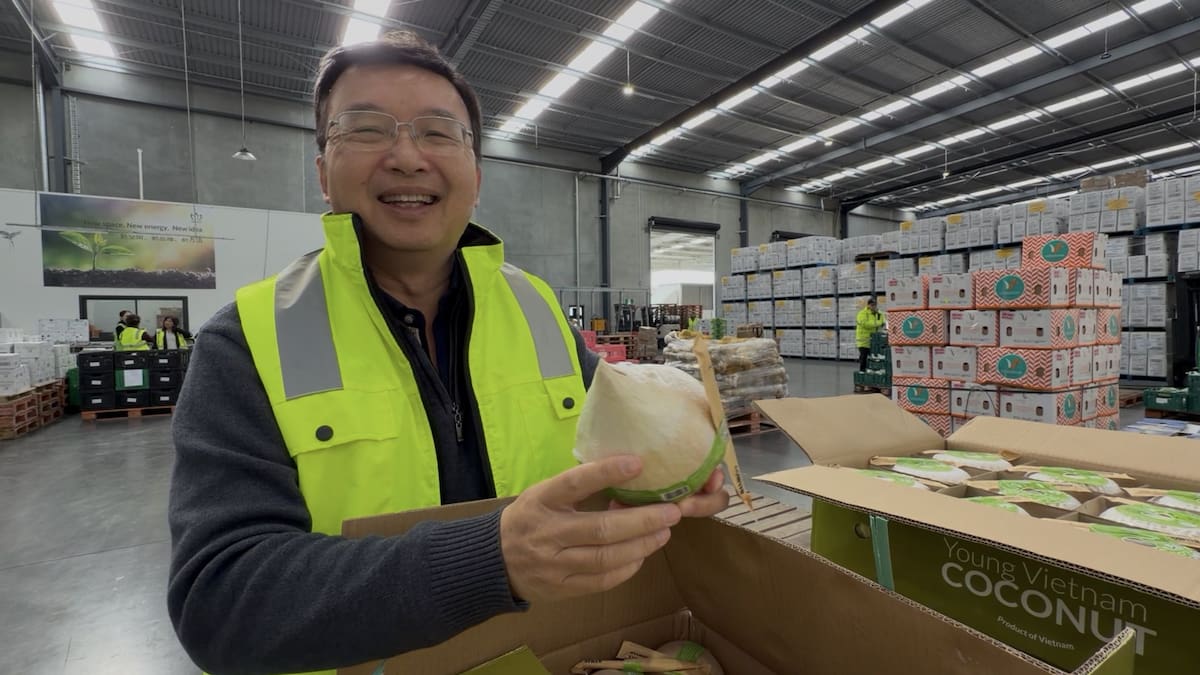
The fictional Peter Pan led the Lost Boys. Auckland’s Peter Pan grows bok choys.
Peter Pan is the major character in J.M. Barrie’s famed fable about a free-spirited boy who refused to grow up. The fictional Peter Pan led the Lost Boys; Auckland’s Peter Pan grows bok choys.
We’d best
explain that sentence. Auckland’s Peter Pan is the founder of Healthy n Fresh, a significant supplier of the Asian leafy greens enjoyed by customers at locally owned New World, PAK’nSAVE and Four Square stores across New Zealand.
Healthy n Fresh also grows dozens of other types of Asian vegetables and fruit at its 28ha Karaka farm, just south of Auckland, which comprises 15 greenhouses spread over 60,000sq m and what Pan says is the biggest hydroponic farm of Asian leafy greens in the southern hemisphere.
Even Cyclone Gabrielle couldn’t slow them down.
While many agricultural and horticultural businesses across the North Island were devastated by the natural disaster in 2023, Healthy n Fresh’s greenhouse operation meant Pan could continue growing produce for Kiwi consumers with minimal disruption.
Pan first came to New Zealand from China to study English in 1988. Fast-forward almost 20 years – taking in the time when he met his wife Michelle, who now co-runs Healthy n Fresh alongside him – and Pan’s knowledge of Chinese vegetables became of keen interest to Foodstuffs.
He first acted as a consultant, helping streamline the chain’s leafy greens produce department and their packaging, storage and check-out efficiency.
Then in 2008, after seeing growing demand for Asian produce among New Zealanders, Pan established Healthy n Fresh, buying the farm in 2018 from a retired dairy farmer.
Since then, both businesses have grown as demand for Asian vegetables has increased across New Zealand.
Pan says it isn’t only new immigrants causing the growth in Asian leafy greens – he has seen “a lot of change in the eating habits of New Zealanders, too”.
“When we started, I delivered five crates of leafy greens to Foodstuffs. Now it’s thousands,” he explains.
“Back then, Kiwis wanted broccoli, cauliflower, cabbage and celery. Now they are into bok choy, kai lan, choy sum, wong bok, coriander, Chinese celery, edible chrysanthemums, gai choy (Chinese mustard greens) and many more.
“Asian leafy greens weren’t popular because Kiwis didn’t know how to use them. They might have tasted and liked them when they went overseas or ate at an Asian restaurant, but they didn’t know how to cook them.”
That’s when Foodstuffs’ know-how piqued Kiwis’ interest through in-store cooking demonstrations, recipes and packaging with instructions.
“Once people tried it,” says Pan, “they would say to us, ‘oh, it’s quite good eating’. We found about 80% who tried it in-store bought the produce.”
As understanding grew, so did popularity – and sales.
Dishes like kai lan (Chinese broccoli) are famously cooked in oyster sauce; many Foodstuffs stores found their supplies of oyster sauce and soy sauce suddenly so popular their shelves emptied.
“Foodstuffs had real faith in us,” says Pan. “The promotional programmes really worked.”
Foodstuffs North Island’s head of produce, Brigit Corson, says customers are increasingly interested in exploring different cuisines and ingredients, whether they have discovered them through travel, restaurants or cooking at home.
“We work closely with local suppliers like Healthy n Fresh to understand changing customer preferences and ensure we can offer a great range of quality produce throughout the year,” she says.
“Decisions about what we stock are guided by customer demand, product quality, availability and value.”
The hydroponic farm was developed in 2020 and has helped provide greater consistency of supply, regardless of seasonal conditions.
“Back in the day, everyone was weather-dependent, and you had delayed or damaged crops sometimes,” says Pan.
“Now we need to control the environment to grow things because the old consumer habit of buying produce only in season has gone. Now people want produce available all year round and we must be able to supply it reliably.”
This is where the greenhouses come in. In recent times, Pan says, the outside temperature has been about 10-11 degrees. Inside, it’s 20 degrees.
The cutting-edge hydroponic nutrient film technique system ensures efficient water and nutrient use, sunlight is the primary energy source, and clever insect netting protection means spraying is minimised.
The system also creates a more comfortable working environment for staff. Because the hydroponics are grown off the ground, staff don’t have to bend all day.
More than 100,000 native trees and shrubs have been planted alongside waterways, stabilising the soil, reducing erosion and supporting sustainability of the broader ecosystem.
Last year, Healthy n Fresh were recognised with several industry awards, including winning the Ballance Agri-Nutrients Soil and Nutrient Management Award, Bayleys People in Primary Sector Award, Hill Labs Agri-Science Award, Norwood Farming Efficiency Award, NZFET Innovation Award, and the Auckland Regional Supreme Winners 2025.
Corson says customer demand for international ingredients continues to grow.
“New Zealand households are increasingly experimenting with flavours and recipes from around the world, creating demand for a wider range of fresh produce and specialty ingredients.
“Our goal is to offer customers great value, and for suppliers of all sizes to thrive. We’ll continue focusing on strong supplier relationships and buying well to deliver the best outcomes for customers.”
“We’re proud of the relationships we’ve built with our suppliers and remain committed to working together to deliver the best outcomes for our customers.”
SaveShare this articleCopy LinkEmailFacebookTwitter/XLinkedInReddit