
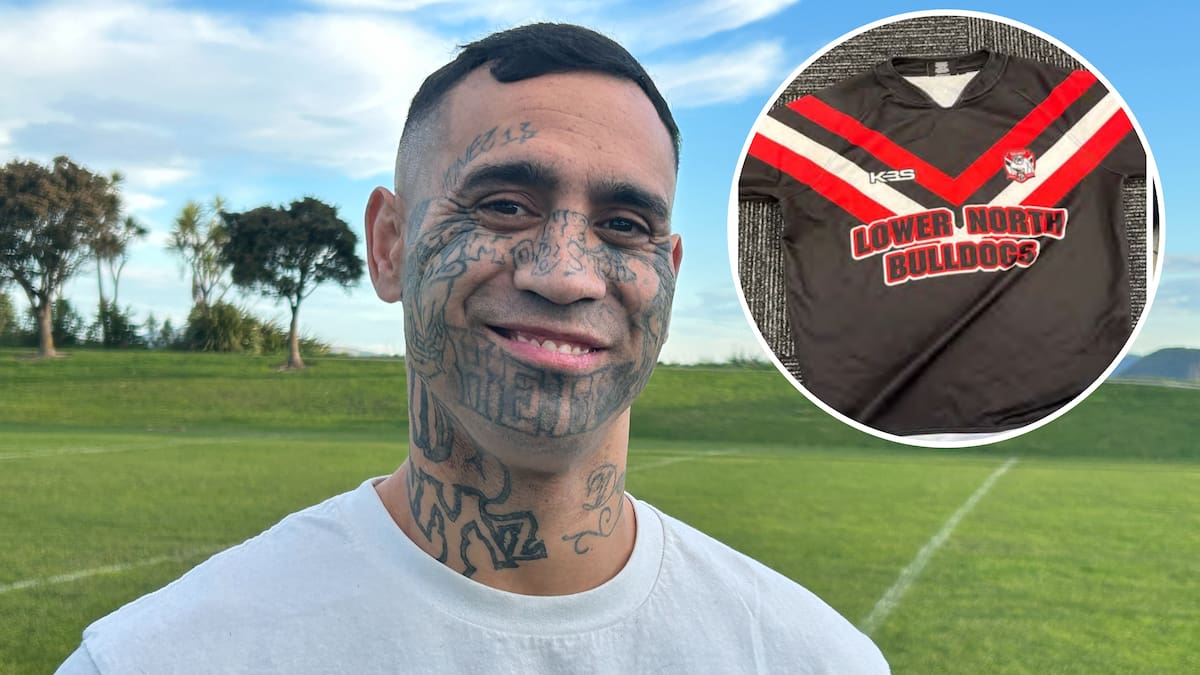
Now Te Rata’s lawyer has described the prosecution as “stupid”, “straight out bullying” and “oppressive conduct” by police.
It was initially a driving matter
In February, the day Te Rata was seen at the Wainuiomata service station, police visited his Lower Hutt home.
He was arrested, cautioned, questioned, served with a summons and photographed in relation to a driving matter.
Crucially, no insignia offence was identified, and the jersey wasn’t seized.
The rugby league jersey belonging to Mongrel Mob member Syd Te Rata, which was produced for the gang’s annual ‘Clash of the Regions’ tournament.
It was only after a member of one of the Gang Disruption Units became involved that police determined the jersey was gang insignia.
On March 3, 11 days after he was filmed at the petrol station, police searched Te Rata’s home and found the jersey in a washing basket. He was arrested and charged for wearing it.
It’s the second time Te Rata has been arrested for displaying gang insignia.
In April 2025, Te Rata was stopped around 3.30am riding his motorcycle in central Lower Hutt while wearing his Mongrel Mob patch.
He was uncooperative and verbally aggressive towards police, tried to pull away from the officer, refused a breath test or to give a blood sample and didn’t have a motorcycle licence.
In explanation, he said he had been stopped after returning from visiting the home of a friend who’d recently died.
“I have known the man all my life and for a substantial part of my life. He had encouraged me to get off methamphetamine and go to the gym instead.
“I was really upset when he passed away. I had gone to his home because I wanted to be close to him. I had deliberately worn my patch because, in wearing that patch, it made me feel emotionally closer to him.”
Te Rata was convicted and discharged for displaying gang insignia in public, but the judge ordered his gang patch be returned to him saying the public display of it involved no public disorder, threats or violence.
“At best, some lowish-level angst between a motorist and a police officer occurred,” Judge Bruce Davidson’s decision said.
Gang insignia or a sports jersey?
In these latest charges, police argued Te Rata’s jersey was Mongrel Mob insignia because it was produced for the gang’s annual “Clash of the Regions” tournament.
The summary of facts said the jersey “had a direct affiliation to the gang”.
But Te Rata’s lawyer Chris Nicholls said the rugby league jersey didn’t meet the statutory definition of prohibited gang insignia, and his client wasn’t knowingly displaying gang insignia.
As part of the defence, Nicholls sought evidence from rugby league historian Ryan Bodman, who identified the Bulldogs as a common rugby league name and their emblems were routinely displayed on their jerseys. Te Rata had also played for the team.
“The style of jersey worn by Mr Te Rata is typical of rugby league jerseys in New Zealand,” Bodman’s statement said.
In police disclosure to the defence, senior constable Maurice Partridge, whose role is to monitor and liaise with gangs and gang members in the Wellington Police district, said the shirt was consistent with gang insignia that denotes membership to, or affiliation to, the Mongrel Mob gang.
“The words ‘Lower Hutt’ seen on the front of the shirt relate to the Lower North region of the Mongrel Mob.
“The words ‘Bulldog’ after the words ‘Lower Hutt’ seen on the front of the shirt relate to the Mongrel Mob Bulldog that is often on their patches and other items of clothing or regalia, which correlates to the term Mongrel in the gang’s name.
Partridge concluded that the words and badges on the shirt, in his opinion, signified that the shirt showed affiliation or membership of the Mongrel Mob.
But, despite the statement, no evidence was offered up by police at a hearing in the Hutt Valley District Court last Monday.
Instead, police asked to withdraw a charge of displaying gang insignia, which was granted by judge Nicola Wills.
Outside court, Nicholls told NZME police had pushed the limits “way too far” because it was clearly a rugby league jersey.
He said his client was deliberately targeted by the police’s Gang Disruption Unit.
“If I was wearing that rugby league jersey down the street no one would have batted an eyelid,” he said.
Syd Te Rata with his lawyers, Chris Nicholls (left) and Jack Cammock-Nicholls (right), at McEwan Park in Petone, where Te Rata wore the jersey at the gang’s annual “Clash of the Regions” tournament.
Nicholls said the decision to withdraw the charge was a victory for common sense, saying a member of the public wouldn’t recognise it as gang insignia.
“Common sense also said it was a rugby league jersey; anyone who knew anything about rugby league would think it was a rugby league jersey.
“And anyone who saw anyone wearing it would think it’s a league jersey and not gang insignia.
“That’s what made the prosecution so stupid, it was straight-out bullying and oppressive conduct by the Gang Disruption Unit.”
Nicholls junior, Jack Cammock-Nicholls, told NZME the charge required that insignia be commonly displayed and recognised as gang insignia.
But Cammock-Nicholls said Te Rata frequently wore the jersey and considered it part of his wardrobe and day-to-day wear.
“This is a case of pretty extreme prosecution, where the police are taking the law to the most oppressive extent possible,” he said.
Inconsistent with the Bill of Rights; High Court
The outcome in Te Rata’s case follows a recent High Court decision which found the prohibition of the display of gang insignia was inconsistent with the NZ Bill of Rights.
The ruling, released last month, related to a gang member, whose name is suppressed, who was convicted and discharged after he was seen on CCTV wearing an embroidered cap outside a restaurant in the Wellington region that belonged to a family member who was a gang member.
The High Court subsequently upheld the man’s conviction for wearing gang insignia. Still, Justice Cheryl Gwyn’s decision found that displaying gang patches in a public place is inconsistent with the right to freedom of expression under the Bill of Rights Act.
The court’s decision is consistent with the then Attorney-General Judith Collins’ report to the House, advising that aspects of the bill were inconsistent with the Bill of Rights Act when it was introduced in 2024.
Nicholls, who was also involved in that case, said people’s right to expression was a fundamental right of all New Zealanders.
“I feel quite strongly there is a need to safeguard and protect that right when it is unreasonably attacked and undermined as the gangs legislation does.”
“It’s basically the right to be free and to express who you are.
“Previous generations have fought and died to protect these rights.”
As a result of Justice Gwyn’s decision, the Attorney-General, Chris Bishop, must notify the House within six sitting days that a declaration has been made, once the judgement is final.
A statement from Bishop’s office said the period for the Attorney to bring the matter to the House was still ongoing and can only be made once the matter is final – either because no appeal has been filed or any appeal has been dealt with.
Because parties have 20 working days to file an appeal, the decision was still in the appeal period.
A select committee will consider the declaration and may make any recommendations to address the declaration, before reporting its findings back to the House.
There is no statutory requirement for the government or the House to respond in any particular way to a declaration of inconsistency.
At the time of the High Court’s decision, the Police Minister Mark Mitchell was unapologetic, releasing a statement.
“The Government will take some advice on the ruling; however, our position remains unchanged. The legislation will not be changing.”
“We’ve said right from the start this legislation will affect and limit the rights of gang members.
“Parliament considered the Bill of Rights Act and the Attorney-General’s report when passing this legislation, however, chose to prioritise the right for Kiwis to live without fear and intimidation in their communities.
“This is tough legislation. That is the point. Gang members make up less than one quarter of 1% of the New Zealand adult population, yet are linked to about 18% of serious violent crime. We make no apologies for getting tough on law and order,” it said.
IPCA complaint
As a result of Te Rata’s latest case, Nicholls has lodged a complaint with the Independent Police Conduct Authority over Police Commissioner Richard Chambers’ refusal to accept a witness summons.
Nicholls said the summons was drafted after police refused to release information under the Official Information Act, seeking policy directions the commissioner gave frontline staff about how to enforce the new Gangs Act.
But in a statement from police, its chief of staff, Cassandra Anderson, said Nicholls applied for a warrant compelling the commissioner to appear as a witness in a case challenging the gang patch legislation, only to advise the police three days later that the commissioner was no longer required.
Police also responded to an Official Information Act request from Nicholls, releasing 300 pages of disclosure.
“The commissioner was not copied into or aware of the correspondence with Mr Nicholls,” Anderson’s statement said.
“Police is not aware of what Mr Nicholls is now complaining about.”
Catherine Hutton is an Open Justice reporter, based in Wellington. She has worked as a journalist at the Waikato Times and RNZ. Most recently she was a media adviser at the Ministry of Justice.
Join the NZ Herald’s Open Justice team for Case by Case, a video and podcast series examining the disputes and decisions making headlines across New Zealand.