

Listen to this article
Estimated 4 minutes
The audio version of this article is generated by AI-based technology. Mispronunciations can occur. We are working with our partners to continually review and improve the results.
For the first time ever, sandhill cranes will be fair game for hunters in certain parts of Quebec and northern Ontario.
In Quebec, hunting season will be open for 14 days, from Sept. 12 to Sept. 25 and is restricted to farmland in Abitibi-Témiscamingue and Saguenay–Lac-Saint-Jean.
The regions were chosen after nearly a decade-long assessment of the species and its growth carried out by the Canadian Wildlife Service for Environment and Climate Change Canada (ECCC).
Mathieu Tétreault, a game bird biologist with the Canadian Wildlife Service, told CBC the assessment was initiated after agricultural unions raised concerns about damages the birds cause to farmers’ crops. Hunting organizations also expressed eagerness for a chance to hunt new game.
Eight years later, the team concluded that a controlled harvest of the bird would be sustainable across both provinces.
“We’re talking about a population that went from around 30,000 birds to over 100,000 birds in 20 years,” Tétreault said.
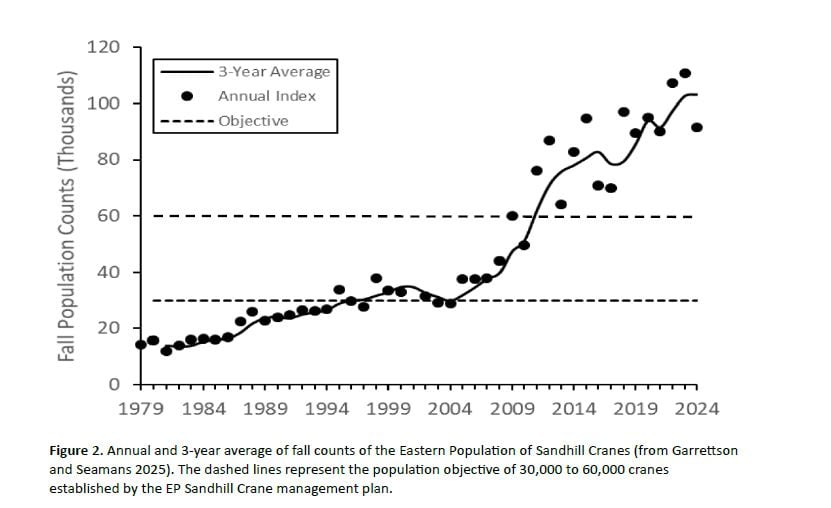 This graph shows the growth of Eastern Population sandhill cranes over several decades in breeding areas across North America. (Environment and Climate Change Canada)
While the bird population is thriving now, Kyle Elliott, an ornithology professor at McGill University, explained that wasn’t always the case.
“They were at the brink of extinction 100 years ago because of an unsustainable hunt,” he said.
But Elliott added that he’s not concerned about that happening again, thanks to the government’s strict rules for the fall season.
Hunters with a migratory bird permit and a small game permit will be able to hunt one bird a day, and can only possess one at a time, meaning someone who shoots a crane must consume it before being able to shoot another one.
“In many ways, it’s just kind of a really good story that we have the crane come back to such a level that we’re actually able to think about a hunt now,” Elliott said.
ECCC has also created a visual tool to help people distinguish sandhill cranes from other birds to prevent the risk of hunters targeting other species by mistake.
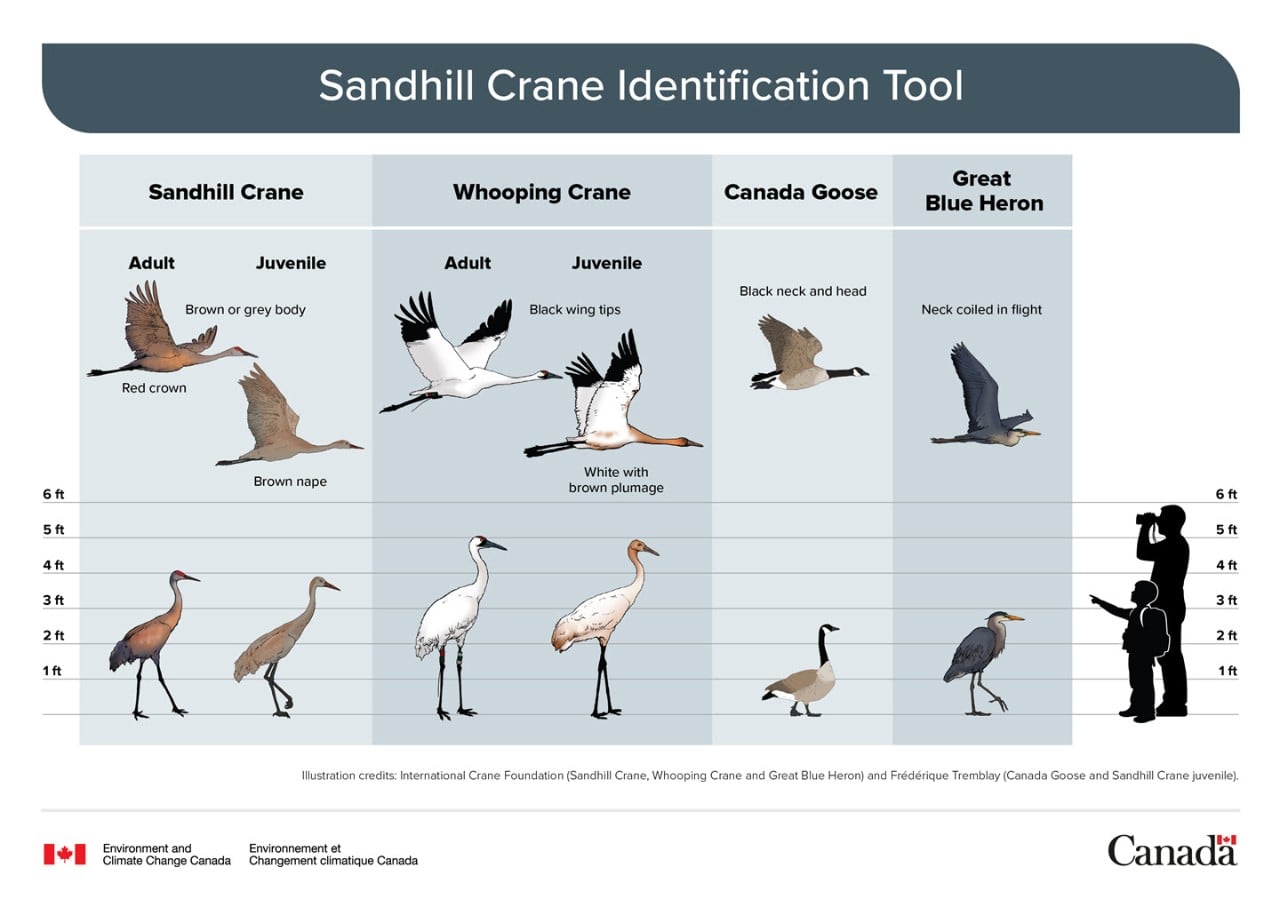 Environment and Climate Change Canada is sharing educational information ahead of the sandhill crane hunting season in September. (Environment and Climate Change Canada)The ‘champagne of birds’
ECCC’s assessment makes it clear that the harvest isn’t likely to reduce crane numbers by a large enough amount to prevent agricultural damage, and is instead intended to “bring more outdoors enjoyment” for hunters, adding that “cranes are known to be a very good table fare.”
But Wallace Metcalfe, president of the Union des producteurs agricoles for Témiscamingue, said farmers are still optimistic, even with the restrictions.
“There’s quite a few farmers that I’ve known that have had to reseed parts of their field because of sandhill cranes,” he said, adding, “I think a limit of one crane per day should do the trick for now.”
Farmers will also be able to request a Damage and Danger permit outside of the harvest period to manage the disruption caused by cranes. According to ECCC, the permits are issued to kill birds as a last resort and permit holders must report the number of cranes they kill.
ECCC data from 2024 shows eight permits were issued in Quebec that year, resulting in the deaths of eight cranes.
Wallace said those kills have allowed some in the region to sample their meat.
“I’ve been told they’re the champagne of birds,” he said.
Naturally, hunters are also looking forward to the new season. Marc Renaud, general manager of the Fédération québécoise des chasseurs et pêcheurs, told Radio-Canada he expects people from all over the province will attempt to hunt the birds, himself included.
But he added that the organization is reminding hunters to be respectful of farmers’ land.
“Unfortunately, some hunters arrive with the impression that the land belongs to everyone and that they can just walk into fields. To respect farmers, you have to knock on doors,” he said.
While the hunt is limited to two regions in Quebec for now, Tétreault said the Canadian Wildlife Service will evaluate the season after four years, as it does for every new hunt. He added that the possibility of an expansion isn’t out of the question.
“It could be that in 10 years we see more and more cranes, for example, in northern areas or farmlands around Montreal and we could expand if we [determine] that the harvest season is still sustainable,” he said.