
None will test the scrum in quite the same way or make the same non-stop physical demands in the collision warfare on both sides of the ball.
None will put the All Blacks in such hostile environments and no other opponent will so determinedly seek to exploit any hint of weakness they sniff out.
Of course, the next four weeks are a chance to make history, but their foundational purpose – given the way things shook out for the All Blacks earlier this year – is to provide a definitive assessment of where this team truly sits in its quest to win next year’s World Cup.
How much of Rennie’s rugby vision is fit for purpose? Can the leadership group hold everything together in the white-hot heat of a test series?
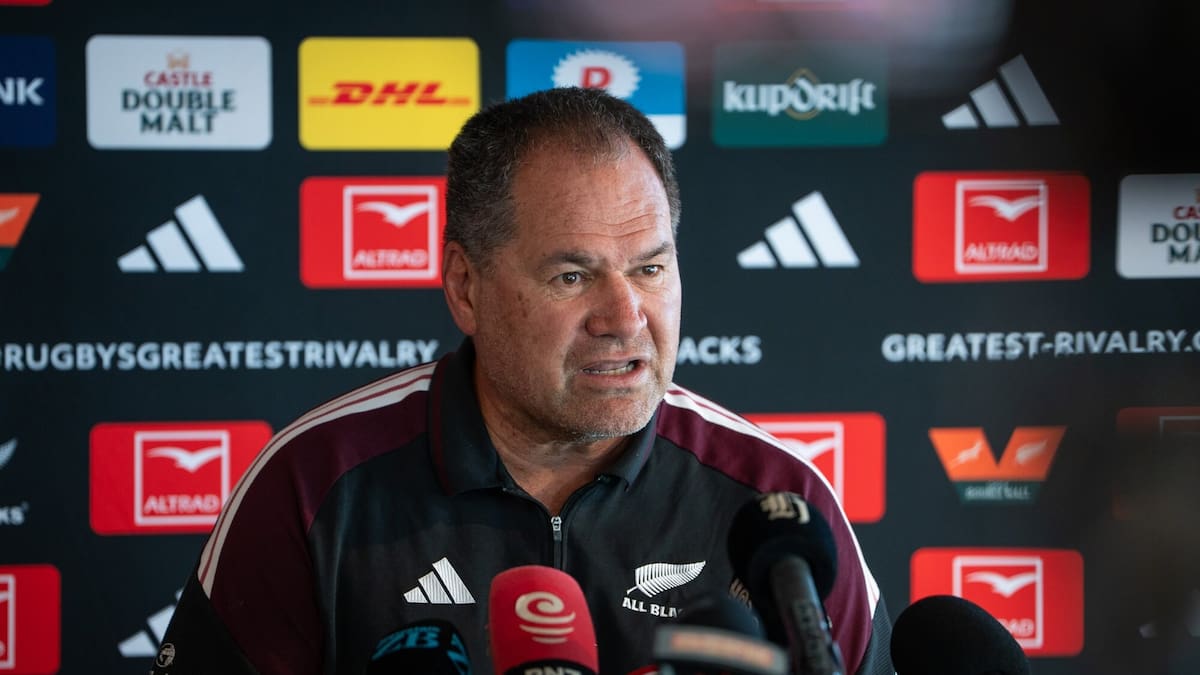
Dave Rennie has brought clarity to his role as All Blacks coach. Photo / Photosport
And who in the squad is up to it or not? Who has the potential to grow their game over the next 15 months and who has maybe hit the wall – taken things as far as they can?
Answers will be forthcoming because there is simply nowhere for anyone to hide in South Africa, and what can be said on the evidence to date is that the All Blacks have a readiness that it’s hard to imagine they would have, had they not made sweeping coaching changes.
The counterfactual of the All Blacks having persevered with former coach Scott Robertson is terrifying.
The wheels, that were barely on at the end of last year, would have come flying off by now and the carnage of seeing an All Blacks team prepared on three motivational video clips that served as the culture would have been catastrophic.
The word from those who were with the team last year is that the players were lost: disillusioned, a little disunited even.
There was no culture of ownership in the leadership group, no deep understanding of how they were trying to play, what their purpose was and for whom they were playing.
It was a team that didn’t have any accountability or a clear understanding of lines of responsibility.
All of which meant there was fragility everywhere: little cracks that good teams could easily expose as South Africa did in Wellington and England at Twickenham.
The arrival of Rennie hasn’t necessarily fixed everything, but the process of rebuilding has begun, and the All Blacks are, if nothing else, in significantly better shape to face the Boks than they would have been had the previous regime been allowed to carry on.
Ardie Savea, as the new captain, has taken ownership of the team and demanded his peers take responsibility for their performances, preparation and 24/7 conduct in a way that wasn’t happening before.
Selection has become consistent and aligned to a clearly defined strategy and that’s because it’s being done by three men with an average age of 69 – three men in Rennie, Neil Barnes and Graham Henry who have the sort of collective rugby experience that would be hard to fit in the Library of Congress.
From left: Jordie Barrett, Scott Robertson, Dave Rennie, Graham Henry and Ruben Love. Photos / Photosport
The return of Henry as an independent selector has been invaluable, for he remains in possession of one of the sharpest minds in the business and has been with the team in South Africa imparting genuine insight to the coaching staff and players – the sort of which only someone who has won the World Cup and revolutionised the internal dynamics of the All Blacks could.
How this is translating on to the field is apparent, too. The All Blacks scrum looks better, especially now that premier tight-head Tyrel Lomax managed 60 highly influential minutes in Pretoria and got his scrummaging eye in as it were.
There is clarity in their attack patterns and in Ruben Love they have found the kind of confident, clear, sprightly playmaker that everything can be built upon.
Jordie Barrett has been weaponised as a second playmaker, Will Jordan – who is expected to be fit for the first test – has grown into a decision-maker as well as a lethal finisher.
And there is a vast contingent of young locks and loose forwards who have been re-programmed to use their footwork to run into space and then take a blitzkrieg approach to cleaning out at the breakdown.
There is still a doubt about how well the All Blacks will cope with the aerial assault they will inevitably face at Ellis Park, and it is of course entirely possible that everything is blown apart by the power of the Springboks and that New Zealanders have to start wondering whether who coaches the team is irrelevant because the players just aren’t that good.
But that seems unlikely. Highly unlikely because there is an undeniable sense that this All Blacks team is going to be competitive, hold itself together for the series because it has a resilience and unity that will be forged rather than split in the furnace that awaits.
And what Rennie has really done in the past five months is restore hope and maybe even build a little optimism that while the series may not be a triumph, it certainly won’t be a disaster.