
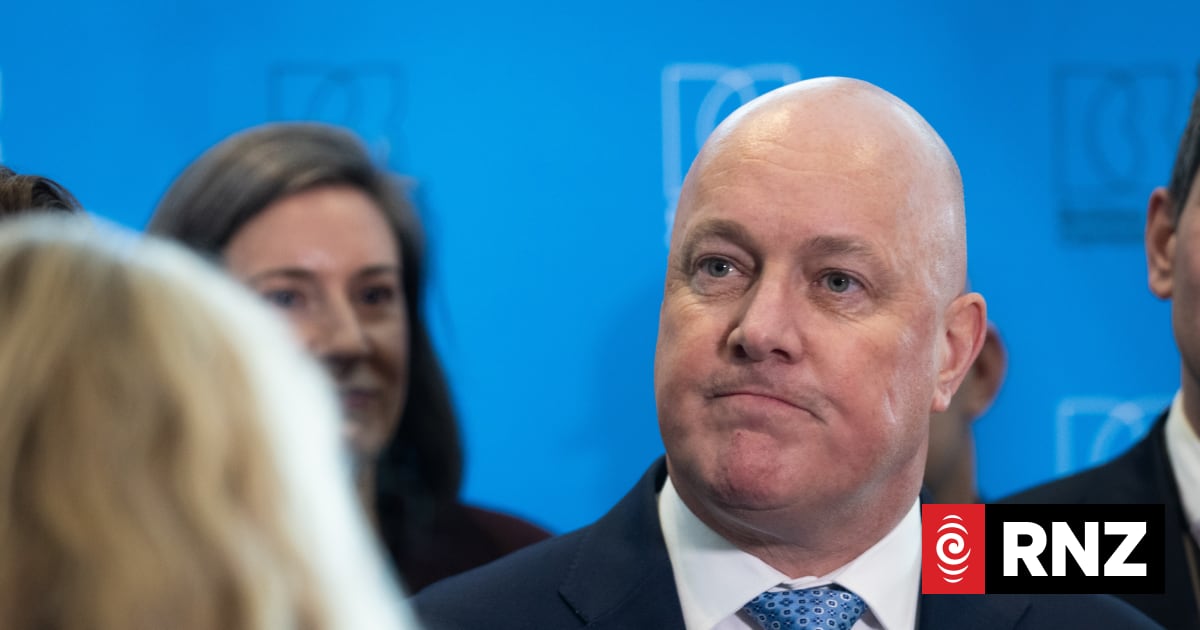
Weekly interview with Prime Minister, Christopher Luxon
Prime Minister Christopher Luxon says he is confident he has Erica Stanford’s full support for his leadership.
Stanford has backed the Prime Minister – insisting she didn’t challenge him for the leadership.
Four days after the confidence vote in her leader, five days after she walked through Wellington airport on her way to it and said nothing, the education minister held a last-minute media stand up on Sunday afternoon to explain why she didn’t give Christopher Luxon her backing in the lead up to last week’s emergency meeting.
Defence Minister Chris Penk ended up taking the fall for the botched leadership coup – losing his ministerial portfolios before quitting.
But there’s been some suggestions he was merely the numbers man for either Stanford or Chris Bishop.
Both deny that was the case.
Luxon told Morning Report on Monday he was in no doubt of Stanford’s backing, in both private conversations, and public statements.
“It’s a pretty intense situation when you turn up at an airport and you’ve got a media scrum that’s in full white heat mode. It’s not a surprise that some of my caucus will freeze,” he said.
“I know I have her full support – always have”.
When asked if he had spoken to Stanford about refusing to say if she supported Luxon prior to the caucus meeting and confidence vote, he said he didn’t need to.
He said Chris Penk was “working for himself”, and had launched a leadership bid in caucus that failed.
Luxon said he didn’t know what the vote was, but that he had the full support of his caucus.
He said the last week had been “pretty tough”, but the issue had now been resolved.
Luxon said he had been watching leadership challenges in Australia and the UK, and his approach was to get everyone – including backbenchers – to discuss their concerns.
“When we have someone who raises a leadership challenge, I’m sorry, we’re going to deal with that issue up front because I’m not going to go back to the behaviour that I observed in the National Party for four or five years… that’s not going to happen.
“And as a result, yes, it means that we have a distraction for a week. Yes, we have to bring everyone to town. Yes, we have to get in a room and have a real conversation, say what’s going on.
“In this case, it was pretty straightforward. One individual launched a challenge that failed. We moved on to a confidence vote and we went out of that room united.
“That’s important to me … that’s the best way to deal with it. I think as a leader, front it, deal with it and make sure everyone stays aligned so that we don’t get into dysfunction like we’ve seen in the past.”
Earlier, Housing Minister Chris Bishop told Morning Report that Penk had acted alone in his challenge of Luxon.
He said the community response to the leadership vote was one of “just move on”.
“Very strongly people saying it’s good you’ve got it sorted,” Bishop said.
“Get on with the job. This country’s got too many challenges to spend our time fixated on this sort of stuff.
“So just get on with it, and that’s exactly what I and the rest of the team are doing.”
Meanwhile, Bishop also spoke on the fast-track housing developments, and said he couldn’t legally pause them.
The mayors of Auckland and Queenstown had called for an immediate pause on developments, including one that lacks water infrastructure.
Bishop said that would require a law change.
Luxon said fast-track had been “hugely successful”.
“Think about the eight renewable energy projects that have got out the door and are actually happening that help our emissions profile,” he said.
“But more importantly, make sure we get a supply of electricity in this country. What we’re identifying in the housing side of it, not all, but some where councils can’t get that enabling infrastructure in place, there may well be a short-term process for stage one of a development.
“We get that up and running and moving, and before stage two comes into place, you’ve got to make sure we’ve got that enabling infrastructure in place.
“And this is just giving councils better tools to recover any growth-related infrastructure costs from future fast-track developments.”
Fast-track legislation has been really important to be able to get things done and built in a country that’s been abysmally slow and hopeless at getting things done, Luxon said.