
The government has announced a detailed business case for a new Waitematā Harbour crossing in Auckland.
That’s despite an investment case already having been completed by the Transport Agency (NZTA) – including value engineering and a barge doing seabed testing – just three months ago.
Announcing the new business case at the weekly post-Cabinet briefing on Monday, Transport Minister Chris Bishop said it was unacceptable weight restrictions and a lack of bus lanes were restricting use of the current Harbour bridge.
He said the bridge formed part of the busiest corridor on state highways across the country.
But despite the NZTA’s study recommending a tunnel, the ministers said more work was needed before Cabinet could select a preferred option.
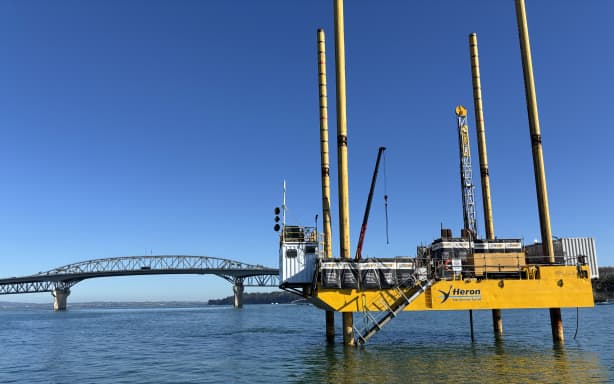
A jack-up barge doing seabed testing in the Waitematā harbour last year.
Davina Zimmer
“Previous governments have gone out and announced what they are going to build before they have done the work required around how much it will cost, how they are going to pay for it, and whether the project is deliverable. This Government does not intend to make the same mistake,” Bishop said.
“We need Auckland – New Zealand’s economic engine room – connected, productive, and set up for growth and prosperity. The case for a new crossing is strong, and we are committed to delivering it,” Bishop said.
“The WHC (Waitematā Harbour Crossing) project will likely be the largest and most expensive infrastructure project ever undertaken in New Zealand. It is imperative that we get it right because New Zealand’s fiscal position, economic performance, and reputation as a modern, functional, first-world country depends on it.”
The work would be carried out by an independent “senior responsible officer and completed some time in 2027.
‘Study about a study’ – Labour
Labour leader Chris Hipkins described the media conference as an “announcement about an announcement about a study about a study”.
“They can’t make a decision about a decision. These are not serious people. They promised real progress, they haven’t delivered.”
Bishop indicated Labour’s Tangi Utikere had been briefed on the decisions earlier in the morning.
“We’re not politicising it. It would have been easy to stand up and announce we’re building a bridge or a tunnel, and then everyone would go ‘oh, this is very exciting’, but we’re not doing that … it’s amazing what happens when you do the right thing,” Bishop said.
Other than the briefing to Utikere, Hipkins said he had not heard of other bipartisan consultation or discussion on the harbour crossing from National this term but he would need to check.
However, he said Labour would not cancel the government’s business case, saying he thought the unanswered questions were what the NZTA investment case had been aimed at solving.
“They’ve commissioned it, we’re not going to stop it … I thought the detailed business case was what they committed to doing two years ago. They clearly haven’t done that. So we’ll continue what they have now commissioned.
“One area where I would agree with Christopher Luxon on is there’s been way too much flip-flopping and chopping and changing of priorities in this area … if the National Party was true to its word, it wouldn’t have done that itself two and a half years ago or three years ago.
“We’ve extended a bipartisan spirit to the government on all infrastructure issues through the term of this Parliament. Thus far, on their side, that’s involved them saying what they want to do and telling us we should agree with it. That isn’t what bipartisanship looks like.”
Bishop also said Cabinet had agreed to commission another study into Meola Reef – as backed by Auckland mayor Wayne Brown – if the council was interested, and willing to pay half the Meola study’s cost.
The council would be invited to take part in the Meola study.
Ministers would also consider a market-led proposal for an “innovative construction methodology” to upgrade the current Auckland Harbour bridge.
Bishop said NZTA had done good work to get the project to this point but the government believed the project should be directly responsible to ministers.
The SRO would be directly answerable to the Finance, Transport and Auckland Ministers as well as Cabinet, and would be recruited globally to find “someone with the expertise and experience to deliver”, he said.
“Every country that has built a megaproject this size has learned the same lesson: they cost more and take longer than the first estimates suggest. Not necessarily because of the engineering, but because of scale, duration, and the number of approvals and decision-makers involved along the way,” he said.
“That’s a governance problem, and it has a governance solution.”
Bishop said the Meola Reef option had been looked at “many times in the past before and discounted as unachievable” but Cabinet had agreed to commission a further study “in the spirit of good faith” if the council desired it.
The proposal to strengthen the existing bridge had come from a “reputable international consortium”, and officials had recommended it be advanced and included as part of the detailed business case.
“As Mayor Brown has said, projects don’t go wrong – they start wrong. I couldn’t agree more, that’s why we are making sure we set this project and, by extension, Auckland up for success,” Bishop said.
Bishop indicated actual construction would take anywhere between five and nine years, possibly longer.
Tunnel or bridge?
Prime Minister Christopher Luxon said the government was not set on whether a new crossing would be a tunnel, a bridge or some other option.
“We’re saying let’s go back, let’s look and understand the lay of the land, let’s literally get on board the council, let’s get on board as many of our bipartisan friends across the aisle that we possibly can and take them with us because we know this will be a long-run project over multiple years, potentially multiple governments, and we want to get that right.”
Luxon said John Key’s government in 2016 had presented “a lovely A3 glossy picture” of a tunnel, and the last Labour government had done the same, but New Zealand was in the top 10 percent in the OECD for spending and the bottom 10 percent for delivery, asset management and renewal.
“We are genuinely trying to do this differently. You can’t just sit in a desk, draw some squiggles over the line, do a bit of an AI artist impression and say we’ve got a plan,” he said.
“We can chuck numbers out there but honestly when it’s plus or minus billions of dollars, what’s the point … lots of discussion, lots of debate, lots of AI-generated pictures and we kid ourselves and it’s fake activity, nothing’s happening – and we’ve got to get it done.”
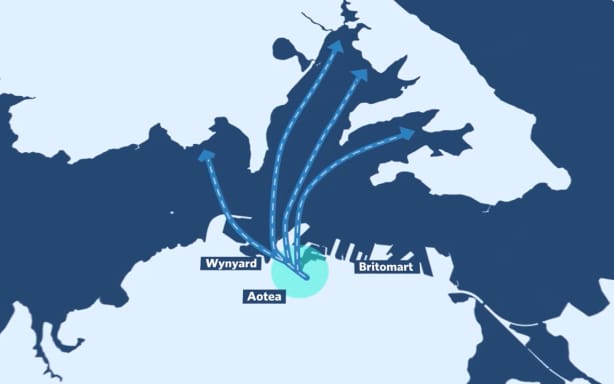
A visualisation of NZTA’s proposed Auckland habour crossings.
Supplied
Bishop said the previous investment cases still left unanswered questions including how much it would cost, whether it should be tolled, how it would be delivered, and when it might open.
“Rather than leave those questions unanswered to make a well-informed decision, we’re actually going to do international best practice and answer those questions before we make a decision.”
That was despite him saying when announcing NZTA’s investment case in October 2024 that the report would be a “detailed analysis of the highest-performing bridge and tunnel options”.
“They have done that. The board has considered considered both those proposals and their preference is a tunnel … but they are not the experts in the highly complicated and complex governance structures, management structures, and the funding and financing options to deliver this.”
He was “confident” NZTA’s work had “significantly advanced” the work towards another harbour crossing but the government needed to know “a lot more” than could be gleaned from desktop studies.
Asked how the government had already spent more than $100m on consultants to scope such projects and those questions remained unanswered, he said that was because it would be “the most expensive and complicated infrastructure project ever in New Zealand history”.
The Meola Reef option would be capped at $1m, Luxon said.