
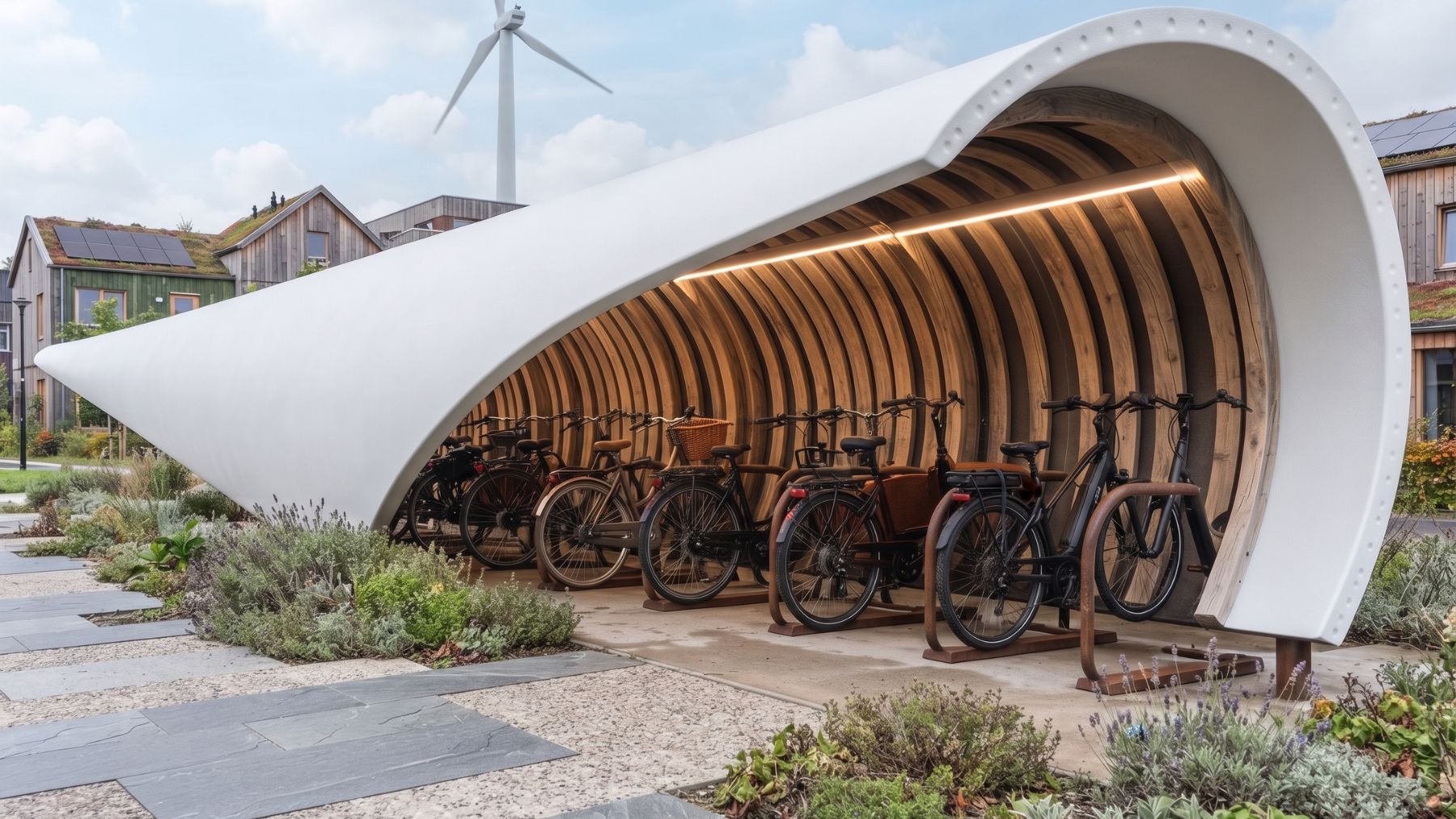
The thing parked over the bicycles is the wrong size for a building.
It is too long, too smooth, and it tapers the wrong way, thick at one end, thin at the other.
Rain runs off it and does not pool.
At the open end you can see straight into the hollow, where a sawn edge shows an inch of white and an internal wall running down the middle.
It was built to spin, and nobody could think of anything else to do with it.
Why that one piece defeats a shredder
Nearly all of a turbine is ordinary industrial metal. Steel tower, cast iron hub, copper windings, and a scrapyard knows what to do with every ton of it, which is where the 85 percent figure comes from.
The blade is the exception, and it is a chemistry problem, not a logistics one.
A blade is glass fiber set in cured epoxy. That resin is a thermoset, meaning the molecules have cross linked into one continuous network, and unlike the polyethylene in a milk bottle it cannot be melted and poured into a new shape. Heat does not soften it. Heat chars it.
Shred it instead and you get short fibers in dust, a filler worth less than the electricity used to make it. So the material has almost no salvage value.
But the shape does, and that is the part everybody skipped. A turbine blade is a hollow beam engineered to hold its own form in a gale, so cut a section out and you are already holding a self supporting arch, made to a standard no bike shed has ever needed.
Related
What it took to cut one
The engineer who did it works at the port, and the first obstacle was not the saw. No drawings came with the blade, so nobody knew what was inside it or where the load went.
So he built a model at home, in cardboard and wood, in his own time, until the proportions worked.
The real cut had to satisfy two conditions at once. Enough internal material removed for bicycles to fit underneath, and enough shell left that a hollow composite hull in a coastal wind stays where it was put.
A local blacksmith and a diamond drilling firm did the physical work. “Instead of chopping a wing” into small pieces and using it for fuel, the engineer said, you might as well use it for something else.
Where the number comes from
The shelter stands at the Port of Aalborg, and the blade was donated rather than bought, which tells you what a used one is worth.
The supply is not the constraint. Europe retires roughly 27,000 tons of blade a year as the turbines put up in the early two thousands come down, and the figure climbs from here.
Others have reached the same conclusion independently. A playground in Rotterdam was built from five damaged blades, footbridges have gone in across Ireland, and an Ohio company sells benches and planters cut from blade sections at between 3,500 and 9,500 dollars apiece.
That last one matters more than it sounds. It is the first sign that a blade section can carry a price tag instead of a disposal fee.
What this does not fix
The honest criticism came from inside the field, and is hard to argue with. Reuse of this kind delays the problem rather than solving it, buying time while a genuine recycling route is developed.
Related
The arithmetic backs that up. There are more blades coming down every year than there are bicycle shelters, playgrounds and footbridges anyone could want, and a shelter is a parking space for the material rather than a destination.
Then there is the moving. A blade is enormous and heavy, and getting one to a site is a specialist job before a single cut is made, which limits how far from a port or a wind farm this makes sense.
None of that makes the shelter pointless. It makes it a demonstration, and the build reads like one.
What a shape is worth
Almost every attempt at this has gone after the material. Grind the composite, burn it for energy, dissolve the resin, recover the fiber, and each route spends money to get back something worth less than what went in.
The port went the other way and kept the geometry.
That is a different kind of recovery, the same instinct that puts a second job on a surface going down anyway, the way a solar highway earns twice from one road. The difference is that the engineering here is already paid for, sitting in an object nobody wanted.
The reported carbon numbers for these builds are startling against pouring concrete or welding steel for the same job, and the wider survey puts several side by side.
Twenty years of turning in the weather, and the thing turns out to be very good at rain. Somebody just had to stop asking what it was made of and start asking what it already was.
Read the whole thing?
Get the week’s signal, not the noise
Our sharpest reporting on energy, climate and nature — free, once a week.