
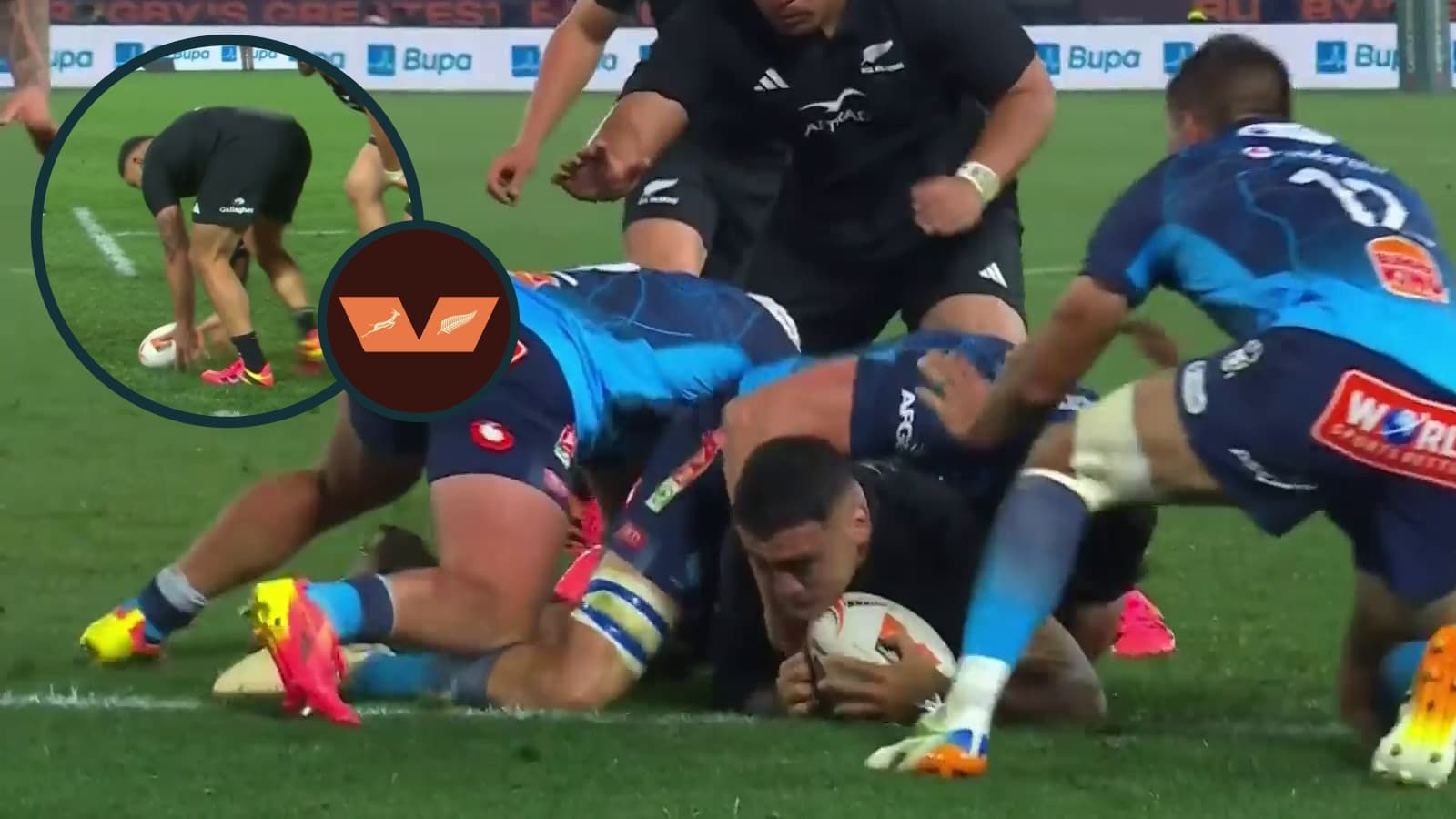
Codie Taylor’s first try against the Bulls in the Rugby’s Greatest Rivalry tour match at Loftus Versfeld has proven to be controversial despite being perfectly legal; let’s discuss.
In the 29th minute of the match, referee Nika Amashukeli issued a yellow card to tighthead prop Francois Klopper, reducing the hosts to 14 men. From the ensuing penalty, tour captain Taylor smartly opted for the scrum, forcing the Bulls to make a change to their pack.
The All Blacks dominated the set-piece, winning another penalty, and instead of doubling down on the scrum, the skipper decided to tap and go, and here’s where the controversial play occurred.
Codie Taylor’s first try against the Bulls
Taylor places the ball on the ground, dummies a tap, which triggered the Bulls‘ defence as Juann Else and JF van Heerden shot up. As the duo and some of their teammates started to move back, the hooker quickly tapped the ball and darted towards the line, managing to muscle his way over despite the efforts of Van Heerden.
“He can do that, I promise you,” Amashukeli said in reply to the Bulls’ pleas that Taylor’s actions were illegal, as he misled the opposition, making them believe that he had tapped the ball initially.
The Georgian referee’s decision was spot on, as there is nothing in the World Rugby laws that explicitly stops a player from dummying a tap. In fact, one of the few times when players cannot mislead the opposition is at the back of a ruck. Law 15.16 (g) reads, “Players must not: Take any action to make opponents believe that the ruck has ended when it has not.”
However, the same does not apply to quick taps. So by the letter of the law, Taylor’s actions were lawful, and Amashukeli made the correct decision in awarding the All Blacks the try.
Still, the try didn’t sit right with many fans and pundits, and understandably so, but what could he have done differently? Well, Amashukeli would have been well within his rights to sanction Taylor as per law 9.27: “A player must not do anything that is against the spirit of good sportsmanship. Sanction: Penalty.”
Smart Play By Codie Taylor.
Bulls plan in the first half rush d, over eager, shut the ABs down at every opportunity. pic.twitter.com/AQZop8xI3O
— Scoop 🐻 ☕️ (@Rugby_Scoop) August 16, 2026
That would be a harsh sanction on the All Blacks’ hooker, perhaps too harsh, but there was an easy solution: Amashukeli could have simply blown his whistle, allowed the defence to reset, and made it clear to Taylor that he couldn’t do that, but given the front-rower the opportunity to retake the penalty.
Again, what Taylor did was perfectly legal according to the lawbook, but it certainly didn’t feel in the spirit of the game or the Greatest Rivalry tour. Ordering the All Blacks to retake the penalty would have been a clever refereeing approach and would have killed off any controversy around the decision.
In doing so, Amashukeli would have shown a real feel for the game, the occasion and the tour. Again, the decision he made was not incorrect and had little bearing on the final outcome of the game, but Taylor’s actions didn’t feel in the spirit of the game. Perhaps the Georgian was wary of comments from New Zealand, slamming the officials for being overly pedantic so far this tour.
Sticking to his decision
While we have been critical of Amashukeli around this decision, the referee’s performance in Pretoria was rather solid and he deserves credit for his decision on Ruan Vermaak’s try.
The Bulls lock hammered into the All Blacks defence and looked to have been stopped short before he reached out and dotted the ball down.
As former Springboks flanker Schalk Burger said on SuperSport’s commentary of the game, ‘nobody was in a better position to make this call’ on whether Vermaak placed the ball on the line or just short.
The referee officially reviewed the decision – perhaps after being alerted by his officiating team – with TMO Eric Gauzins telling Amashukeli that he needed to overturn his on-field decision of a try after reviewing several angles.
“The ball is grounded short, and then it’s a knock-on,” Gauzins said.
Assistant referee Karl Dickson replied: “It’s either a try or it’s short.”
Want more from Planet Rugby? Add us as a preferred source on Google to your favourites list for world-class coverage you can trust.
Ultimately, Amashukeli disagreed with his TMO and stuck to his guns: “With the angle I’ve seen, the on-field decision is a try. I don’t think that the angles we’ve seen provide clear evidence to overturn this try – so my decision is try.”
As Burger stated, the referee was in the best position to make the decision, and while we could have done without the review, Amashukeli deserves credit for standing firm on what he saw in real time.
READ MORE: Rassie Erasmus delays Springboks team announcement for All Blacks’ series opener