
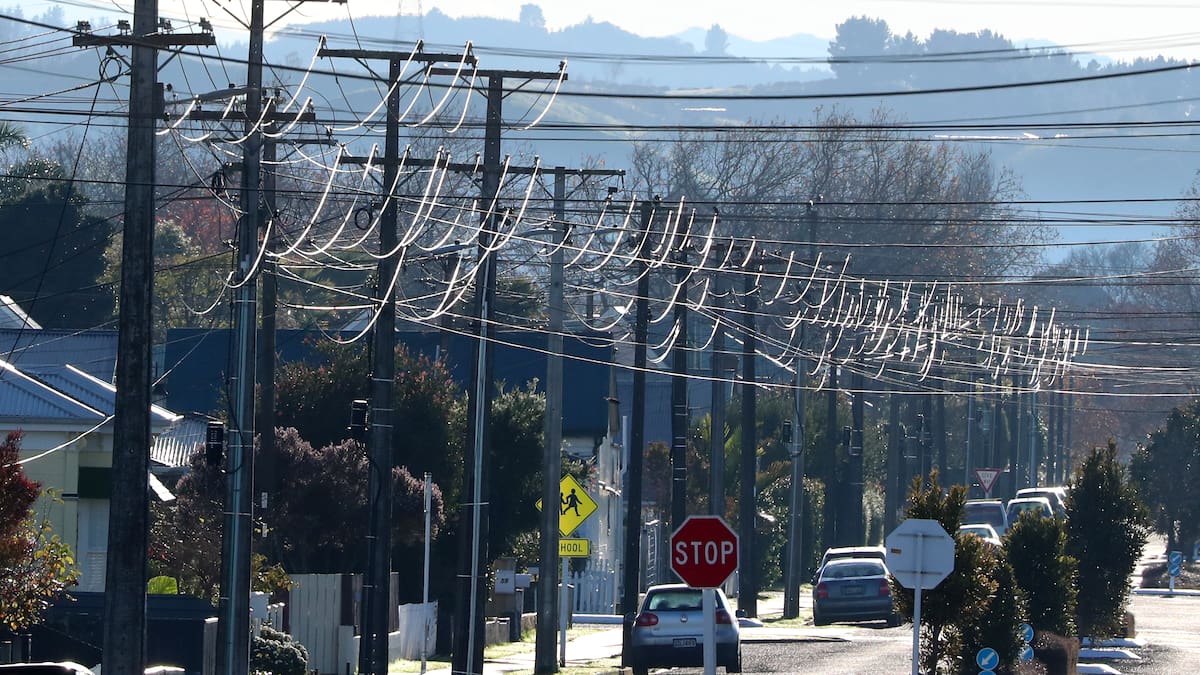
However, Powerco’s lines charges, regulated by the Commerce Commission, have increased.
Powerco has upped its lines charges to consumers, in line with regulated Commerce Commission price caps. Photo / Powerco
Last month the company, which doesn’t publish full annual results, reported earnings before interest, tax, depreciation, amortisation and fair value adjustments of $415m in the year to March 31, up from $341m the previous year.
On April 1, 2025, the Commerce Commission approved an allowable 45% price increase for electricity distributors in the five years to 2030.
In the first half of this year, power bills across New Zealand households and small businesses rose by an average 6.8%, driven largely by higher lines charges (covering distribution companies and the transmission company Transpower), the Electricity Authority reported last week.
There was an 8% price increase in 2025.
Taylor said the price rise “supports higher levels of investment for reliability and growth, as well as adjusting or changes in interest rates and operational costs”.
Powerco is owned by Australian interests: 51% by funds managed by Sydney-based asset manager Dexus and 49% by the major pension fund, Australian Retirement Trust.
Margaret Cooney, chief operating officer of electricity retailer Octopus Energy, said PNZHL’s profit increase was also likely a function of the increased revenue cap allowed by the commission and that Powerco’s prices are in the “upper mid pack” of lines companies.
Since the regulator lifted the price cap, Powerco’s prices have risen by about 8% according to Cooney, which she said was consistent with the regulator’s allowances.
Octopus Energy chief operating officer Margaret Cooney says rising profits and prices are a “rough combo” for power consumers. Photo / Mark Mitchell
She said increased profits and prices are a “rough combo” for consumers, but those who shift their usage to off-peak prices and who (if they have electricity generation) shift their export to the grid to peak demand times can shave their costs.
She also said Powerco is working on how consumer batteries and demand management can be better rewarded, which she described as encouraging.
The bulk of Powerco’s business is in electricity; its lines connect the transmission network, operated by Crown-owned Transpower, and electricity-using customers, largely made up of households and businesses.
Its network includes Coromandel, Bay of Plenty, South Waikato, Taranaki, Whanganui, Manawatū and Wairarapa.
Likewise, it receives natural gas from the network operator, First Gas, and distributes it through a reticulated grid to end customers.
Reticulated gas and electricity lines businesses operate as regional monopolies and are regulated across areas including revenue, pricing and reliability.
NZX-listed Vector, the country’s largest gas and electricity distributor, reports full-year results on Tuesday.
New Zealand’s high electricity prices have become a political hot potato in recent years.
New Zealand First and the Green Party are taking plans to break up the country’s large electricity generator-retailer businesses into the November election.
Lines companies such as Powerco form a large part of the electricity cost for households, but have attracted relatively little attention; their charges amount to some 25% of residential electricity bills.
The Frontier Economics report to the Government last year on the electricity market recommended forced amalgamation of the country’s 29 lines companies, which range enormously in size.
It suggested a reduction to five large distribution firms to improve efficiency, investment and pricing.
However, the Government rejected this as expensive and complex, opting for smaller tweaks to the system.
Stay ahead with the latest market moves, corporate updates, and economic insights by subscribing to our Business newsletter – your essential weekly round-up of all the business news you need.