
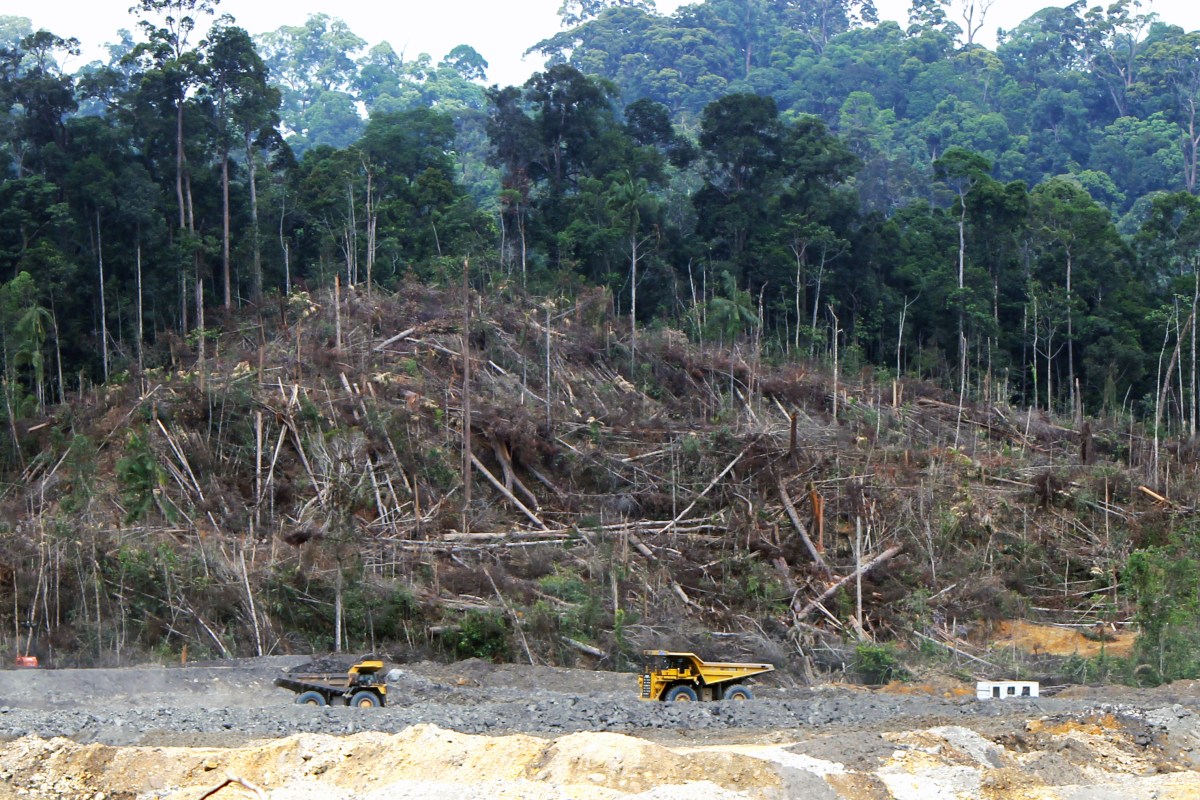
A tax on food uses of vegetable oils could insulate global vegetable-oil prices from U.S. biofuel policy, thereby eliminating incentives for further deforestation.
This year, the federal government requires that more than 10% of diesel used in the US be biofuel. To meet this requirement, Americans will have to use almost 7 billion gallons of biomass-based diesel (BBD), up from 4.3 billion gallons in 2025. Unlike corn-based fuels such as E85, most BBD is made from vegetable oils such as soybean or palm. The BBD mandate stems from the Renewable Fuel Standard, a 2007 law that requires some gasoline and diesel to be replaced with biofuels.
In a recent research paper, Tzu-Hui Chen, Rich Sexton, and I find that using vegetable oils to make biofuel has generated more carbon emissions than regular diesel because it caused deforestation. In this blog, I propose a way to mandate biofuels without causing deforestation, although implementation would face practical and political barriers.
 Deforestation in Indonesia. CC by 2.0 via Wikimedia Commons.
Carbon Emissions from Biofuel
When we use a fossil fuel, we take carbon that was stored underground and put it into the atmosphere.
When we use a biofuel like BBD, we take carbon from the atmosphere and put it back into the atmosphere. As soybeans grow, they suck carbon dioxide out of the air through photosynthesis. Burning biofuel made from soybeans sends that carbon dioxide back into the atmosphere.
Now, the biofuel system is not completely circular because it generates additional emissions through things like operating a tractor on the farm, making fertilizer, and processing soybeans into fuel. Still, based on a comparison of photosynthesis to fossil fuel extraction, biofuels appear great for the climate; they make fuel from carbon that is already in the atmosphere rather than adding new carbon from underground.
Some of you are yelling at your screen right now because I excluded land from the above narrative. Growing crops for fuel also requires land, and land contains carbon. For example, when farmers clear forests to grow crops, the carbon in the trees and soil ends up in the atmosphere.
Accounting for land-use change switches the biofuel narrative: biofuels transfer carbon from forests and soils into the atmosphere, whereas fossil fuels transfer carbon from underground into the atmosphere. That sounds bad for biofuels.
The paper I mentioned above finds that, after accounting for induced deforestation in Indonesia and Malaysia, BBD from soybeans is worse for the climate than regular diesel. Thus, this is an example of a US policy that increases carbon emissions by altering economic activity in other parts of the world.

Can US policy makers prevent people in other countries from deforesting in response to US biofuel policy?
The theoretical answer is yes, but only if biofuel policy does not increase vegetable oil prices. No increase in prices means no incentive to clear land to produce more vegetable oil.
Of course, long-time observers understand that biofuel policies are driven by agricultural interests and not by climate-policy advocates. Biofuel supporters see their purpose as raising crop prices for the benefit of corn and soybean farmers. This creates a dilemma. The political backing for biofuels relies on increasing crop prices, but avoiding deforestation requires that crop prices not increase.
Here is a solution to the dilemma: (i) tax the use of vegetable oils in food, and (ii) send the proceeds of the tax to farmers. The tax needs to be large enough to reduce food use by the same amount as the increased biofuel use so that total demand does not change and therefore prices do not change.
The graph below illustrates this idea using supply and demand curves. A biofuel mandate shifts the demand for vegetable oil to the right. A food tax shifts the demand for vegetable oil down.
 Created by ChatGPT
Successfully enacting this policy would require knowledge of the elasticity of demand for vegetable oils. If demand were elastic, then a small tax would cause food consumers to cut back substantially. If demand were inelastic, then a large tax would be required.
How large would the tax need to be?
In a different recent working paper, Tzu-Hui Chen, Rich Sexton, Andrew Swanson and I estimate a demand elasticity of -0.1 for US soybean oil. This estimate is in line with recent global estimates, and somewhat lower than older estimates for the United States. A lot of vegetable oil is used as a minor ingredient in processed food, so it is reasonable that demand from those users could be quite inelastic.
In 2025, the US used 23.5 billion pounds of crop-based vegetable oil for food and 19 billion pounds for biofuel (labeled as industrial in the figure below). In 2026, USDA predicts an additional 5 billion being used for biofuel. To offset the effects of this increase, we would need to reduce demand from food consumers by 5 billion pounds (about 10% of total consumption). An elasticity of -0.1 means that a 10% demand reduction requires a 100% price increase. If the demand elasticity were larger, then the tax would be smaller.
 I made the soybean oil use figure with this R script and the help of Claude Code.
The price of vegetable oil in 2025 was 50c per pound. A 50c per pound tax on food use would raise an expected $12 billion per year. Coincidentally, this is the same amount that the Trump Administration recently proposed to send farmers to compensate for economic losses due to tariffs and other cost increases.
The graph below shows US consumption of the four major oils. Soybean oil is 75% of US vegetable oil consumption, but the tax would need to be levied on all oils to prevent food users from avoiding the tax by switching to an alternate oil such as palm. Such switching would raise the price of the alternate oil and in response its producers would deforest land to increase production.
 I made the soybean oil use figure with this R script and the help of Claude Code.
Practical Realities
I doubt this proposed tax would garner enough political support to be implemented, although Health Secretary Kennedy’s hostility to “seed oils” in food suggests that there would be a political constituency for it. The tax would also be costly to administer. For example, to make sure food processing firms didn’t move offshore to avoid the tax, you would need to tax the vegetable oil in imported processed foods.
Nonetheless, working through the logic of this proposed tax lays bare the tradeoffs in biofuel policy. Biofuels induce deforestation when they induce cropland expansion. We can avoid cropland expansion if the demand for crops to use in biofuel is met entirely by reductions in demand from other users, rather than by increases in supply.
In short, vegetable-oil based biofuels can benefit the climate, but only if we let them take food out of our mouths.
Follow us on Bluesky, LinkedIn, and our new Instagram. Also subscribe to our email list to keep up with future content and announcements.
Suggested citation: Smith, Aaron. “How to Prevent Biofuels from Causing Deforestation ” Energy Institute Blog, August 17, 2026, https://energyathaas.wordpress.com/2026/08/17/how-to-prevent-biofuels-from-causing-deforestation/