
Hughes spoke with police twice in the days after Hanna’s death and recently prepared an affidavit in advance of the coronial inquest into Hanna’s death, which is now in its third week at the Newmarket Court Hearing Centre.
But she was never called to give evidence at Polkinghorne’s high-profile 2024 murder trial, even though she was the first person except for her brother at the scene, having beaten first responders.
Polkinghorne, who also didn’t give evidence at his murder trial, testified for the first time last week.
In both the criminal trial and the coronial inquest, Polkinghorne and his lawyers have insisted that Hanna died by suicide, while police and prosecutors have alleged he killed his wife then staged the scene to look like a suicide.
But after more than eight weeks of testimony and arguments in the High Court at Auckland, jurors appeared unconvinced by both theories.
“Most of the people on the jury do not think there is enough evidence to support Pauline having committed suicide,” the jury foreman wrote in a note to the judge shortly before the group reached a verdict.
“However, some people on the jury do not think that the Crown has supplied enough evidence that we can answer yes to the question, ‘Has the Crown made you sure that Dr Polkinghorne caused the death of his wife, Ms Pauline Hanna, by intentionally strangling her?’”
The task of determining the circumstances of Hanna’s death has now passed to Coroner Tania Tetitaha. She has limited the scope of the hearing to the hours immediately before and after Hanna’s death but has the option to schedule follow-up hearings if she feels that more areas of evidence need to be explored.
Hughes, who testified for less than an hour today, said when she got to the home her brother could not speak.
“I walked past Pauline’s body to get a pillow to put under her head,” she recalled, adding that she then grabbed another pillow to put underneath Polkinghorne’s bare knees as he cradled his wife. “Between the two of us, we lifted her head and wiggled the pillow under her head.
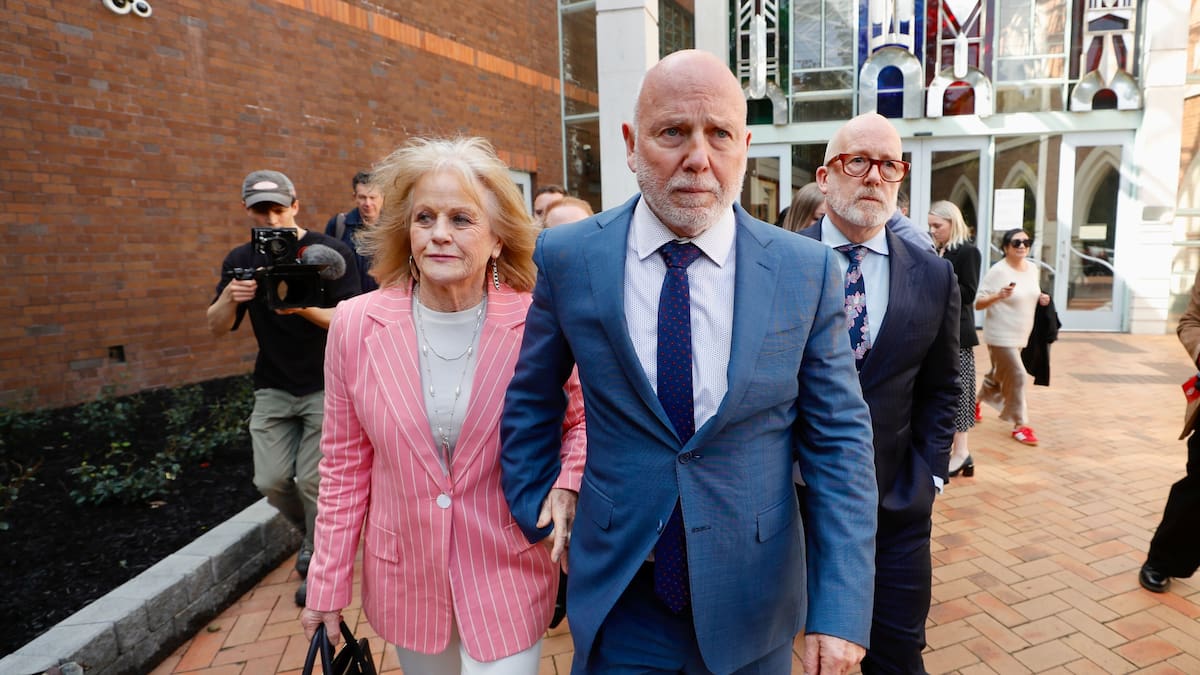
Arriving at the High Court in Auckland for day 30 of his murder trial in September 2024, Philip Polkinghorne is flanked by his sister, Ruth Hughes. Photo / Michael Craig
“Philip kept saying her hands were cold.”
Her brother, she said, “kept howling”.
When paramedics later arrived, one carrying an oxygen tank, the retired nurse told them they wouldn’t need it. It was too late.
Sometime during that initial interaction with her brother, Hughes noticed that he had a scrape on his forehead.
Prosecutors made a big deal of the injury at Polkinghorne’s murder trial, suggesting it was an indication that a struggle had taken place.
Hughes, meanwhile, seemed certain today that it would have been caused by the “sharp” stairs in the entryway.
“It’s in the direct line of him putting his head down to cradle Pauline,” she said. “It’s an assumption, but it seems logical.”
Hughes acknowledged she couldn’t remember every detail about the scene.
“It was so catastrophic, it’s hard to recall things,” she explained. “It was just utterly devastating.
“It’s something I never, ever wish to experience again, seeing my brother in the state he was in [and] Pauline.”
She described her relationship with Hanna as “very light” but had no negative words to say about her.
A photo of Pauline Hanna has sat on a table in court during the coroner’s inquest into her death.
“She adored Philip, and he too,” she said. “We used to always say she was the glue for their family.”
Hughes’ testimony was followed by that of Melbourne-based pathologist Dr Joanna Glengarry, the final witness of this phase of the inquest.
Glengarry, who reviewed autopsy documents as well as the testimony of four pathologists who gave evidence at the criminal trial, said the pathology findings were “essentially neutral” as to whether Hanna’s death was the result of homicide or suicide.
Her initial feeling, however, was that it was a suicide based in part on a lack of evidence for an assault, she said. Suicide is how she would have reported the death had she been the initial medical examiner assigned to the case.
Crown Solicitor Alysha McClintock reviewed with Glengarry four sets of minor injuries noted during the autopsy: a cluster of nose abrasions, an abrasion to her back, a cluster of bruising on her right arm that might be the result of a strong grip and a contusion on her scalp above her right ear.
If someone was assaulted prior to death, you would normally see more injuries as a result of struggling, the expert said. But she agreed with McClintock that there might be fewer injuries if a person was already incapacitated in some way when they were killed.
Polkinghorne has suggested his wife drank a bottle and a half of wine on the night leading up to her death. She also had sleeping medication zopiclone in her system, which could have made her slower to react if awakened.
A psychologist who gave evidence at the murder trial described sleeping pills and alcohol as a dangerous combination that could increase the risk of suicide.
A suppression order that was put in place ahead of the coronial inquest prevents the media from reporting the alleged mechanism of suicide, meaning a large swath of the hearing has been kept secret to the public at large aside from those in the courtroom gallery.
Coroner Tania Tetitaha. Photo / Corey Fleming
As today’s hearing ended, Coroner Tetitaha said she would prefer to have closing addresses in person in addition to written submissions. No date has yet been set for the addresses, but Tetitaha said she anticipated a hearing – either in Auckland or Whangarei – some time between October and December.
The submissions, she said, should include opinions regarding whether a second phase of the inquest should be scheduled to call more witnesses. Because she already had transcripts from the trial, she would only be interested in new evidence, she said.
Craig Kapitan is an Auckland-based journalist covering courts and justice. He joined the Herald in 2021 and has reported on courts since 2002 in three newsrooms in the US and New Zealand.