
Black holes grow in two main ways: by swallowing gas or by merging with other black holes. Gas accretion is usually the dominant process, but in certain eras of cosmic history, mergers may play a bigger role.
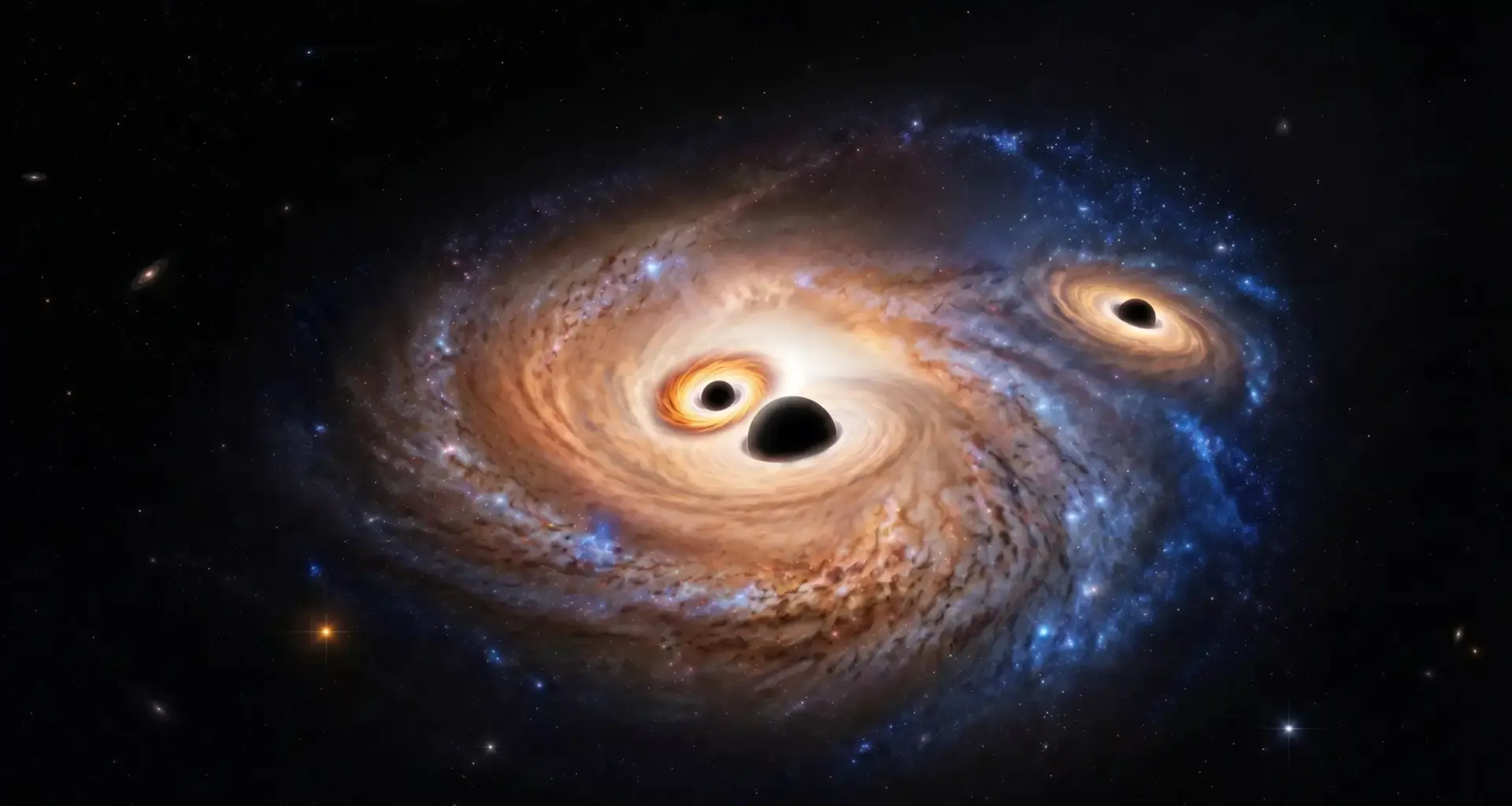
Using the James Webb Space Telescope (JWST), astronomers have spotted something extraordinary in a distant galaxy called J0148‑4214, seen as it was more than 12 billion years ago. They detected multiple broad Hydrogen emission regions, a clear indication of actively feeding black holes. The data show not just one but three huge black holes undergoing accretion, within a tiny region just 1.7 kiloparsecs across.
Hannah Übler, research group leader at MPE and lead author of the study, said, “This is the first evidence of three active black holes in a single galaxy in the distant Universe. Two of them are located in the galactic center and are separated by only 620 light-years in projection. A third black hole is located in the outer region of the galaxy, at a distance of approximately 5500 light-years from the center.”
“It suggests that processes in the early Universe were efficient at bringing massive black holes together, setting the stage for the massive black hole mergers we expect to detect with future gravitational wave observatories.”
Scientists discover how giant black holes grow through cosmic collisions
Astronomers identified the three black holes in galaxy J0148‑4214 by spotting their spectral “fingerprints”, hydrogen atoms racing at high speeds under the pull of immense gravity. In the galaxy’s core, the spectrum was unusually complex, hinting at two black holes sitting side by side.
To separate them, the team applied spectroastrometry. This method monitors small spatial changes in light throughout the galaxy and enabled them to determine the black holes’ positions even though they could not be seen as individual sources. Another black hole was found at a greater distance.
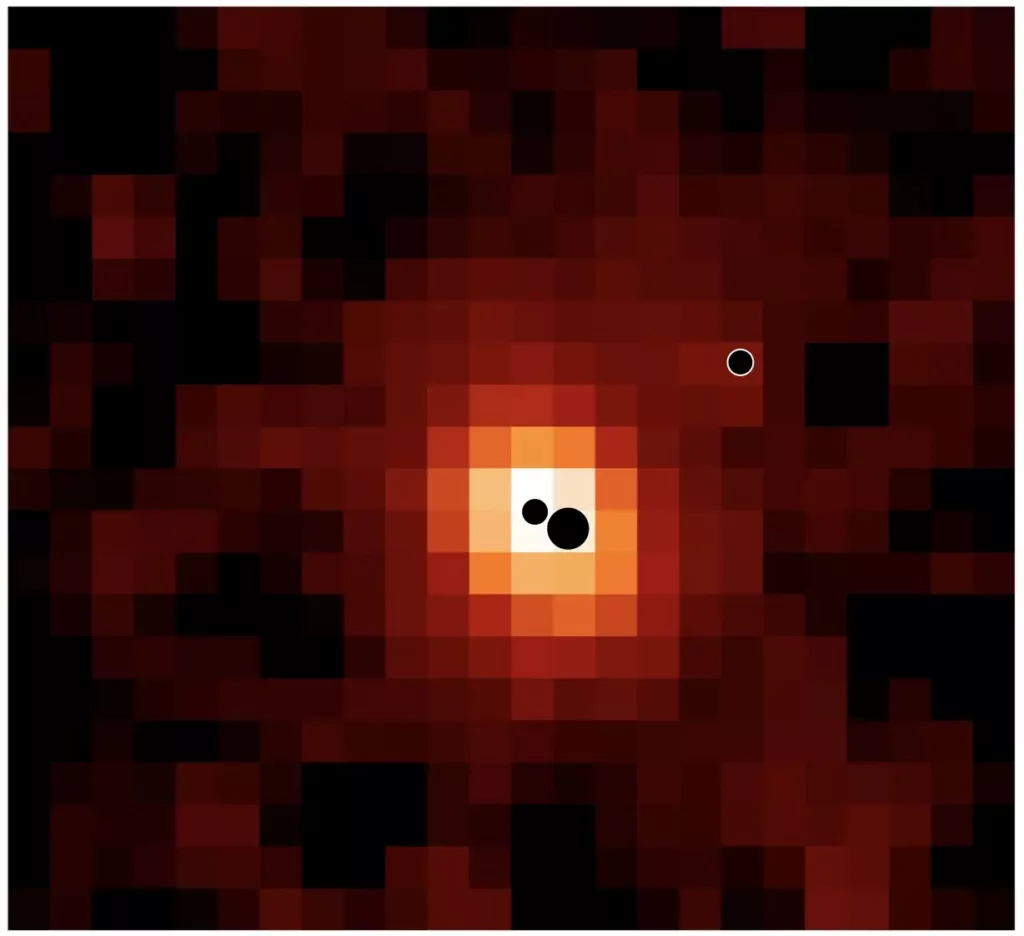 Map of the distant galaxy J0148-4214 in ionized hydrogen (Hα). The locations of the three massive black holes are indicated by black circles (not to scale). The most massive and least massive black holes are located in the galaxy center; a third black hole is located in the galaxy outskirts.
© Hannah Üble
To eliminate other possible causes, such as supernovae, stellar winds, or giant stars, the researchers looked for further spectral clues. The evidence strongly suggests that three massive black holes are actively feeding and situated near each other in one galaxy, providing a rare glimpse into how black holes might have grown and merged in the early Universe.
Astronomers have determined the masses of three black holes in the galaxy J0148−4214: one with a mass of about 80 million solar masses, another at 2 million solar masses, and a third, smaller but quite active, at 0.6 million solar masses.
NASA’s telescopes have seen the most distant black hole yet
It’s striking that the smallest of the three black holes is eating so fast that it surpasses the Eddington limit, the theoretical speed limit for black hole growth set by basic models.
Dr. Giovanni Mazzolari, second author of the study and researcher at MPE, said, “The JWST data allowed us not only to identify the three black holes, but also to estimate their masses, accretion rates, and the stellar mass of the galaxy.”
“We find a total stellar mass of about 1.3 billion suns, and the black holes represent a significant fraction of that.”
The central pair of black holes is expected to merge within a few hundred million years, offering a fast track for black hole growth in the early Universe.
As co‑author Roberto Maiolino notes, “These results are extremely exciting. They suggest that black hole merging may be an additional, fast route for their rapid growth in the early Universe.”
The third black hole, sitting off‑center, could be the remnant of a past merger kicked out by gravitational recoil, or it may still be migrating inward.
These observations clearly demonstrate the great power of JWST’s integral field spectroscopy. Using NIRSpec-IFS, astronomers managed to identify all three black holes, whereas traditional methods would most likely have failed to do so.
This study offers new insights into how supermassive black holes and their host galaxies grow in size. It supports the notion that mergers and cosmic interactions were important factors in the early Universe for enabling black holes to grow rapidly.
This triple system could also be a precursor to future black hole mergers, a type of event that future gravitational-wave observatories such as LISA may one day detect.
Journal Reference:
Hnnah Ubler, Giovanni Mazzolari, Roberto Maiolino et al. BlackTHUNDER: Evidence of three massive black holes in a z ∼ 5 galaxy. Astronomy & Astrophysics. DOI: 10.1051/0004-6361/202557419