
The airport’s recently released master plan provides a long-term framework to bring together the multibillion-dollar infrastructure projects. It includes safeguards for future rapid transit corridors to build a seamless transport network.
“It’s not the complete answer, but you’ve got to have some form of mass rapid transit to an airport. You just can’t rely on cars,” Mary-Liz Tuck, Auckland Airport’s chief strategic planning officer, said.
Together with the new Auckland City Deal and targeted roading upgrades, Tuck says Auckland Airport is actively tackling the challenge. Getting these connections right isn’t just about easing the airport run, it is a key part of South Auckland and New Zealand’s economic future.
Currently, 95% of workers commute to the airport precinct in private vehicles, while public buses carry just 2% of trips. With passenger numbers expected to rise from 19 million today to 24 million by 2033, Tuck says changing how people travel is essential.
“It’s not the complete answer, but you’ve got to have some form of mass rapid transit to an airport. You just can’t rely on cars,” she said.
With light rail delayed, the airport is pushing for pragmatic, immediate bus solutions. This includes a dedicated Northern Busway-style corridor and the proposed Airport to Botany route. Modelling shows the Airport to Botany link could bring an extra 269,000 people within a 45-minute public transport journey by 2048.
“We think we are going to need buses as an interim solution at a minimum. Wouldn’t it be fantastic having something like what they’ve got on the North Shore coming out to the airport precinct?” Tuck said.
Active transport is also taking off. Tuck notes strong worker pick-up for cycleway connections and bike-to-work schemes. “Surprisingly, that’s the thing that most people have really jumped on,” she said.
The airport views the opening of the City Rail Link (CRL) as a potential catalyst for public transport reliability. It will also provide an opportunity to make more of the Puhinui bus-rail interchange.
“We see CRL as a real opportunity. With CRL opening and all of the focus on rail, we have a real opportunity to start getting people thinking again about catching the train and the airport link bus to get to the airport.”
Tuck says it will make the most difference for airport workers. “That’s where we like to focus because those are the people we can communicate with easiest. If you’re pushing public transport for people who work at the airport, it has to be an efficient system so they can get to work on time.”
While waiting for major long-term projects to materialise, the airport is optimising its existing assets. A key focus is removing local bottlenecks through smart infrastructure upgrades. This includes reconfiguring the two-lane Pūkaki Bridge into three dynamic lanes with overhead gantries to manage peak traffic into the precinct.
A key focus is removing local bottlenecks through smart infrastructure upgrades. This includes reconfiguring the two-lane Pūkaki Bridge into three dynamic lanes with overhead gantries to manage peak traffic into the precinct. Illustration / Artist’s impression
“The biggest issue is actually making sure that all of the network grows at the same time. We can do things at the airport, but if you can’t get to us, it doesn’t matter. It’s about being clever with what we’ve got, but also planning together for the future.”
Beyond passenger travel, the airport ranks as the country’s third-largest port by trade value, handling $31.8b in high-value imports and exports every year.
That makes fast, reliable freight corridors between the airport precinct and the Port of Auckland critical for national supply chains.
“I think a lot of people don’t realise how much high-value export aggregates at Auckland to get out to international markets fast. Connecting the Port of Auckland and the airport and creating a good corridor to get freight through, is essential,” Tuck said.
The Landing, a 100ha business park at the airport, houses distribution operations for major logistics and retail brands. Trade through the precinct is projected to hit $41.8b annually by 2033.
Cargo growth relies heavily on international flight connections to get products to market. Tuck points to strategic routes like the Southern Link, which connects South America to Asia via Auckland, as a critical driver underpinning the precinct’s expanding freight role.
These economic linkages are explicitly recognised in the new Auckland City Deal. Under the agreement, central government, Auckland Council and Auckland Airport will deliver a joint, long-term development plan to safeguard freight movement across key access points like Pūkaki Bridge, Puhinui Rd and the southeastern corridor.
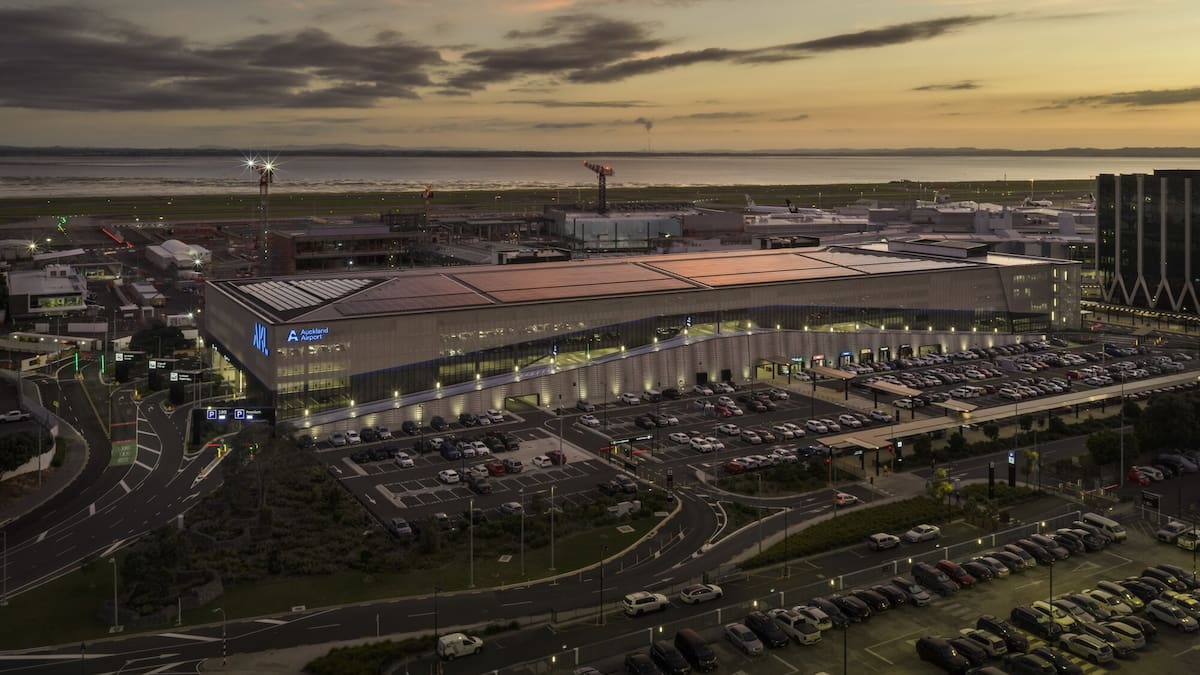
An aerial view of Auckland Airport.
“The crucial part of the City Deal is that public and private sectors have to work together and come up with solutions together. Auckland being prosperous is really important and it’s about how we support the growth of these major economic engines,” Tuck said.
Delivering this requires alignment across transport agencies. While Auckland Airport operates as a road-controlling authority for its 24km internal road network, external access relies entirely on NZ Transport Agency Waka Kotahi (NZTA), Auckland Transport and Auckland Council.
The newly signed Auckland City Deal provides the framework to bring these parties together. It commits central government, Auckland Council and the airport to jointly prepare a long-term development and investment plan for the precinct. Crucially, it identifies key connection points like the southeastern corridor and explores new funding and financing tools to unlock transport investment.
“The crucial part of the City Deal is that public and private sectors have to work together and come up with solutions together. It shines a light on the fact that you’ve got to support the growth of these major economic engines. We can provide really good data on where people are coming from and going to, so we can be far more targeted in how we plan together for the future,” she says.
Auckland Airport is a sponsor of the Herald’s Infrastructure Report.