
 Credit: MIT News.
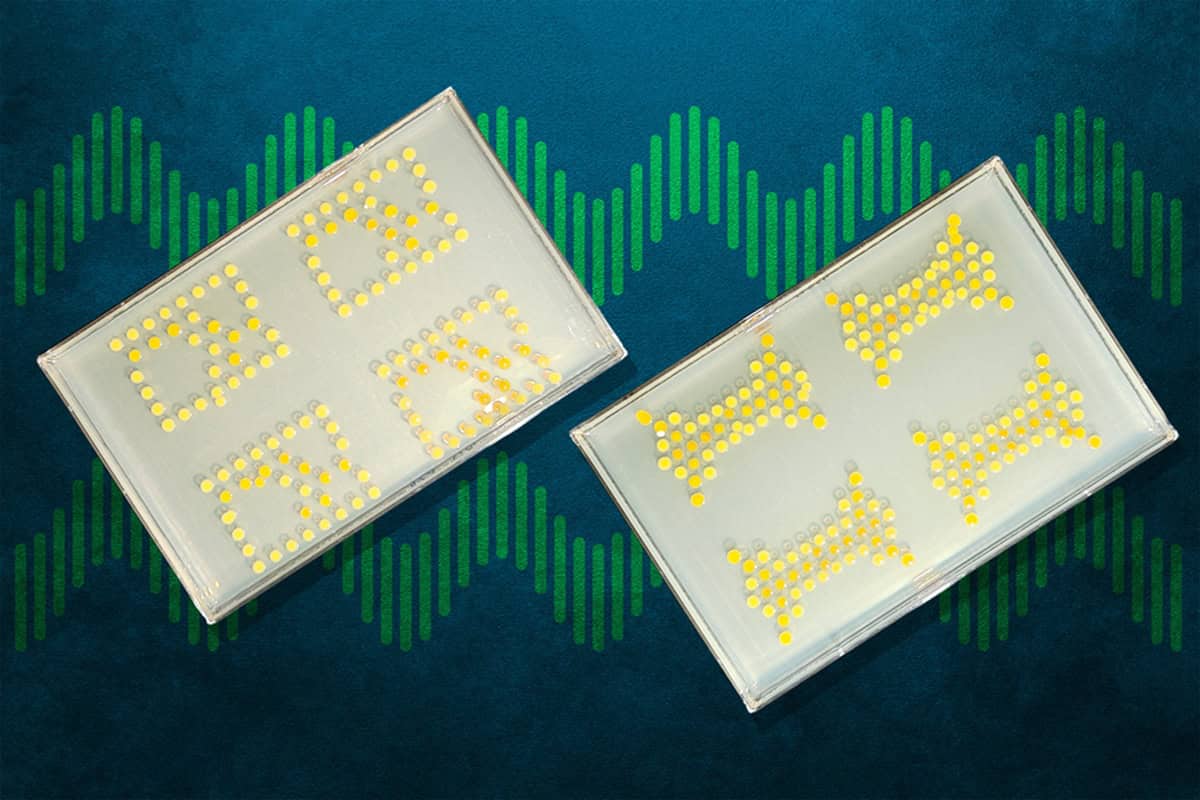
Under fluorescent light, the device looks less like a computer than a tiny constellation of dots. The specks are actually bacteria glowing red and green across a slab of agar that can perform mathematical computations. One colony receives a chemical message. Another decides whether to let it pass. Others relay it down the line.
Researchers at the Massachusetts Institute of Technology (MIT) have engineered bacteria to perform the job of transistors, then arranged colonies of those bacteria into what amounts to a living circuit board. In the new Nature Chemical Biology study, the team used just five engineered strains to build circuits that could route information, add two binary inputs and perform a full-adder operation involving three inputs.
The striking part is not simply that bacteria can compute. Synthetic biologists have made cells perform logic for years. It is that the researchers can change the computation without redesigning the bacteria themselves. Two strains serve as biological transistors and three as relays. Rearrange those five building blocks on the plate, and the circuit does something different.
“We’ve built some initial computer architecture components that are commonly used, but any operation can be built with these five strains,” Hamid Doosthosseini, an MIT postdoctoral researcher and the study’s lead author, said in MIT News.
A transistor made from a colony of bacteria

A conventional transistor works like an electrically controlled valve. A signal enters through one terminal, leaves through another and a third input determines whether that passage is open or closed.
The researchers recreated that basic architecture chemically.
They worked with Pantoea agglomerans, a bacterium commonly found on plant surfaces. One engineered strain acts somewhat like an N-type transistor: it passes a chemical signal only when a second “switch” signal is present. The other behaves like its P-type counterpart, allowing the signal through unless that switch is activated.
Instead of electrons, the circuit carries small molecules that bacteria already use to communicate. A molecule called OC12 serves as the incoming signal, OC6 operates the switch and an activated transistor produces another molecule, OHC14, as its output. Three additional bacterial strains act as relays, translating one chemical message into another so it can activate the next transistor.
×
Thank you! One more thing…
Please check your inbox and confirm your subscription.
The translation part is important because molecules naturally diffuse in every direction. A circuit needs something closer to a wire, sending information toward the next component instead of indiscriminately bathing everything nearby. The researchers inserted an intermediate chemical signal and physically spaced the colonies so that a message would preferentially reach its intended neighbor.
They then printed the bacteria onto agar using an acoustic liquid-handling machine that deposited droplets as small as 2.5 nanoliters. Colonies that needed to communicate generally sat about five millimeters apart. A border of otherwise inactive green-fluorescent bacteria helped prevent colonies at the edges from growing differently simply because they had more available nutrients.
The logic is increasingly moving out of DNA
This is not the first time scientists have persuaded cells to act like computer components. But earlier approaches generally put much more of the circuit design inside the cells’ DNA.
In a landmark 2011 Nature study, Christopher Voigt, the senior author of the new paper, and his colleagues engineered E. coli colonies to perform NOR logic and connected them with chemical “wires.” Changing how the colonies communicated allowed the researchers to build different logical operations.
Researchers have since pushed biological computing much further. A 2018 Nature Methods study assembled communicating mammalian cells into a three-input full adder, so the full-adder itself is not the novelty here. A 2021 Nature Communications paper even printed bacterial “inks” onto paper and showed that changing their spatial arrangement could change the computation.
But scaling up these systems has repeatedly run into a biological wiring problem. Every engineered gate may need its own compatible input and output signals, and stuffing many genetic circuits into the same cell taxes the machinery that the cell needs to stay alive.
The scale of that problem became especially clear in another study from Voigt’s group, published in Nature Chemical Biology in 2025. The researchers divided a two-bit version of the MD5 hashing algorithm among 66 engineered E. coli strains containing 110 logic gates, collectively requiring about 1.1 million bases of introduced DNA. Because different cells need different genetically encoded sensing, logic and communication functions, scaling a biological computer this way becomes increasingly complex until you hit a brick wall.
The new architecture solves some of these problems from the opposite direction. Rather than constructing an ever-growing catalogue of genetically distinct gates and wires, the researchers made a very small catalogue of reusable parts and transferred much of the complexity into where those parts are placed.
The transistor strains do not contain genetic instructions saying, in effect, “be part of a half-adder” or “be part of a demultiplexer.” They perform only a simple reusable operation: depending on a switch signal, allow or block the passage of another chemical signal. The three relay strains simply translate one signaling molecule into another.
Then the researchers determine the larger computation by placing those same five cell types in different arrangements.
“This work shows that we can get toward more complicated functions by linking up simpler functions in individual cells,” Voigt said in MIT News. “Computationally, there’s nothing that your iPhone can do that these circuits couldn’t do.”
It can add, even when some parts get the answer wrong

Using different arrangements of the same strains, the researchers built a demultiplexer, which takes one incoming signal and routes it toward one of four destinations depending on two control inputs. That circuit required 22 colonies.
They also made a half-adder, which adds two one-bit numbers and reports both the sum and whether a carry is required. Finally, they built a 24-colony full adder, which accepts three one-bit inputs — two numbers plus an incoming carry — and calculates a sum and outgoing carry.
When the researchers tested the full adder they found that even when some of its components malfunctioned, the circuit still got the final answer right.
The researchers counted 18 incorrect internal states in the full-adder experiments, mostly colonies switching weakly on when they were supposed to remain off because signals had leaked in from nearby colonies. Yet the final outputs remained correct in the tested configurations. The team had designed the layout so that unwanted signals were either too far away to propagate or reached locations where they merely reinforced the answer the circuit was already supposed to produce.
That failure tolerance could prove useful in demanding environments such as living tissue or soil where a typical silicon computer would break. But it also highlights how far the system remains from an electronic chip.
Signals travel painfully slowly. The researchers measured an average of roughly eight hours for a colony to propagate a signal, and the larger circuit boards were generally evaluated after about 72 hours. A modern silicon processor, by comparison, operates on nanosecond or sub-nanosecond timescales: at a few gigahertz, only a fraction of a billionth of a second separates successive clock cycles. Eight hours is therefore roughly 100 trillion times longer than a single modern CPU clock cycle.
For these living circuits, however, speed is not really the point. A device sitting on a plant root may have hours or days to decide how to respond to drought or disease.
A computer that eventually eats its own power supply
As a bacterial circuit operates, its colonies consume nutrients. Molecules carrying signals accumulate and diffuse into places where they are not wanted. Eventually colonies grow into one another.
Those effects currently put a hard ceiling on the usefulness and scaling of such technology. The authors write that signal buildup and crosstalk make it impossible, for now, to operate one of these living computers for much beyond about three days. They suggest that enzymes could eventually destroy old signaling molecules, effectively clearing a chemical signal after it has been used.
There is also the small matter of size. A transistor on one of these plates can be a colony roughly half a centimeter across containing hundreds of millions to billions of cells. Modern electronic transistors are measured in nanometers.
But the authors point out that the colony is not fundamentally the transistor. Each individual engineered bacterium, about a micrometer across, contains the machinery required to perform that function. Shrinking the distances between communicating cells, slowing their growth, continuously supplying nutrients or embedding them in three-dimensional materials could allow much denser systems although the biological transistor lifespan remains a tough nut to crack.
The researchers are particularly interested in agriculture. Because P. agglomerans naturally colonizes plant surfaces, future versions might live on roots or leaves, integrating several environmental signals before deciding whether a plant needs a response — perhaps producing a protective compound only when a particular combination of stresses is detected.
“We’re not trying to replace computers, but rather put computational control into biology. If you have bacteria on the root of a plant, or the plant itself is doing the computing, running a simple calculation overnight is fast enough relative to a growth season,” Voigt said in MIT News.
For a laptop, eight hours is absurdly slow. For a root deciding what to do over the course of a summer, it may be an entirely different kind of clock.