
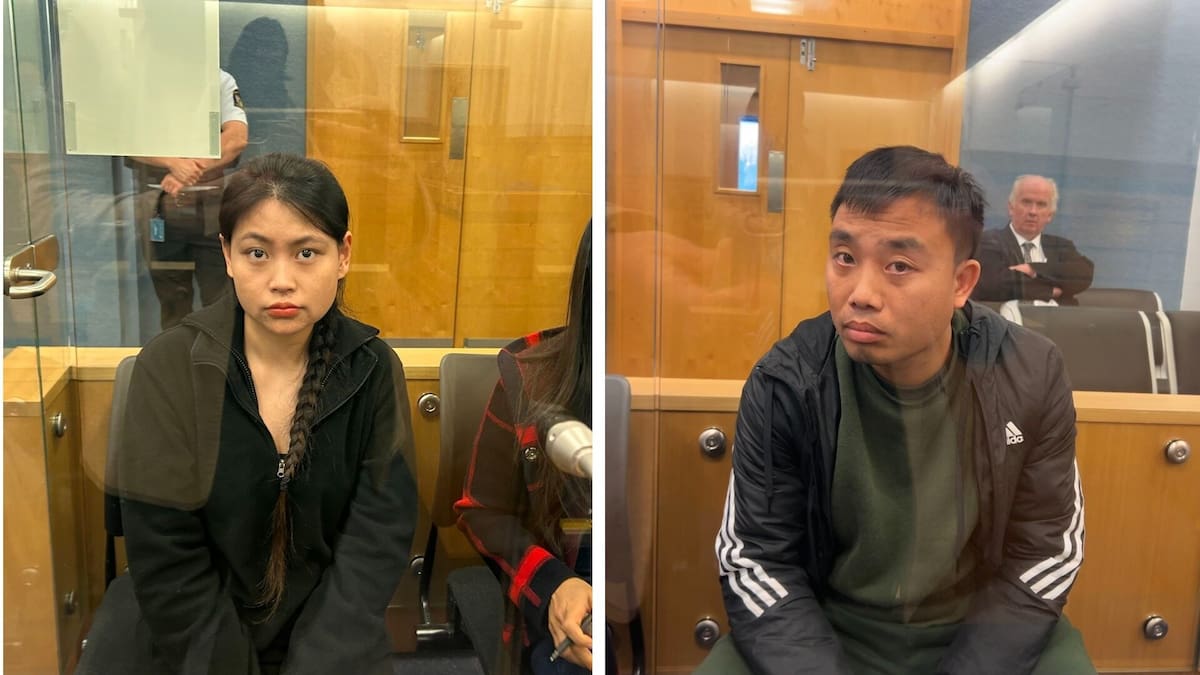
Mai was jailed by Judge Arthur Tompkins for three years and nine months in May. The couple’s lawyer, Callum Fredric, aimed his submissions at getting his clients’ prison time below that.
After police were alerted to the smell of weed, officers executing a search warrant arrived to find the group working in the warehouse on July 4, 2024.
They had diverted the power and, like other similar operations, the warehouse had its carpet and doors removed, boards fastened to window frames to prevent light escaping, and flexible ducting connecting filters to fans to circulate air for ventilation and reduce the cannabis odour.
There were also filters and fans, beneath which sat artificial lighting and large pots filled with plants, all connected to an irrigation and plant feeding system.
As well as the 460 plants, there was 41.5kg of saleable dried cannabis bud already harvested, and 103 50-litre bags of soil.
The trio were all found with cash on them; Mai had $3750, Tu Vu $1700.80, and Hong Vu $5839.90 and A$580 ($699).
After speaking to their lawyers, they all refused to give police access to their phones.
By the time police searched their Duke St property, it was apparent they had tried to clear out some of the cannabis.
There were three standalone dwellings comprising a house, a shed with four makeshift rooms, one of which was made from a portable tent, and another shed.
In total, police found 61kg of cannabis there.
Police accepted the trio were not the principal protagonists, but said they were “significantly” involved as overseers of the operation and were motivated by financial gain.
Crown prosecutor Lexie Glaser urged the judge to sentence the couple in line with Mai, for whom he took a five-year jail starting point. Mai has filed an appeal against his sentence.
She accepted the couple should get credit for their guilty pleas and hardship as foreigners, but noted they had arrived in New Zealand in 2023 before offending the following year.
However, neither had shown any remorse and had instead minimised their actions, shifted blame and had a “dismissive attitude”.
Fredric pushed for a lower starting point of four years’ jail, and an end point of two years and nine months.
Although they offended over two premises, neither was “huge” and comprised two moderately sized operations.
The 60kg of plants seized from Duke St was not saleable and, once dried, would have been “substantially lower” than that weight.
Police found cannabis-growing operations at a warehouse on William St, Huntly, and a property on Duke St, Ngāruawāhia. Photo / NZME
He said there was no evidence the Vus did anything other than grow and tend to the plants.
“It’s not clear what type of operational role they held beyond just growing the plants and tending to the plantation.”
In his affidavit to the court, Tu Vu said he’d paid $40,000 to an agent to move to New Zealand for work, only to find he’d been scammed and there was no job available.
“Out of financial desperation, owing a lot of money, he has accepted work as a cannabis labourer,” Fredric said.
The foreign hardship would be harder on the pair because they wouldn’t be able to ring each other as they would be housed in separate prisons.
They were also away from their three children and were keen to be deported to Vietnam at the end of their prison stints.
Judge Tompkins said that, while the pair had been assessed as being at low risk of reoffending, there had been limited or no remorse shown, particularly by Tu Vu.
He accepted the pair had significant roles in the operation but that there were others higher up the chain.
“These three defendants were not … principal antagonists in the cultivation,” the judge said.
“Having said that, this was a significant operation with a high degree of premeditation.”
He ultimately accepted that the pair were lower down the hierarchy than Mai, so took a starting point of four years and three months’ jail.
After applying credits for their guilty pleas and personal mitigating factors, Judge Tompkins jailed each of them for three years.
He also ordered the forfeiture of the cash with which they were found.
Belinda Feek is an Open Justice reporter based in Waikato. She has worked at NZME for 11 years and has been a journalist for 22.