
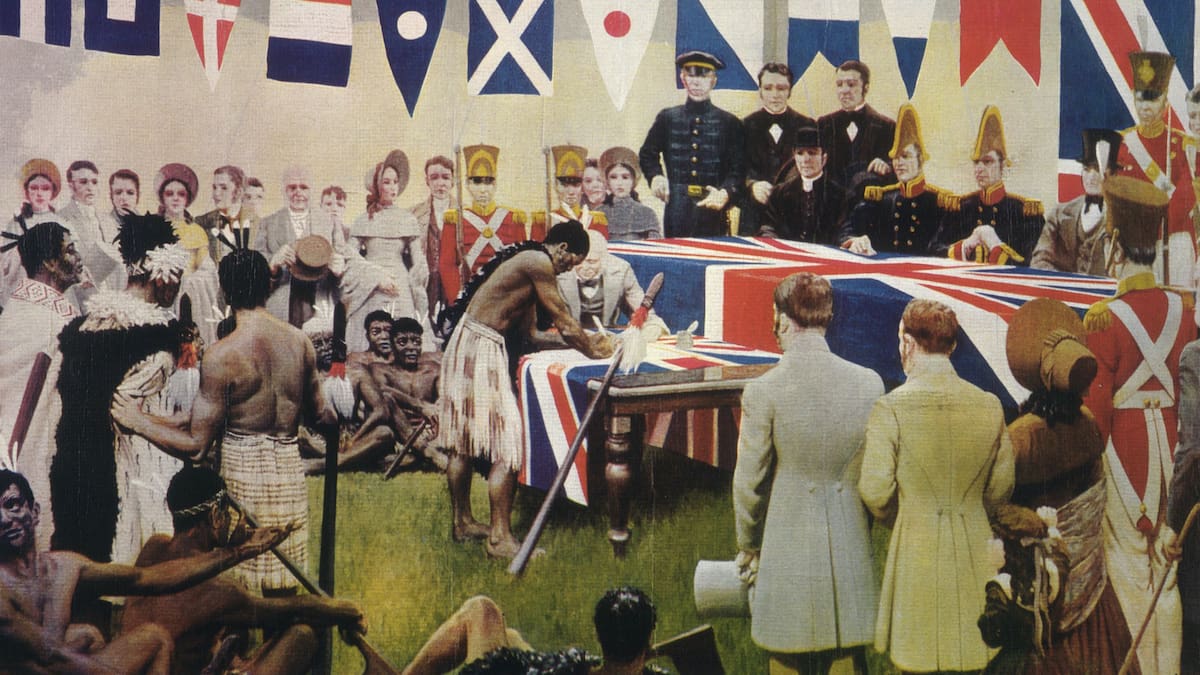
“The curriculum provides a sanitised view of New Zealand history and fails to meet the demands of students and other New Zealanders for an honest engagement with our past.”
His comments follow the Government releasing the new Science and Social Sciences curriculums for Years 0-10.
Burns stopped short of saying the curriculum represented an inaccurate version of New Zealand history, and acknowledged that students should be encouraged to think critically, source different views and come to their own perspective.
“But in a lot of ways it does reproduce a lot of the kind of common misconceptions or unproductive ways of seeing the past.”
The danger, he said, was that it could encourage “extreme” views including that Māori ceded sovereignty, that the New Zealand Wars were not the result of land being taken from Māori by force, and that te Tiriti is a flawed document that needs to be axed and rewritten.
These are complex issues that politicians routinely discuss, for example this term over Act’s Treaty Principles Bill.
“But I don’t think that represents the view held by most academic historians. If we’re calling it a knowledge-rich curriculum, it’s really important to bring out those expert voices,” he said.
“Otherwise, we can end up with extreme views being legitimised and seen as a part of school history, which aren’t really supported by academic historical work.”
Ministry of Education deputy secretary of curriculum Pauline Cleaver said the curriculum teaches students that there is no one source of truth when it comes to history.
“The reference to lawlessness relates to concerns raised by rangatira at the time. Students learn that people can view the same events in different ways. Through the ‘identify values and perspectives’ practice, students learn to consider whose voices are included, whose voices may be missing, and how this can shape understanding.”
Pauline Cleaver, Ministry of Education deputy secretary of curriculum. Photo / Supplied
She said the curriculum sets out the knowledge to learn, while the practices will help students consider evidence and build a deeper understanding of the past.
“This helps students recognise that no single source provides the full picture,” she said in a statement.
“Students build their understanding of Te Tiriti o Waitangi over time. They learn about Māori histories, connections to whenua, tikanga and kawa, rights and responsibilities, and the significance of Waitangi Day.
“This provides a foundation for later learning about He Whakaputanga, Te Tiriti o Waitangi, and Te Tiriti’s place in New Zealand’s constitutional arrangements, government and society.”
Cleaver also defended the lack of any mention of climate change in the social sciences curriculum, which had been included in earlier drafts.
Professor Chris Eames, from the University of Waikato school of education, said it was a “travesty of omission, at a time where other countries are taking significant steps to include climate change in their curricula”.
“We are woefully under-preparing our young people by disavowing the responsibility borne of creating climate change ourselves. This is very disappointing.”
He acknowledged some required knowledge about climate was included but it was “scattered across year levels, and there is scant connection made between human activities and our changing climate”.
Cleaver pointed to areas in the science curriculum where students learn about the planet’s water cycle, atmosphere, ecosystems and biodiversity.
“Through this learning, students develop an understanding of how natural systems interact and change over time.”
The social sciences curriculum also addresses the environment and how humans and natural processes shape it.
She said these will “help students understand environmental change, evaluate evidence, and explore how communities respond to challenges and opportunities”.
Schools can also explore these concepts through a range of local, national and global contexts that are relevant to their students and communities.
On Wednesday Education Minister Erica Stanford said she had asked the ministry to review the climate change content with experts.
Click on the banner link below to learn more about the history of Māori-Pākehā land deals in the Herald’s Whenua series
Derek Cheng is a senior journalist who started at the Herald in 2004. He has worked several stints in the press gallery team and is a former deputy political editor.