
 image: ©Just_Super | iStock
A study by researchers at Colgate University suggests that the background of low-frequency gravitational waves detected by Pulsar Timing Arrays (PTAs) could carry signatures from the remnants of primordial “Dark Stars,” offering insights into how the universe’s first supermassive black holes were formed
Pulsar Timing Arrays monitor networks of rapidly rotating neutron stars, known as pulsars, to measure minute shifts in radio pulse arrival times on Earth caused by passing gravitational waves. International collaborations have identified evidence of a stochastic, nanohertz-frequency gravitational-wave background.
The primary driver of this signal is widely believed to be a cosmic population of inspiraling supermassive black hole binaries.
Published in Physical Review D, the study by Sohan Ghodla and Cosmin Ilie establishes a connection between these present-day gravitational-wave signals and events occurring during cosmic dawn.
By modelling the cosmological evolution, host galactic halos, and merger rates of early black hole seeds, the researchers evaluated how ancestral seed populations contribute to the gravitational-wave background measured billions of years later.
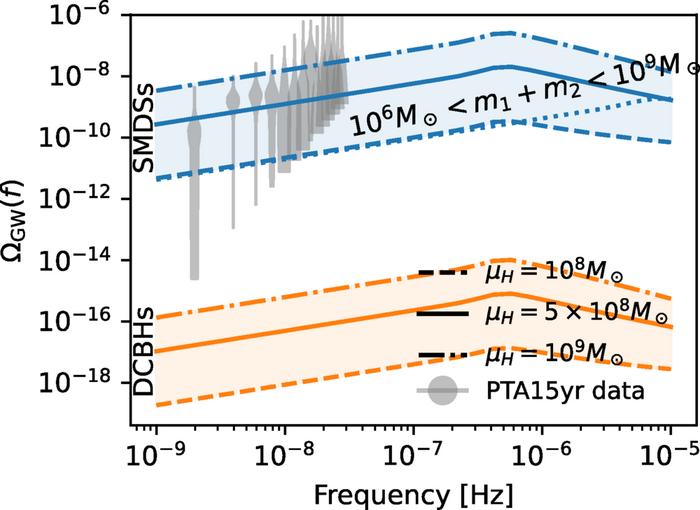 Predicted nanohertz gravitational-wave backgrounds from descendants of early supermassive black-hole seeds. Models in which black holes originate from collapsed supermassive Dark Stars can reach the gravitational-wave background measured by Pulsar Timing Arrays, whereas the much rarer direct-collapse-black-hole population considered in the study produces a substantially weaker signal. Credit Ghodla and Ilie, Physical Review D (2026).
Dark Star Remnants versus Direct-Collapse Seeds
The researchers evaluated two primary theoretical channels for producing the early, massive black hole seeds necessary to grow the enormous black holes observed in the early universe:
Supermassive dark stars:
Theoretical primordial stars powered by dark matter heating rather than conventional nuclear fusion. In models using Weakly Interacting Massive Particles (WIMPs), Dark Stars remain relatively cool and extended while accreting surrounding gas, reaching masses of up to a million Suns before collapsing into supermassive black hole seeds. The authors found that if these remnants exist at a space density of approximately 10-3 Mpc-3, their merger descendants could account for a dominant share of the background signal measured by PTAs.
Direct-Collapse Black Holes:
A competing formation channel involving the direct gravitational collapse of pristine primordial gas clouds. Because direct-collapse events require specific environmental conditions and are predicted to be far rarer (with estimated densities around 10-6 Mpc-3), their descendants produce a substantially weaker contribution to the PTA signal.
Constraining early seed abundance
The key insight of the study is that present-day PTA measurements can be used to establish an upper limit on the abundance of supermassive black hole seeds formed at redshifts greater than 10. According to the team’s models, seed densities reaching the 10-2 to 10-1 Mpc-3 range would begin to overproduce the observed gravitational-wave background, depending on the mass of the dark-matter halos in which they formed.
The mathematical framework also confirmed that black hole binaries with total masses exceeding one billion solar masses generate the vast majority of the PTA signal, while lower-mass systems contribute far less.
As PTA data sets expand alongside observations from space observatories like the James Webb Space Telescope and Chandra, these gravitational-wave measurements could help determine whether Dark Star remnants acted as the primary seeds for the universe’s largest black holes.