
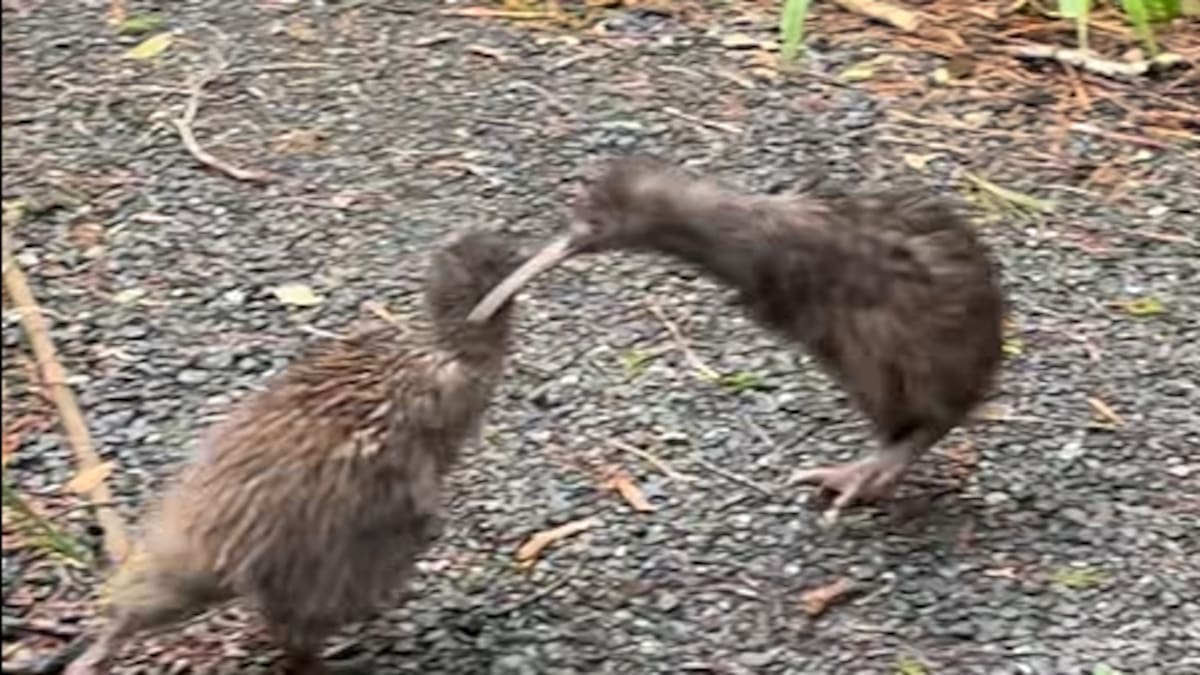
“They’re pretty good at kicking. They’ve got big tough legs, big claws, and they can tag you, they can tag each other.”
Hamilton said the birds were unlikely to seriously injure one another.
“They’ll be sore, but it’s more like sparring rather than to the death,” he said.
Hamilton said kiwi are tough in their bottom half but have fragile bills and chests, so they’ll keep punching and kicking at each other.
“Like a lot of animals, they’re fighting over territory and mates.
“It’s nature at work. The biggest, strongest animal gets to pass on its genes.”
Department of Conservation principal ranger for biodiversity Kev Carter, speaking from Stewart Island, agreed, describing the confrontation as “a bit of a turf war” during breeding season.
“They’ll more vigorously defend their territories at that time of year.”
Carter said Ulva Island’s kiwi population was likely close to carrying capacity, meaning the island might already be supporting about as many kiwi as it can.
Carter said kiwi were thriving on the island because it remained pest-free.
Kiwi fighting on Ulva Island. Photo / Ulva Island Ferry
Hamilton said scenes like this may have been commonplace before predators arrived in New Zealand.
“In the pre-human days there must have been millions and millions of kiwi,” he said.
“There were no stoats to eat the chicks and no dogs to kill the adults. The biggest issue would probably have been fighting for space and food.”
Hamilton said the footage suggested the local kiwi population was thriving.
“It’s a healthy sign. They must be going well down there.”
Northland residents have recorded similar encounters on home security cameras as kiwi numbers have recovered in parts of the region.
Backyard Kiwi’s Todd Hamilton said kiwi are territorial birds and fighting was not unusual among them.
Hamilton said sustained predator control and responsible dog ownership had helped drive the resurgence in other parts of the country.
“If you’ve got kiwi already, the most important thing you can do is control your dogs,” Hamilton said.
Dogs remain one of the greatest threats to adult kiwi.
He said protecting adults was crucial because a kiwi can breed for decades, having up to three chicks a year.
However, only about 5% of chicks born in the wild survive to reach adulthood due to predators, according to Save the Kiwi.