
Integrated with this is the seafaring nature of Victoria, with rows of eccentric houseboats and a constant flurry of seaplanes arriving and leaving the harbour.
My awareness of British influence was exacerbated upon arriving at my accommodation, the Royal Scot Hotel. True to its name, we were greeted upon arrival with our own bagpipe performance, by an endearing man in kilt and all.
It may have been the gardens though, which really tipped the Britishness over the scales.
A glimpse of Victoria’s harbour Photo / 123RF
Butchart Gardens
I can enjoy a good garden, but I wouldn’t call myself an enthusiast; Victoria’s Butchart Gardens, however, gave me a whole new perspective.
Nestled just outside Victoria on Vancouver Island, the gardens have a rich history, which I learned on the drive to the island. Once a quarry, through Miss Butchart’s and countless gardeners’ hard work over the last 100 years, it has become a must-see in Victoria.
Arriving at the grounds felt like arriving at some fantastical castle, with ivy-covered walls, grand iron fences and neatly arranged colour co-ordinated flowers. The fantasy does not stop at the gate either.
Traversing through, it was hard to pick a direction; with my map showing such a variety of locations, it felt like my own choose-your-own adventure book.
I can enjoy a good garden but I wouldn’t call myself an enthusiast, Victoria’s Butchart Gardens may have given me a whole new perspective. Photo / 123RF
From my vantage point (beside a shed made of bark walls and a moss roof), I could see neat rows of flowers of every hue and type imaginable. In the rose garden, I found enjoyment in exploring the winding rows of flowers, studying the funny names each flower had been given and where they originated from. I can confirm there were at least two from New Zealand.
Amidst all the sights, the Japanese garden was the one I’d been looking forward to most, and it didn’t disappoint. Crossing the threshold into the new space, through statues, cherry blossoms and fountains, I felt like I’d truly stepped inside a bubble of Japan. I left Butchart Gardens feeling something I didn’t expect – a sense of wonderment and a want to go back.
Food and drink
Heading back to the city, we passed countless vineyards, highlighting one of Victoria’s most well-known exports – wine. I didn’t get a chance to try it, but I did get amongst its other local drink, craft beer.
Every restaurant featured a local brew, so I knew I had to go straight to the source. The breweries here have everything from classic pale ales to the more experimental – I discovered a dangerous tropical sour which tasted like juice but packed a punch at 8% ABV.
A tropical sour tasted like juice but packed a punch at 8% ABV. Photo / Lachlan Rennie
On the food front, Victoria’s restaurants take full advantage of being surrounded by the sea, with fresh fish and seafood options everywhere. The city is also full of fish and chip shops – leaning into its Britishness again.
Tourists and residents alike clearly take advantage of the city’s world-class food and drink, with the city buzzing with life.
There are also street musicians dotted throughout Victoria, meaning every time I dined there was a tune paired with my meal – my personal favourite was the violins.
Places to explore
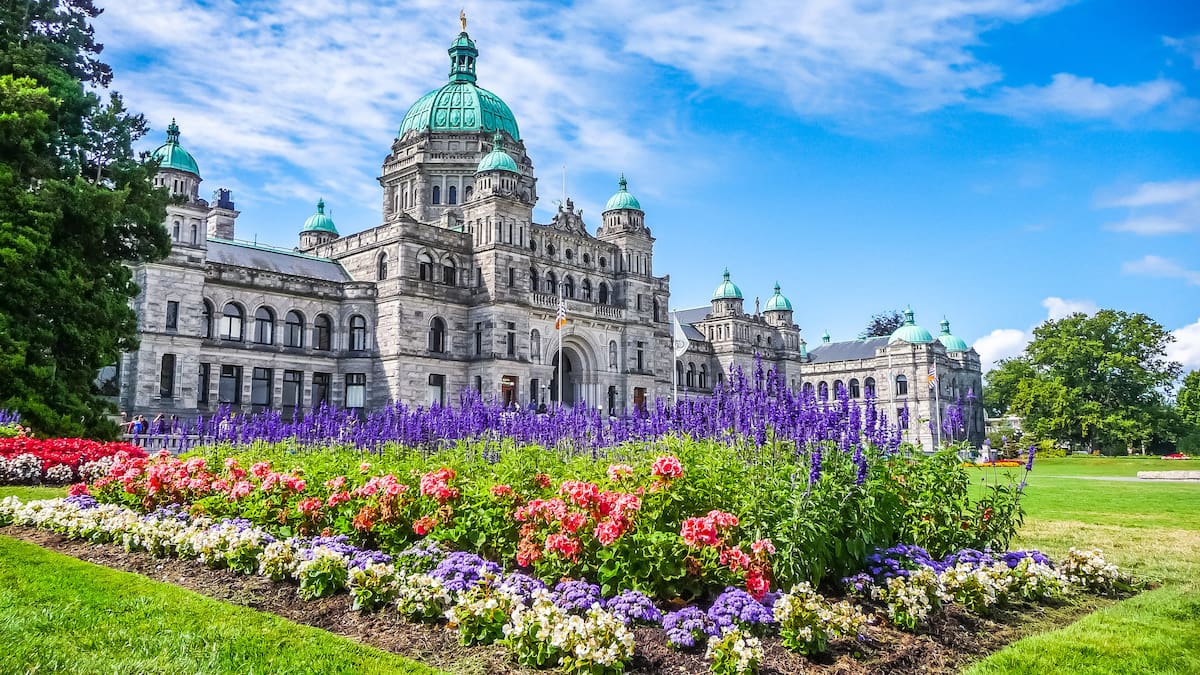
The centrepiece of Victoria’s Britishness, aside from its namesake, is the Parliament Buildings of British Columbia. The grand marble creation topped with copper is impossible to ignore. Lined with fairy lights, it’s a must-see both day and night.
In 1892, an architecture competition was held to find its designer, and 25-year-old English immigrant Francis Rattenbury won, despite blowing the budget twice.
The buildings run free tours year-round and, taking advantage of that, I wandered freely through the legislative building. The murals and interior design were grand. Not a bad stop for a free visit.
The centrepiece of Victoria’s Britishness, aside from its namesake, is the Parliament Buildings of British Columbia. Photo / 123rf
It isn’t the only piece of living history Victoria has to offer.
Chinatown is a short walk from the harbour and is the oldest in Canada and the second oldest in North America.
Established in 1858 during the Fraser River Gold Rush, the self-contained community is clearly marked with a huge ornate red and gold arch at the entrance, featuring hand-carved stone lions.
It also includes Fan Tan Alley – the narrowest street in the country, measuring just 0.9m at its narrowest point. Despite being a squeeze, it’s worth a visit, with boutique shops, art galleries and a cool record store.
Fan Tan Alley is the narrowest street in Canada measuring just 0.9m at its narrowest point. Photo / Lachlan Rennie
Whale-watching
If there’s one thing you can’t skip in Victoria, it’s whale-watching. Aboard the boat excursion I experienced, we explored the small rocky islands off the coast, which are teeming with harbour seals. They noticed us instantly and the curious ones swam up to check us out.
Perched on a nearby island was a bald eagle surveying the surrounding area and looking formidable. Next we headed out into the open ocean, keeping our eyes peeled for anything resembling a whale.
Sidney and her baby Lucky. Photo / Lachlan Rennie
In Victoria, all the whale-watching companies share locations with each other, which was definitely to our benefit as we cruised to join another group alongside a family of orcas.
The sleek black dorsal fins steadily rose and fell from the surface with the occasional puff of spray.
Our onboard marine biologist filled us in on the family dynamics – the three included Sidney, the largest female in the local population; Stan, identifiable by his enormous dorsal fin standing well over a metre tall; and finally Lucky, who gained her name after Sidney was beached while pregnant with her and somehow survived. Seeing an orca for the first time was truly impressive, and an entire family even better.
A city that stays with you
As incredible as the whale-watching is, Victoria has a way of surprising you with its quieter moments too.
In fact, it was one of the simpler experiences that stood out to me the most – going for a morning run, ravenously trying to consume as many sights as I could.
I weaved through the cobbled streets and neat gardens before setting off along the shore, running to a lighthouse jutting out from the coast. I was greeted and smiled at the whole way, and not just by humans.
Playing in the kelp alongside the platform were sea otters, something I hadn’t even considered I’d see.
The platform from where I could see my otter friends. Photo / Lachlan Rennie
Victoria’s combination of British charm, Pacific wilderness, and seaside character offers visitors a unique slice of Canada; I feel lucky to have experienced it.
Checklist
CANADA
GETTING THERE
Fly from Auckland to Vancouver with Air New Zealand. Victoria is a three-hour drive south from Vancouver and includes a ferry.
DETAILS
The journalist travelled courtesy of Cosmos Tours.