
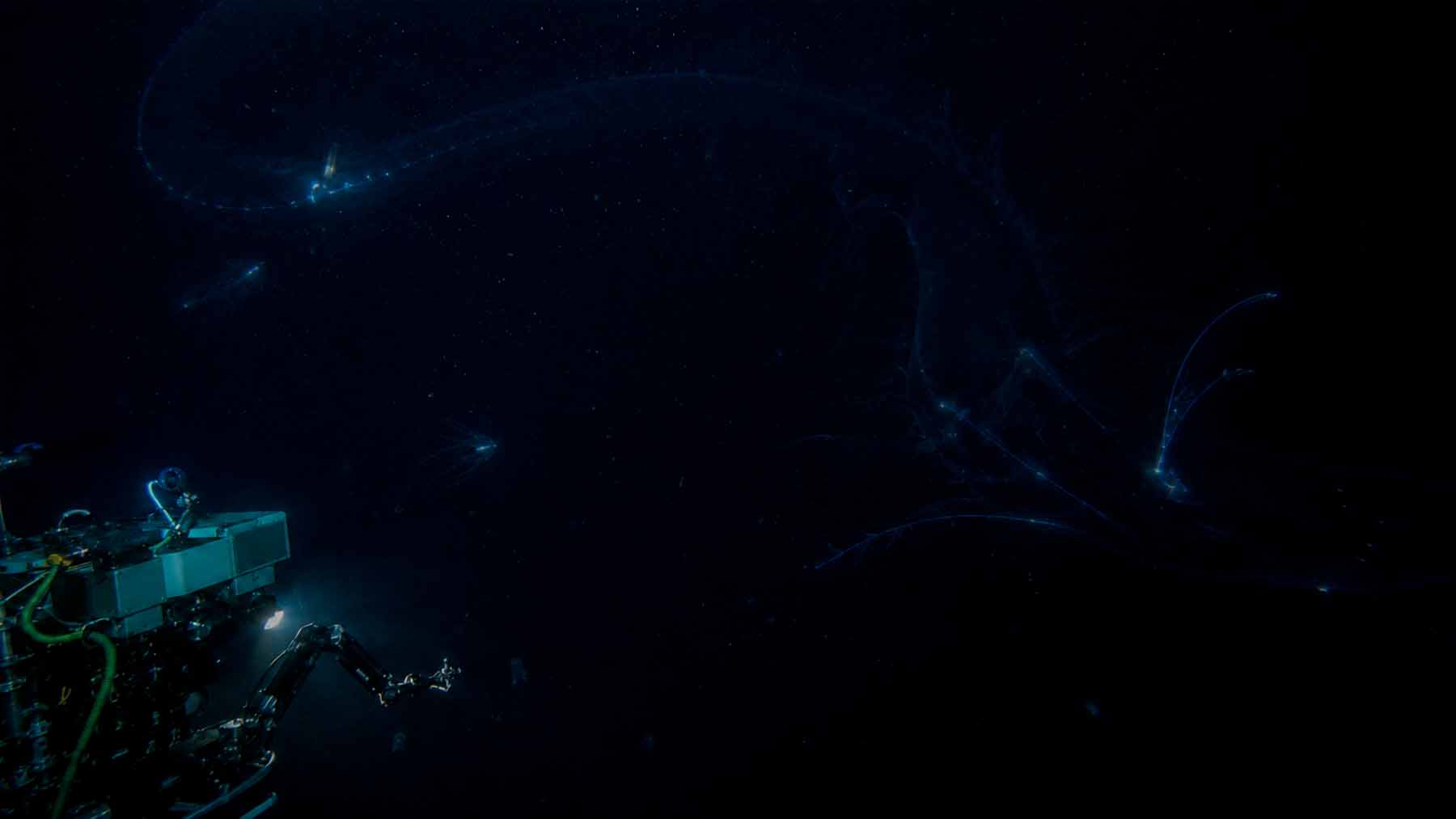
An expedition off California has delivered fresh data on deep-sea life. Scientists worked from Monterey Bay to the Channel Islands, with the target being a type of gelatinous plankton.
Specialized robotic underwater equipment was put to work, capable of moving through a wide range of temperatures and light levels.
Researchers came across several rare species in the darkest zones, one of these being a massive, ghost-like floating predator. What is this unnamed organism, and how does it hunt in darkness?
How ocean boundaries and the deepest habitats are being mapped
The research vessel David Packard set out with the crew focused on a transition zone in the open water column.
There are no barriers in the open ocean, but biologists have noted population boundaries for jelly species between Central California and Washington. The data gathered after turning south in the direction of the Channel Islands enabled researchers to track how the populations shift between the cold waters of the north and warmer southern currents.
Gelatinous plankton, which include jellies, siphonophores, and ctenophores, play an important role in the marine food chain. Their bodies are so fragile that net sampling often shreds them.
The crew had a complex task running several operations at once to collect specimens. During morning dives, scuba divers gathered jellies on the surface. After sunset, the team turned to trawling to catch specimens swimming upward while feeding in the dark.
This combination of sampling methods has helped to map how marine life responds to different water temperatures. Comparisons between closely related species and how they adapt in different conditions offer insightful details about deep-sea physiology.
Related
Sending robots where light never reaches
The team went even deeper. Using the remotely operated vehicle Doc Ricketts, engineers headed for the seafloor. The submersible was operated by trained pilots from a control room on the ship, and the deepest dive yet from the David Packard was a success.
From thousands of feet under the waves, scientists got a clear view of some of the world’s most fragile animals in their natural habitat.
The specialization came in with a low-light camera capable of filming soft bioluminescent pulses without harsh lights blinding the fish. There are many deep-sea species that produce light, either for hunting or protection, and this equipment was able to film the flashing patterns in detail.
Researchers studying the footage spotted several comb jelly species that have never been scientifically described before.
A siphonophore that had previously only been recorded in the Gulf of California also came into view. This finding in particular proves that the species has a far wider geographical range than oceanographers believed until now.
An unnamed deep-sea predator brought to light
The deepest dives uncovered the biggest discovery: a new species of Erenna siphonophore.
To the average person, a siphonophore looks like a pale ribbon drifting in the dark water. It is a ghostly-looking organism that can be as long as 130 feet.
Related
In reality, it is a floating colony made up of thousands of specialized individuals working together as a single body.
This newly found Erenna stands out because of its elaborate lures, reports the Monterey Bay Aquarium Research Institute. Deep underwater, the creature twitches these glowing appendages to mimic small prey. The motion tricks unsuspecting fish and crustaceans into swimming straight into a dense curtain of stinging tentacles.
Genetic sequencing and physical measurements are underway
While researchers filmed its bioluminescence on video directly within its natural habitat, the species does not have an official scientific name yet. Scientists are currently completing genetic sequencing and physical measurements in the lab to formally classify it.
Finding an unnamed siphonophore shows how much of the deep ocean remains unmapped. Combining deep-sea robotics with comparative physiology gives marine biologists a clearer baseline for deep-water ecosystems.
Establishing these records helps researchers map how food webs connect and evaluate how fragile oceanic populations might respond to changing ocean conditions over time.
Read the whole thing?
Get the week’s signal, not the noise
Our sharpest reporting on energy, climate and nature — free, once a week.