
Infertility is a common medical condition, and it can often be difficult to ascertain the root cause. Professor of Anatomy and Embryology Terry C. Hrubec explores the connection between infertility and exposure to quaternary ammonium compounds
Infertility is a serious health condition affecting millions of people. The World Health Organization estimates that one out of every six people worldwide will experience infertility at some point. Infertility affects both men and women in equal proportions. A majority of couples who experience infertility suffer psychological harms such as depression, anxiety, shame, worthlessness, and guilt because of their condition.
What does infertility look like?
In males, infertility can be exhibited by low sperm numbers, low sperm mobility, or abnormally shaped sperm. In females, infertility can occur with structural abnormalities of the reproductive organs, problems with ovulation of an egg, or attachment of the fertilized egg in the womb. Additionally, infertility can result from an inability of the fertilized egg to survive and grow to term.
Common causes of infertility include infection, obesity, chemical exposures, and lifestyle conditions such as smoking or excessive drinking. Some chemical exposures are directly toxic to eggs and sperm, damaging them outright or reducing their ability to behave normally. Other chemical exposures affect the endocrine system and keep it from functioning properly. The endocrine system is responsible for regulating hormone levels in the body. Chemicals that affect the endocrine system are called endocrine disruptors; these chemicals can cause infertility in both men and women.
Infertility in a mouse colony – a detective story
Since there are many causes of infertility, figuring out the cause in any one situation can often be challenging. When the fertility suddenly dropped in the mouse colony of researchers at the Edward Via College of Osteopathic Medicine (VCOM) in Blacksburg, Virginia, US, it took some time and detective work to determine the cause. Investigations showed that the decreased fertility was not due to infection or disease, contamination of the food or bedding with toxicants, or genetic changes in the mice. The research team eventually determined it was due to a change in the disinfectant used to clean the mouse room. The new disinfectant contained two chemicals belonging to a class of chemicals called quaternary ammonium compounds.
Quaternary ammonium compounds (QACs)
QACs are a large class of common chemicals. They are present in over 10,000 household and personal care products. They are routinely used in medical, food service, and industrial settings as disinfectants. They have been in commercial production for over 60 years and have long been considered safe. Recent research is finding this is not the case.
QACs and reproduction in mice
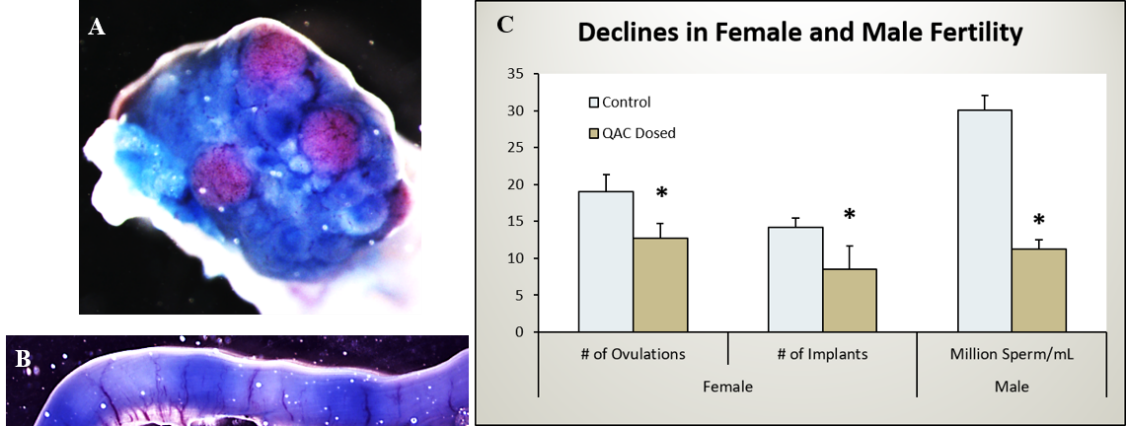
To test that the disinfectant was actually causing infertility in their mice, the researchers at VCOM dosed the mice by adding the disinfectant to the mouse food for six months. Over that time there were statistically significant declines in fertility. The dosed mice had fewer babies than controls. Not only was the litter size smaller, but it also took the dosed females longer to get pregnant, and they had fewer pregnancies. Additionally, dosing with the disinfectant affected the female’s normal reproductive cycling, making the cycles irregular and further apart.
Further testing found that fertility in both male and female mice was affected. Females ovulated fewer eggs. Of the eggs that were ovulated, fewer implanted in the uterus and started to develop. In males, sperm counts were lower, and the sperm had decreased mobility. The studies also found that the QACs concentrated in the testicles of the male mice.
QACs and reproduction in people
It is no surprise that QACs affected reproduction in mice. One of the QACs found in the disinfectant cleaner used in the mouse room, ADBAC (also called benzalkonium chloride), was patented in 1975 for use as a contraceptive agent in animals and people. ADBAC is also approved for use as a spermicidal cream in Europe and Canada as a routine means of contraception.
Do QACs cause infertility in people?
It is not known if QAC exposure causes or contributes to infertility in people. There have been no studies investigating this. From the mouse studies, it is known that mice exposed to the disinfectant through normal cleaning of the mouse room and mice dosed with the disinfectant both develop infertility. It is also known that QACs concentrate in the testicles of the male mice, where the chemical exposes the developing sperm. People are exposed to QACs in the home and workplace every day, and the QACs are absorbed into our bodies. The amount of QACs detected in the blood of people is similar to the amount found in mice from research studies. It is just not known if this exposure is harmful. Since ADBAC is used as a spermicidal drug, if it accumulates in the testicles of men as it does in mice, it could very likely be toxic to the developing sperm and could contribute to infertility; however, this has not been tested.
Are QACs safe?
Studies have found that QACs can increase inflammation in the body, inhibit mitochondrial function in cells, and affect lipid and sterol metabolism in people and animals. QACs can cross the placenta and get into the developing brain to cause neural tube defects which result in congenital disabilities in mice and rats. QACs can also be passed from the mother to baby through breast milk in humans. Since people have such extensive contact with QACs, there is clearly a possibility for harm. Studies are critically needed to determine if QACs are toxic and contribute to infertility and other diseases in people.