
The book is so page-turningly intriguing, disturbing and downright bizarre that I – as someone who also tells true stories for a living – find it unfair such an astonishing story should have fallen so easily into the lap of Jon Ronson, who surely already has more than enough.
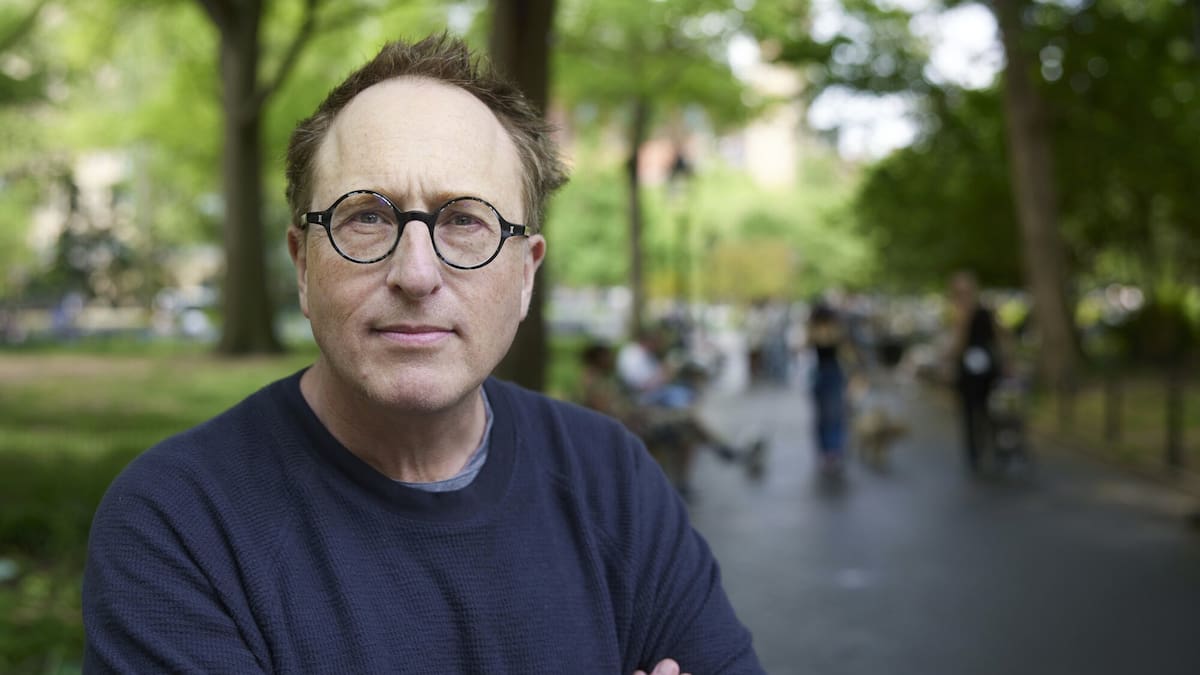
Jon Ronson during one of his live tours in 2025. Photo / Sara Bowrey
What Ronson quickly learns about Mark is that he’s an extremely wealthy man in his early 60s attempting to bring young women to live in his castle, ostensibly to star in a reality TV series called 101 Princesses.
The show’s central conceit, according to Mark, is that the young women are auditioning to be his “queen”, by, among other things, making out with each other on camera in settings as varied as the castle’s pole dancing nightclub and hot tub grotto.
If this is all sounding a bit Playboy mansion to you, you’re not alone. Ronson spends considerable time in the early pages comparing Mark to Hugh Hefner, who also kept women at his beck and call at a gaudy shrine to his own desires.
The story of Mark, like Hefner’s, is so strange that, were it not documented by a journalist, it would be unbelievable.
During their first meeting at The Castle, Mark explains the concept of 101 Princesses to Ronson. In short, he says he finds women on dating apps, initiates relationships with them, brings them to the castle and coaxes them into having sex with the other women living there.
In the book, Ronson quotes Mark as saying: “I always thought it would be amazing if I had living here six, eight girls, but the only way it works is if the girls love girls. That’s how Princessing works.”
He goes on to tell Ronson that once the women are brought around to the idea of sex with other women, “they actually really like it”.
After sharing this and other self-incriminating revelations, Mark asks Ronson to sign a non-disclosure agreement. Ronson refuses. He already knows the enormity of the story he has on his hands. The only difficulty he faces is how to tell it.
He tells me: “There’s nothing obviously relatable about Chris Mark. The trouble you have luring women to your castle – that’s not an obviously resonant story. But then I thought, actually, there is something unexpectedly resonant here, which is that he is discovering that you can’t lord it over your princesses in your castle any more like it’s the 1970s.
“Unless you’re the creme de la creme of manosphere influencers, it’s a terrible time to try to be Hugh Hefner.”
The deeper Ronson got into Mark’s story, the more he came to see it as more than the story of one man who’s gone off the rails.
He got to thinking about society’s changing nature and how men fit within it: “You know, factory life’s dead, office life’s dying, there’s been a power rebalancing, men are realising that certain privileges they had in the past they don’t have any more.”
The question that remains is: what happens to men now?
“At least part of the answer is that we’re all being encouraged to be content creators, personal brands. I heard a statistic that 39% of Americans now consider themselves content creators.”
The need to establish and nurture oneself as a brand, coupled with the sea of conflicting ideologies and attempts to define what being a man is, Ronson says, is “turning people haywire”.
Although The Castle is primarily the story of Mark, it takes detours into the stories of a few other men turning haywire in their own ways, including a lawncare influencer, the creator of Father Ted, a town historian and Ronson himself.
The Castle by Jon Ronson centres on a man who owns a literal castle in rural Connecticut in the United States.
Far from letting himself off, Ronson is a brutal self-critic.
“I judge myself entirely on work and there’s definitely a kind of gnawing emptiness that creeps in on the days off, and there are no days off for that reason,” he tells me.
“It’s the one contribution I can make, the one thing I can do well – these stories – and it fulfils me. As Randy Newman said when I asked him, ‘Why do you write songs?’, he said ‘It’s how I judge myself and how I feel better’. And that’s definitely true for me.
“I always remember [British documentarian] Adam Curtis saying to me: ‘I sit in my little room constructing my stories because it makes the outside world feel less frightening’.
“I’m harnessing the horrors of the world by making them work as a story.”
He describes himself as an introvert who hates and avoids social occasions. He says he’s not so bad with outdoor parties, helped in part by cannabis edibles, legal in New York State, where he lives. But the thought of a party in a New York City apartment, he says, fills him with horror, to the extent he would spend much of his time at such an event hiding in the toilet.
The page is a safer, more pleasurable place for introverts. “You can control a story in a way you can’t at a dinner party,” he says.
Despite a stellar, decades-long career, Ronson admits every time he writes a book it feels like he’s doing it for the first time. “Like I’ve forgotten all the tricks and I’m starting from scratch,” he says.
However, the story behind The Castle was so compelling and crazy, he quickly forgot the self-doubt and remembered how much fun it is.
“You know, you’re on a journey. It’s dark and scary, but it’s also absurd and funny. It’s all the things I love to do. Yeah. And I’ve gotta say, I wrote those chapters with a real sense of joy.”
In book-length non-fiction storytelling, he occupies rarefied air alongside big names like Malcolm Gladwell (The Tipping Point, Blink), Michael Lewis (Moneyball, The Big Short) and Patrick Radden Keefe (Empire of Pain, London Falling). But where those writers are authoritative, decisive and confident on the page, Ronson is a bit of a shambles. This is by design.
“People like us, there’s pressure on us and maybe pressure inside of us to be this kind of authority figure, like we know what we’re talking about. But very often we don’t,” he says.
He recognises he’s prone to cognitive biases and other human errors. Recognising this is one thing; admitting it on the page is another.
“I think people like it. If you present yourself as this sort of slightly bumbling Clouseau-type, Colombo-type investigator where you’re full of your own flaws too. That’s the truth about people – we’re basically a mess.”
Over the past five years, contemporaneous with the events he documents in The Castle, Ronson has produced two seasons of the hit BBC podcast series Things Fell Apart, in which he tells stories of people caught up in the opening salvos of what became known as the culture wars.
It’s difficult territory because these are touchy times, people are increasingly divided, and their beliefs are increasingly reinforced by social media and the bubbles they occupy within it.
Ronson says ideology-led journalism, increasingly prevalent in the United States, stops you being surprised and is part of the problem.
Asked for a solution to the social division chronicled in Things Fell Apart and The Castle, Ronson says: “The solution to it is this – it’s narrative non-fiction: you’re not being led by ideology, you’re being led by curiosity; you want to find things out and you’re prepared to be surprised; you’re prepared to go places where you didn’t expect.
“We’re the way out of this. We’re the way to fix this.”
Jon Ronson’s live event Enter the Castle comes to Auckland’s Bruce Mason Centre on Sunday, October 25. Tickets at fane.com.auThe Castle by Jon Ronson (RRP $40).