
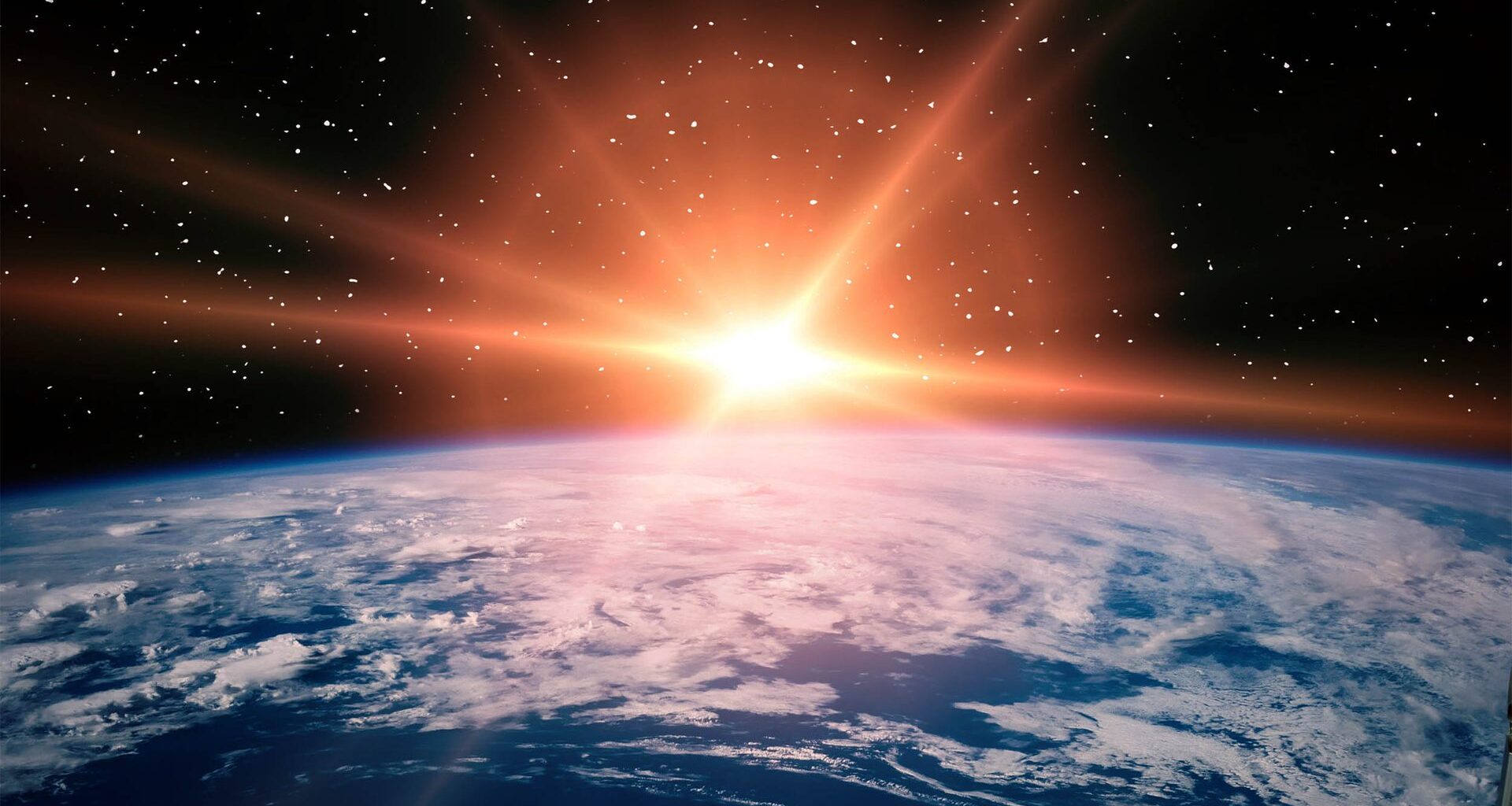
The sunlight reaching Earth from the Sun’s visible surface crosses space in about 8 minutes. Before that, however, the radiant energy that ultimately emerges as sunlight can spend…
The sunlight reaching Earth from the Sun’s visible surface crosses space in about 8 minutes. Before that, however, the radiant energy that ultimately emerges as sunlight can spend an extraordinarily long time moving outward through the Sun’s dense interior.
A widely cited calculation published in 1992 estimated a photon-diffusion timescale of about 170,000 years for the present Sun. That figure describes a statistical transport process, not one unchanged photon surviving from the solar core to your skin.
Light moves by diffusion
The Sun’s interior is made of extremely hot plasma, composed largely of ionized hydrogen and helium along with free electrons. Deep inside the Sun, matter is so dense that radiation cannot simply stream outward as it does once it reaches space.
Photons interact repeatedly with matter through processes that include absorption, re-emission, and scattering. Each interaction changes the route taken by radiant energy, so its outward progress resembles a random walk rather than a straight path.
A random walk can involve enormous motion while producing only modest net progress. A photon may travel a short distance, interact with matter, and then continue in a direction that is partly sideways or even back toward the core.
This repeated interaction is especially important in the radiative zone, where radiation is the main mechanism carrying energy outward. Farther from the center, convection becomes increasingly important in moving energy toward the solar surface.
Random walks change the math
The basic random-walk relationship is often summarized by saying that net displacement grows roughly with the square root of the number of steps. Reaching a distance R with an average step length l therefore requires a number of steps that scales approximately as (R/l)^2.
That is different from saying that the distance traveled is the square of the number of steps. The original calculation confused those quantities, leading to an incorrect description of both the number of interactions and the total path length.
The average step length also cannot be treated as a single fixed value everywhere inside the Sun. Density, temperature, and opacity change strongly with depth, so the distance radiation can travel before another interaction varies through the solar interior.
R. Mitalas and K. R. Sills addressed this issue using step lengths derived from a solar model. They found an average step length of about 0.035 inches (0.090 centimeters), substantially shorter than the 0.2- to 0.4-inch (0.5- to 1.0-centimeter) values commonly used in earlier simplified estimates.
The 170,000-year estimate
With the shorter average step length, Mitalas and Sills calculated a photon-diffusion timescale of about 170,000 years for the present Sun. Their paper was published in The Astrophysical Journal in December 1992.
The result did not come from a recent, sophisticated simulation, as the original version suggested. It came from a simple random-walk treatment combined with step lengths determined from a solar model.
The 170,000-year figure should therefore be presented as a model-based photon-diffusion estimate rather than a precisely measured travel time. The calculation describes the statistical diffusion of radiation through the Sun’s interior.
It also does not support an accepted range extending from 170,000 to more than 500,000 years. No peer-reviewed source supporting the 500,000-year figure in the original article was identified.
Photons do not stay intact
There is another important limitation to the familiar story of a photon “escaping” the Sun. Photons can be absorbed, and energy can later be emitted again in new photons with different energies and directions.
For that reason, the visible photon that eventually leaves the photosphere should not be imagined as the same individual photon originally produced by a nuclear reaction in the core.
The random-walk picture tracks the diffusion of radiation and energy through matter, not the uninterrupted biography of a single particle.
Energy generated in the core also changes form as it moves outward. High-energy radiation interacting with the solar plasma is repeatedly redistributed, and the spectrum that ultimately emerges from the photosphere is very different from the radiation associated with fusion reactions deep inside the Sun.
Once a visible photon escapes the photosphere, the situation changes dramatically. Space between the Sun and Earth is transparent enough that the photon can cover roughly 93 million miles (150 million kilometers) in about 8 minutes.
Human history comparison
A timescale of 170,000 years is still immense on a human scale. Neanderthals lived from roughly 400,000 to 40,000 years ago, so a 170,000-year diffusion timescale overlaps a period when Neanderthals were present.
It is not, however, older than Homo sapiens as a species. Fossil evidence places Homo sapiens at about 300,000 years ago, with important early remains from Jebel Irhoud in Morocco dating to roughly that period.
The safer comparison is therefore that the 170,000-year estimate reaches back to a time when both Neanderthals and Homo sapiens already existed. Saying that the sunlight reaching us began its journey before Homo sapiens appeared is not supported by this estimate.
Limits of the estimate
Photon diffusion inside a star is a model of statistical energy transport through matter whose properties change dramatically with radius. A simple random-walk analogy is useful for explaining the basic idea, but it cannot reproduce every detail of radiative transfer inside the Sun.
The original article’s claim that a mean free path below 0.039 inches (1 millimeter) was established by “more recent research” is also misleading.
Mitalas and Sills reported an average value of 0.035 inches (0.090 centimeters) in 1992, and that shorter step length led them to the 170,000-year result.
No peer-reviewed source was identified for the claim that a shorter mean free path pushes the crossing time above 500,000 years. That figure has therefore been removed rather than presented as part of an accepted scientific range.
The central point remains striking without exaggeration. Radiation can diffuse through the dense solar interior for a very long time, while a photon that has escaped the Sun can cross interplanetary space to Earth in only about 8 minutes.
The photon-diffusion estimate was published in the journal The Astrophysical Journal.
—–
Like what you read? Subscribe to our newsletter for engaging articles, exclusive content, and the latest updates.
Check us out on EarthSnap, a free app brought to you by Eric Ralls and Earth.com.
—–