
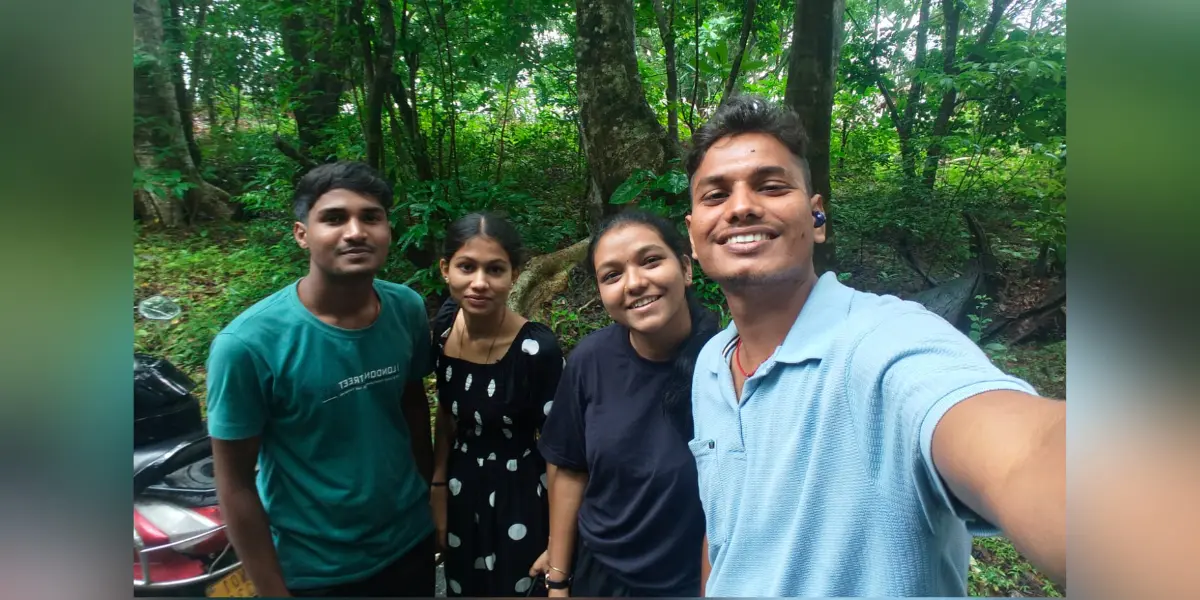
Sri Vijaya Puram, Aug 22: By the time the working day ends, Soni Kumari, Gaurav Rai, B Vijay and Bononi Mondal are ready to begin working again.
There are fruits to be cut and packed, supplies to be gathered, and everything has to fit onto a scooty. Then the four friends set off for either Corbyn Cove Beach or Mazar Pahad, where, as evening settles over the Islands, they set up a small fruit stall they have named Fruits Bite.
Less than a month ago, it did not exist.
There was no shop, no investor and not much by way of capital. The four put together around Rs 5,000-6,000, enough to buy fruit, tissues and the basic things they needed to begin. On their first day, four or five customers turned up.
For a new business, particularly one being attempted after office hours, that might have been discouraging. Instead, they returned the next evening.
“We thought, let’s just do it. If it happens, it happens. If it doesn’t, what will happen?” Soni said.
It is a wonderfully uncomplicated description of entrepreneurship.
For two or three years, the four colleagues, who became friends and eventually business partners, had talked about doing something of their own. Like many such conversations, theirs had no particular destination at first.

They considered selling fast food. But there was already plenty of oily food available, they felt. They wanted to offer something different.
Eventually, somebody arrived at fruit.
The idea was hardly revolutionary. That may have been part of its appeal. It did not require a kitchen, a large investment or a storefront. They could buy what they needed, prepare it after work, put it on a scooty and find out whether anyone wanted it.
So they did.
The first evening brought those four or five customers. The second was better. Then social media began doing what social media occasionally does very well for a tiny business: people who had never heard of Fruits Bite discovered that it existed.
Soon, customers began asking a question the four had not had to answer when they started: Where will you be today?
Some came back. Others told them what they liked and what they did not. The four encouraged this. If something wasn’t good, they wanted customers to say so.
For a business still learning what its customers want, criticism is useful information.
Then somebody did something none of them had anticipated.
A customer made them a banner.
It was a small gesture, but perhaps precisely because the business was so new, it mattered. Fruits Bite was no longer simply four friends experimenting with fruit after work. Somebody outside their immediate circle had cared enough about what they were doing to make something for them.
At home, meanwhile, another small support system was taking shape.
At Gaurav’s house, his mother starts preparing before the four return from their regular jobs. When they arrive, some of the work is already done. They finish the rest, gather what they need and leave for the evening.
Their other parents have supported them too.
That support matters because starting Fruits Bite meant quietly disregarding some of the conventional advice young people around them had received.
Why not concentrate on finding a government job? Why not stick to regular employment?
In the Islands, as elsewhere, security has an understandable attraction. A government position comes with a salary, predictability and social approval. Selling fruit from a scooty after finishing another job offers rather less certainty.
The four have not rejected security altogether. They still have their jobs.
What they have rejected, at least for a few hours every evening, is the idea that they must choose between having a job and trying to build something of their own.
For Soni, that willingness to do something unconventional has another dimension.
She remembers growing up with restrictions. She was not allowed to leave home after 4 p.m. or talk to boys, she said, and had no friends at school. Going to work changed some of that. She met people. The world outside became less abstract and, perhaps, less threatening.
When Fruits Bite came along, there was another conversation to be had at home.
Soni told her mother that the people whose opinions families sometimes worry about would not necessarily be present when the family actually needed help. When either she or her mother had been unwell, she said, it was the family that had been there.
Her mother eventually gave her a rule that was both permissive and very parental.
“She told me, whatever you want to do, do it. Just don’t do anything wrong. Do something good,” Soni recalled.
And so, after work, her daughter goes out to sell fruit with three friends.
There is a temptation with stories about small entrepreneurs to race towards the ending. A tiny investment becomes a flourishing enterprise; a roadside experiment becomes a company; adversity is overcome and success arrives conveniently before the final paragraph.
Fruits Bite offers no such ending, at least not yet.
It is less than a month old.
The four are still working out what people want. They are considering adding fruits such as dragon fruit and kiwi. They are learning how much to prepare, where to go and how customers respond. They still have their regular jobs to report to before any of this begins.
Perhaps Fruits Bite will grow. Perhaps it will remain a small evening business. Perhaps, eventually, the four will decide that it doesn’t work.
They don’t know.
That uncertainty is what makes their experiment interesting.

Starting a business is often discussed through the language of funding rounds, incubators, valuations and business plans. None of those things was present when four colleagues in Andaman decided that Rs 5,000-6,000 was enough to test an idea they had been discussing for years.
Their calculation was considerably simpler: the downside was a few thousand rupees and some evenings; the upside was something they could not yet know.
And so each evening the experiment begins again.
The day’s regular work ends. At home, fruit is being prepared. The four gather what they need, load it onto their scooty and make their way towards Corbyn Cove or Mazar Pahad.
Somewhere along the way, the conversation they had been having for two or three years stopped being a conversation.
It became Fruits Bite.