
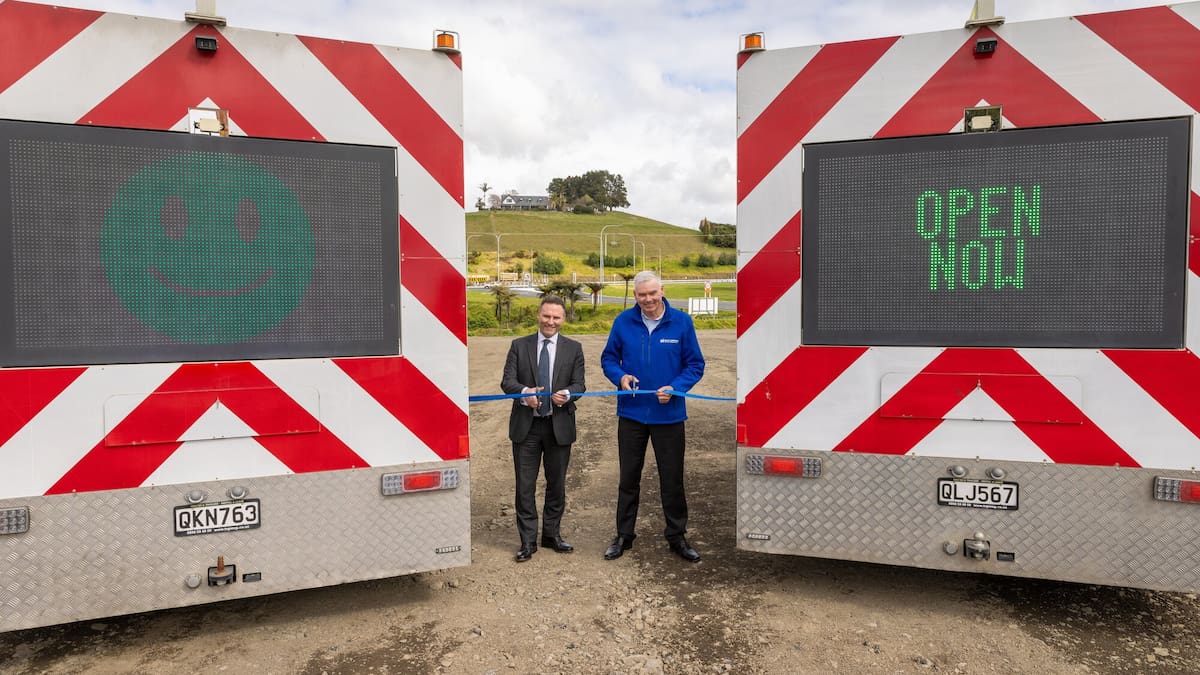
While the roundabout was expected to improve safety and traffic flow, it has been described as an interim solution.
It has been designed to address the intersection’s immediate needs until a future interchange is built as part of Takitimu North Link Stage 2 – the planned extension of the new four-lane highway being built between Tauranga and Te Puna.
Stage 1 is due to finish in 2028. Construction funding for Stage 2 has not been confirmed, but it received fast-track approval in March, with design work and land designation underway.
Western Bay of Plenty Mayor James Denyer said the Ōmokoroa project was about more than a new roundabout.
“It is about enabling the growth and future success of Ōmokoroa.”
He said the community had called for investment after the previous SH2 intersection had become a safety and congestion concern.
The new roundabout at the intersection of State Highway 2 and Ōmokoroa Rd. Photo / Western Bay of Plenty District Council
“The junction with State Highway 2 was a real safety risk and witnessed multiple crashes over the years, some fatal.
“I certainly didn’t enjoy turning right out of Ōmokoroa to go home to Katikati.”
Denyer said the project would also support future housing and employment.
“It is about enabling the growth and future success of Ōmokoroa, which is not only the pre-eminent growth area in our district but a whole new town for New Zealand.”
Western Bay of Plenty District Council says Ōmokoroa is expected to be home to about 13,000 residents by 2050. Stats NZ put the population at 5800 last year.
A council statement said the project was part of a wider programme of infrastructure investment in Ōmokoroa. Stage 2 of Ōmokoroa Rd urbanisation was expected to finish in October, while the Prole Rd urbanisation, Wāhi ō Waipapa Wetland and Tangimoana pedestrian bridge projects were complete.
Coromandel MP Scott Simpson said at the ribbon-cutting event that Ōmokoroa was growing quickly and needed major infrastructure investment.
“This is but part of a jigsaw puzzle that is ongoing growth investment in the Bay of Plenty and the Western Bay of Plenty.”
Simpson said the upgrade would help future-proof the community but was not the end of the work needed in the area.
“It is part of an ongoing project that will need continued effort, support, both political, financial, and organisational.”
Coromandel MP Scott Simpson with Western Bay councillor Grant Dally and Bay of Plenty MP Tom Rutherford at Friday’s ribbon‑cutting for the SH2/Ōmokoroa upgrade. Photo / Zoe Blake
Council chief executive Matt Potton said the project was the result of extensive planning and construction.
“Behind what we see today are actually years of planning, design, consents, utility relocations, funding applications, and, of course, the physical construction.”
He said Stage 2 of the Ōmokoroa urbanisation project was underway and due to be completed in November.
Potton also acknowledged the disruption caused during construction.
“Delivering infrastructure of this scale while maintaining access has been an ongoing challenge.”
HEB national project senior representative Brian Fuller said the roundabout had been built by a strong local workforce.
“These are people who know these roads, live in and understand the community, and they are real local people,” he said.
Fuller said crews had worked around live traffic, installing utilities, drainage, pavement, surfacing and lighting.
He said the project had received positive feedback from road users.
“Many people are commenting on improved travel times, smooth movements through the intersection, and reduced delays.”
Higgins Bay of Plenty regional manager Dean Taylor said his company began work on Stage 1 in 2022.
The project involved moving about 11,000 cubic metres of earth, installing about 500m of stormwater pipes and building more than 10,000sq m of finished pavements and footpaths.
NZTA regional relationships director Andrew Corkill said the project would become increasingly important as Ōmokoroa grew.
“As this community grows, safe, reliable transport connections become even more important.”
Corkill said NZTA had supported the project through funding, land and planning for the future transport network.
“Today’s project is not just about the road layout we see in front of us now, but it’s part of the longer-term transport vision for Ōmokoroa and the wider corridor.”