
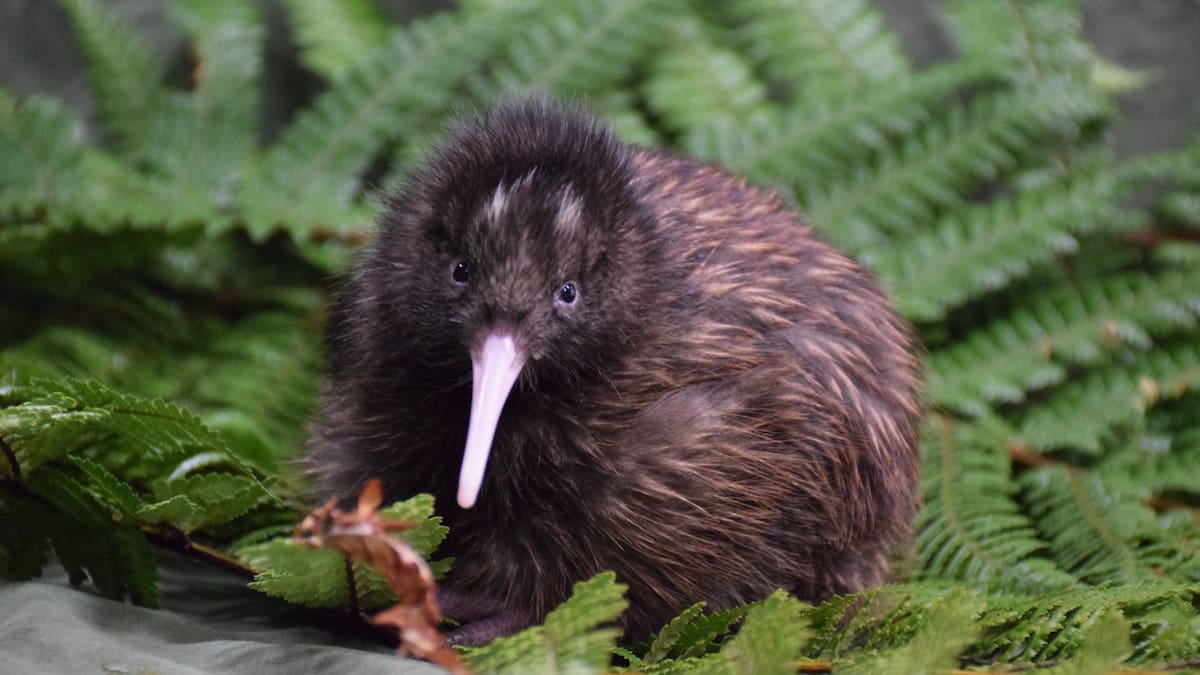
Kiwi chick progresses
Young bird doubles its weight
“Happy event” expected
Hawke’s Bay Herald-Tribune, January 4, 1938
Since it was brought to the Hawke’s Bay Acclimatisation Society’s farm at Greenmeadows about three weeks ago, a kiwi chick, which was found by a shepherd at the back of Kotemaori, near Mohaka, has more than doubled its weight.
When the chick was brought to the society’s office in Napier, it was only a few days old and weighed six ounces.
When it was weighed this morning, it scaled 14 oz.
The society’s curator, Mr F. D. Robson, is very pleased with the progress made, and says the youngster is eating well.
It will take from 18 months to two years to become fully grown.
Questioned regarding a rumour that a “happy event” was shortly expected in the kiwi family now in captivity on the farm, Mr Robson said he felt sure the birds had mated, and they had built themselves a burrow in their run, but he did not expect there would be any eggs laid this season.
However, next season he hopes a chick will hatch.
He has reared kiwis from the chick stage before but has never actually seen one hatched.
The kiwi, Mr Robson says, does not usually breed in captivity, but as the pair on the farm are kept in a large run as close to natural conditions as possible, he is optimistic.
Kiwis are not often found in this district, although there are still quite a number around the headwaters of the Wanganui river and in other places where native bush is plentiful and unspoiled.
Kiwis Plentiful
Central Hawke’s Bay Press, May 3, 1940
Kiwis are reported to be plentiful at the back of Waverley and Waitotara, and are usually found in gorse and scrub country, where they are often attacked by dogs.
Kiwis are nocturnal birds and cannot see well in the daylight, and they are therefore easy prey for dogs.
At the back of Ngutuwera the birds are very plentiful and can be heard calling at night.
Often after scrub fires their nests and bones are found, the destruction from this cause being fairly high.
Kiwi’s Nest ’Nursery’
Northern Advocate, October 3, 1949
A kiwi’s nest, inhabited by two adult birds and two young kiwis, has been discovered on a farm property near Whangarei.
The birds, which have been identified as the small grey kiwi (Apteryx oweni), were observed for a considerable time yesterday by an amateur ornithologist.
Being nocturnal in their habits, the kiwis seemed to be unaware of the presence of the observer until any noise was made.
Their home was in a depression in semi-open bush.
The hole in which they lived was about six feet across, and, in the manner of these peculiar flightless birds, they had dug a tunnel into the bank, where they retreated when disturbed.
The family abode seemed more of a nursery than a nest.
Leaf mould floor
The floor was covered with leaf mould, with a few feathers and twigs but not enough to make a nest in the usual fashion.
About six inches long, the young kiwis were probably only a few weeks old.
Adult grey kiwis grow to a length of nineteen inches.
Their plumage is grey, spotted with yellowish white, the spots forming a band.
The bill of the male bird is shorter than that of the female, which is about three and a half inches long.
Unlike the brown kiwi and the southern kiwi, the grey kiwi has a straight bill.
The other species have slightly curved bills.
– Source: Papers Past