
Back to Article List
Seek out this easy-to-split but complex multiple star system in the Northern Crown, visible in the evening sky.
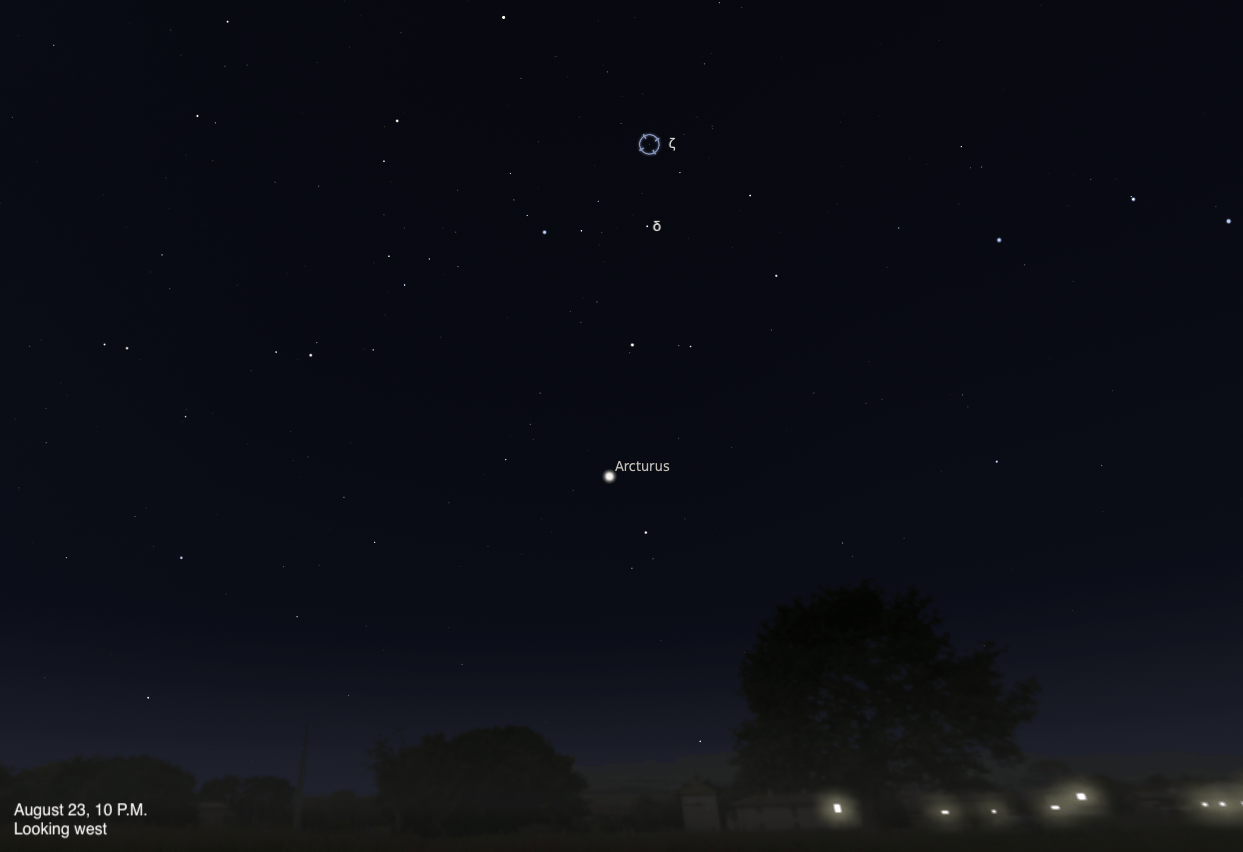
The lovely double star Zeta Coronae Borealis (circled) lies high in the western sky this evening, just to the upper right of the curved figure of the Northern Crown. Credit: Stellarium
Looking for a sky event this week? Check out our full Sky This Week column.
August 22: Titan northwest of Saturn
Let’s check out a lovely binary star in Corona Borealis the Northern Crown. Still high in the west around 10 P.M. local daylight time, this curved constellation lies to the upper left of kite-shaped Boötes, whose brightest star, Arcturus, dominates the western sky.
Situated in northwestern Corona Borealis, our target today is 5th-magnitude Zeta (ζ) Coronae Borealis, just under 6° northeast of brighter magnitude 3.5 Delta (δ) Boötis. Perfect for a small telescope, this star splits easily into two components separated by about 6”. The brighter sun here is magnitude 5.0, while its fainter companion is magnitude 5.9. Both shine blue-white, but because they’re so close, their colors may look noticeably different from each other. What hues do you see?
In truth, this is likely more than a binary star system. Spectroscopic studies show that although the more easterly star (dubbed Zeta2 [ζ2]) cannot be split, it, too, is a multi-star system with as many as four components. The data have been hard for astronomers to parse, so they’re not actually sure how many stars this system could contain! If you want the gory details, check out this star’s page on the late stellar astronomer Jim Kaler’s STARS website.
Sunrise: 6:19 A.M.
Sunset: 7:45 P.M.
Moonrise: 5:29 P.M.
Moonset: 1:30 A.M.
Moon Phase: Waxing gibbous (85%)
*Times for sunrise, sunset, moonrise, and moonset are given in local time from 40° N 90° W. The Moon’s illumination is given at 10 P.M. local time from the same location.
Tomorrow morning’s observation is a challenge, but if you’ve got a large scope or have some astroimaging experience, it’s one you’ll want to try.
Saturn’s moon Iapetus has a two-toned surface, with one hemisphere much brighter than the other. Iapetus is also tidally locked to Saturn — as it orbits, it slowly rotates so that the same side always faces its parent planet. But from our point of view here on Earth, we get to see the changing faces of the moon as it turns in time with its orbital motion. At western elongation, when it reaches its farthest point west of the ringed planet, its brighter hemisphere is turned earthward and it is at its brightest, around magnitude 10. On the other side of its orbit, at eastern elongation, its darker side faces us and the moon plunges to 12th magnitude.
Iapetus reaches eastern elongation August 24, when it is at its faintest. That already makes it harder than usual to spot, but the difficulty is increased by its large distance from Saturn as well. You’ll find it some 9.4’ east of the planet. Because it is both faint and far from Saturn, it will be challenging to spot visually, but dark skies and a large telescope will aid your efforts. It should show up on astrophotos, too, so give that a try if you’ve got the setup.
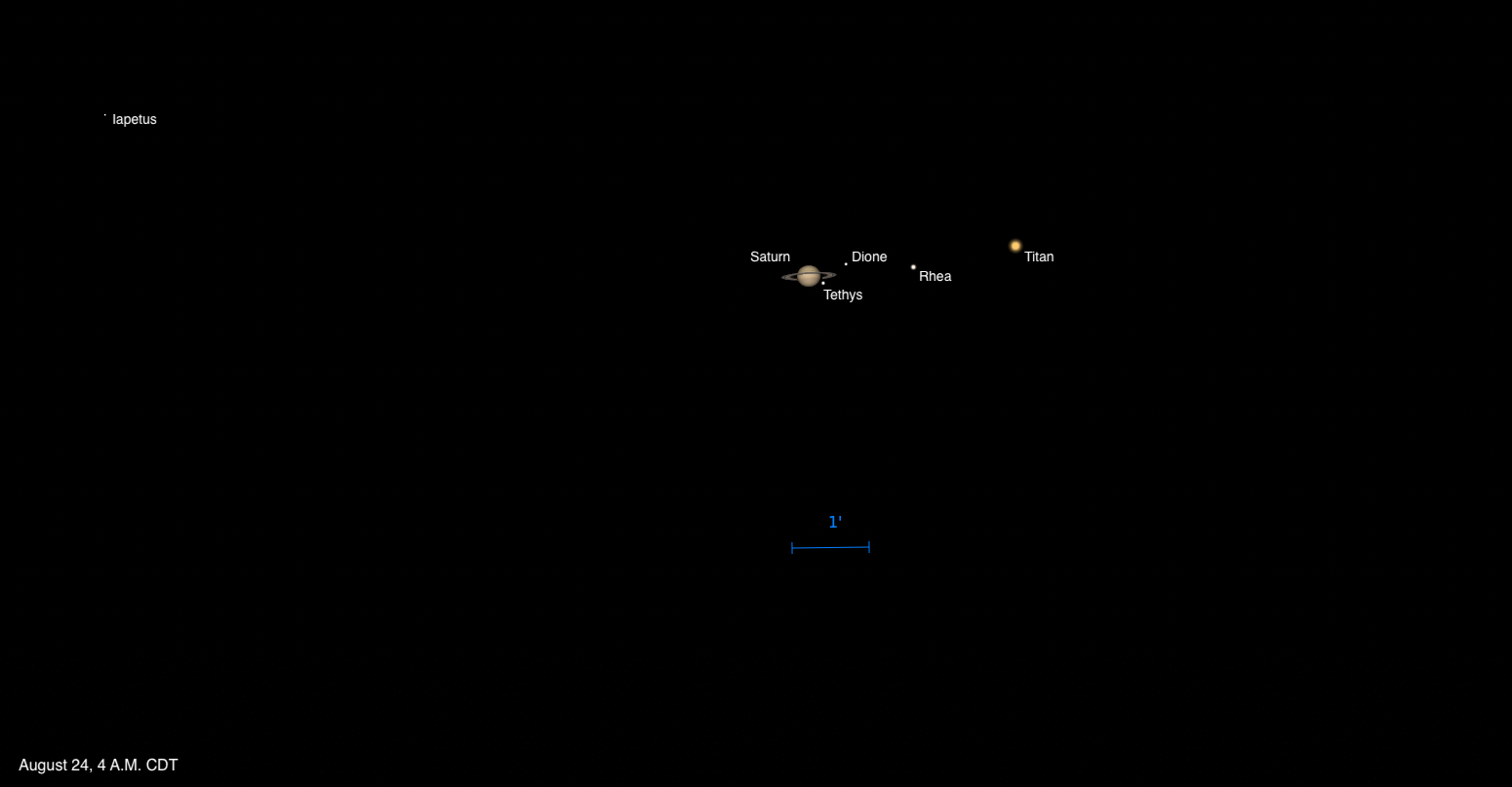
Iapetus is faint and sits far from Saturn today, but see if you can spot — or image — it as it reaches greatest eastern elongation. East is left and north is up in this view. Only moons brighter than about 12th magnitude are shown here; note their positions may be different if you’re observing at a different time. Credit: Stellarium/Oleg Pluton
Alison Klesman is senior editor of Astronomy magazine. She holds a Ph.D. in astronomy and has studied a variety of topics, from minor planets to supermassive black holes.