
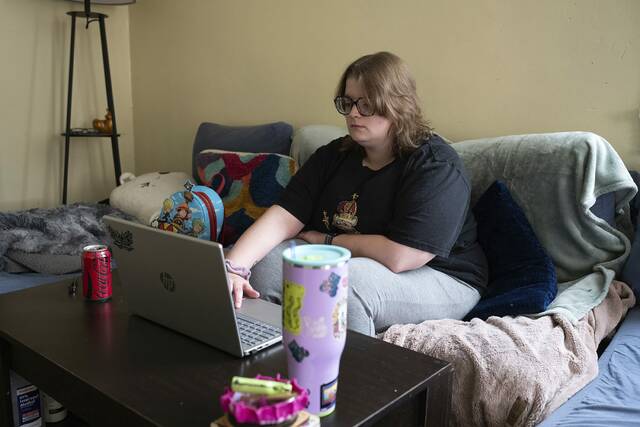
In 2020, the covid-19 pandemic almost uniformly forced mental health providers and their patients to shift therapy appointments online.
More than a half-decade later, teletherapy seems to have cemented its place in healthcare — though patients and providers alike now say they’ve noticed a push to return to the clinician’s couch.
“Telehealth is nice for the convenience, but in person, I feel like I’m able to get to the root of the problem,” Maryann Fox said. “I feel like it’s more raw and real in person.”
Fox, 29, of Brackenridge, has been in a mix of virtual and in-person therapy off and on for about five years, seeking help for childhood trauma and anxiety, she said.
Her current provider, whom she’s seen weekly for just over a year, offers both options, but Fox said she almost always opts to go into the office — even though it means making the commute into Pittsburgh.
That’s because Fox has found talking things through in an office setting takes away many of the distractions of her home life and narrows her focus solely to her treatment.
“Part of what I’m working on is how I process grief,” she said. “In office, I feel like I’m kind of able to shut everything else out and actually let myself cry or let myself feel the things I should be feeling or need to feel.”
Plus, she said, the drive back through the Alle-Kiski Valley allows her more time to reflect on the session.
Still taking advantage of virtual options occasionally, Fox said she’ll jump online when traffic is especially bad or she’s feeling ill.
But getting help through a screen hasn’t always proved helpful to her.
“I had a strictly telehealth therapist my first go-around getting mental health help here. It was during covid,” she said. “By the time I met her in person, it kind of felt like she didn’t really know me at all.”
Fox’s outlook isn’t necessarily unique.
Joel Richard is the program manager in charge of organizing group therapy sessions and facilitator trainings for the Pennsylvania branch of the National Alliance on Mental Illness, a nationwide advocacy and support group.
Richard, who is based in Pittsburgh, said about half of the group’s sessions are online and half in-person.
“We’ve seen a large push and demand for in-person stuff, so we’ve been making an effort to offer that as well,” he said.
Richard has participated in group sessions as both a participant and leader. He said it’s much easier to form emotional bonds in a face-to-face setting, but part of the issue is also practical.
“You’re never going to have somebody with an unstable internet connection in person,” Richard said. “You’re not going to have a meeting where somebody is halfway through sharing their deepest, darkest moments to you, and then suddenly the internet cuts out, and we’ve had that happen in a group, where it really just takes the wind out of their sails.”
Occasionally, Richard said he’s also seen participants become a bit too comfortable in a virtual setting, attending meetings while lying in bed or having other people walking around them — which he said can make others more hesitant to share.
Dr. Julie Leone, a counselor who runs Solstice Counseling and Wellness Services in Mt. Pleasant, said it’s possible to develop a rapport with a patient virtually.
But she still prefers in-person appointments, and it seems her patients do, too.
During the pandemic, Leone said, about 75% of her patients were online. Now that number is something like 40%.
“There are some things you can gauge as a clinician when someone’s in person that you can’t online,” she said. “Is someone bathing? Are they struggling with self-care? If they don’t tell you when you’re online, you’re probably not going to know.”
But the flexibility of online appointments has also allowed her to continue to treat patients who move away to college and continue with appointments even when she’s snowed in at her home.
That’s teletherapy’s significant advantage: a low barrier to entry.
Dr. Timothy Law, chief medical officer of Highmark, said that means people who require mental health treatment can receive it earlier and more easily, which he said leads to better patient outcomes.
That’s especially true for patients who live in rural areas, like many of his patients in central Kentucky, where he works as a physician.
But it’s also true for patients who may feel embarrassed or fearful of seeking mental health treatment, he said.
“It’s given you a bit more anonymity to be able to seek care,” Law said.
Generally, scientific research — including a 2022 study in Mental Health Review Journal and a 2021 study in Military Medicine — found that there is little discernible difference in outcomes between patients receiving mental health treatment in person and virtually.
But other studies have found that those who receive teletherapy care have higher appointment attendance and significantly lower no-show rates.
Dr. Justin Shuster, medical director of the general adult inpatient and psychiatry access clinic at UPMC Western Psychiatric Hospital, estimates that 90% of the 100 patients he sees each month are online — many of whom take appointments in their parked cars.
He even has some patients he’s never met in person.
“I don’t know if there’s a real push to get people back in,” Shuster said. “In my experience, patients prefer the convenience and other access of it.”
Shuster does acknowledge an additional barrier, however: His office is located within Western Psych.
He said the stigma of walking into a psychiatric hospital for an appointment may deter more in-person patients from seeking care in the office.
“I don’t know that I would do it, to be totally honest,” Shuster said.
The most important factor in the effectiveness of mental health therapy, Shuster said, is a patient’s relationship with their therapist.
And it’s a relationship he doesn’t think is lost through the barrier of a screen.
Plus, he said, virtual sessions allow for useful insights on his part.
“As a psychiatrist, we read into things a lot,” Shuster said. “Seeing someone’s home is very interesting to me. I can see are they organized or disorganized. Sometimes a family member will walk through. I can kind of see how they interact. Do they bicker?”
For Shuster, the convenience and flexibility of online appointments present a “threat to the old model,” but Law said he doesn’t expect teletherapy to entirely displace in-person options.
“It’s now just become a regular part of the toolbox for physicians to provide care in that space,” he said.