
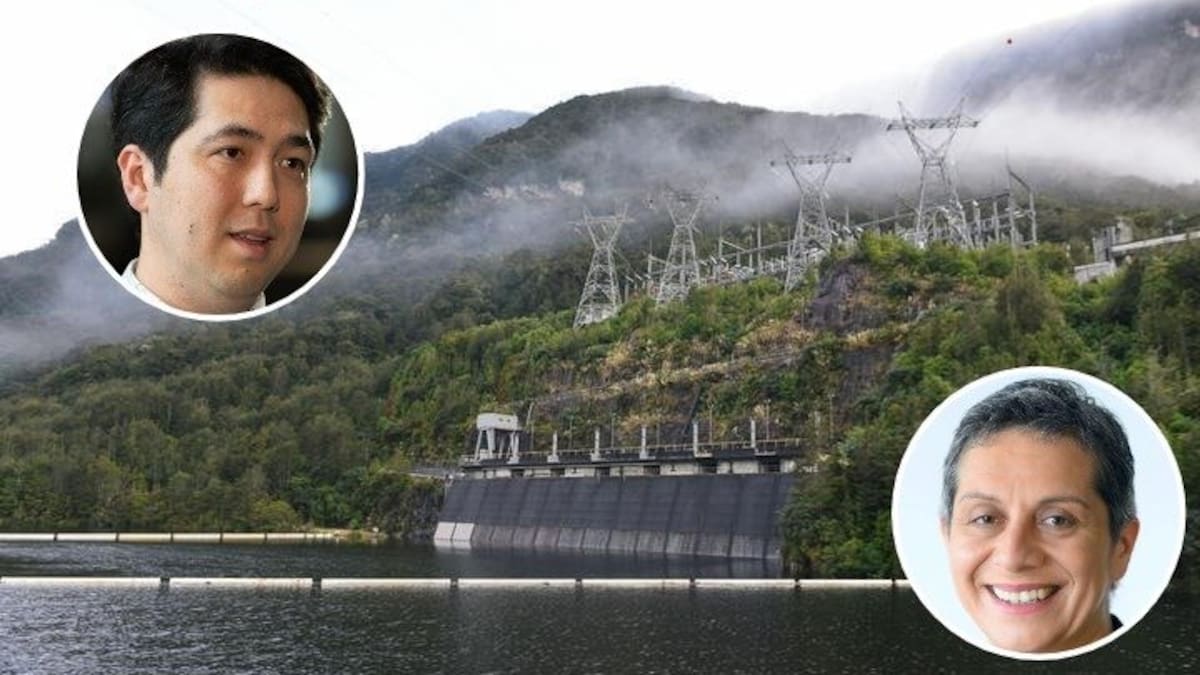
The former Meta executive is co-chair with Anna Kominik, a former Electricity Authority chairwoman.
“The bills are high because our energy system kind of persistently runs on shortages,” Pan says.
“Our back-ups are really expensive, and they tend to set the price, at least the wholesale price.
“It doesn’t help that the plans keep changing, so what we are really proposing is this long-term package that incentivises folks to actually build more cheap, clean power.”
Growth NZ co-chair and NZME director Bowen Pan. Photo / Cameron Pitney
Changing those incentives comes at steps two and three of a five-year, eight-step plan, “Powering a prosperous New Zealand”.
Step one is agreement of the kind that has eluded successive governments and opposition parties.
Steps four and five are a major regulatory overhaul.
The report notes energy regulation is split across four bodies: the Electricity Authority, the Commerce Commission, the Gas Industry Company and the Ministry of Business, Innovation and Employment.
Growth NZ suggests merging those functions to create one super-regulator made even larger by splitting grid owner and system operator Transpower to divide its dual roles.
It suggests that might promote investment in batteries, demand responses and non-transmission solutions rather than yet more poles, pylons and wires.
It also suggests mandatory consolidation for the distribution companies that connect to the grid.
“We have 29 lines companies, and Australia has 10; we’ve got four regulator-policymaker entities,” Kominik says.
“Everyone’s got a job, and nobody’s accountable for a better outcome for consumers.”
Anna Kominik is co-chair at Growth NZ and a former Electricity Authority chairwoman.
Growth NZ’s energy plan also points out a conflict successive Governments have struggled with: regulating with one hand while collecting half a billion dollars a year in dividends from Genesis, Mercury and Meridian.
It proposes establishing a “clear institutional wall” and placing the Government’s gentailer shareholdings in “a Temasek-style holding company”, referring to the sovereign wealth fund of the kind Singapore runs with a commercial mandate, transparent reporting, and no role in energy policy or regulation.
Growth NZ also supports a proposal similar to one put forward by Contact Energy five years ago and by the Frontier Economics review of the energy system published last year.
It wants a Government-owned “Thermal NewCo” that would own or contract the remaining thermal fleet and its fuel supply, such as Huntly power station, where Genesis maintains a coal-fired back-stop to the electricity system under contract with Contact, Mercury and Meridian.
That new company would sell firming cover to all buyers on equal terms, and retire that fleet as renewables, storage and demand flexibility take up the slack.
The Growth NZ plan addresses more competitive pricing and proposes a national financing platform that tags the cost of home solar installations to a meter rather than a customer, so any obligation stays with the occupant of a home.
Growth NZ’s plan has one more back-stop – structural separation of the retail and generation parts of those four major players, which it says is “a serious tool, not a slogan” and would be more complex than the break-up of Telecom into Chorus and Spark.
“Research suggests that, regulated well, vertical integration can be efficient and even cheaper than broken-up firms,” the report says.
For that reason, it argues for levelling the playing field and allowing and promoting open entry to new generators and retailers first, and resorting to break-ups only as “a credible, pre-designed escalation” with the triggers agreed and published.
For a civic movement, it certainly reads like a political or lobby group manifesto, so who is Growth NZ and why should anyone pay attention?
A look at its website shows a cross-section of New Zealand entrepreneurship.
Venture capitalist Rob Coneybeer, who has made New Zealand a second home; those who’ve come home again such as Pan and wife Maya, or Nuvocargo founder Sam Blackman; local entrepreneur Cecilia Robinson, angel investor Suse Reynolds and many more.
Pan says Growth NZ has more than 200 people involved directly with policy, operations and marketing and a wider circle of about 1000 supporters engaged across the country.
That’s more than enough to start a political party, and despite sounding like they’re running the policy formation for one, Pan and Kominik don’t want your vote, just your attention.
“Our only goal is for New Zealand to be broadly prosperous for every New Zealander,” Pan says.
“So that we can actually get to a better place for all of us and it’s not just concentrated in one part of the community,” Kominik adds.
“We have the capacity to be one of the world’s renewable energy superpowers,” Pan says.
“We are very far away from that right now, but if that’s something we want, we certainly have the natural endowments to actually achieve that.”
Bowen Pan is also an independent director of NZME, publisher of the New Zealand Herald. Stay ahead with the latest market moves, corporate updates, and economic insights by subscribing to our Business newsletter – your essential weekly round-up of all the business news you need.