
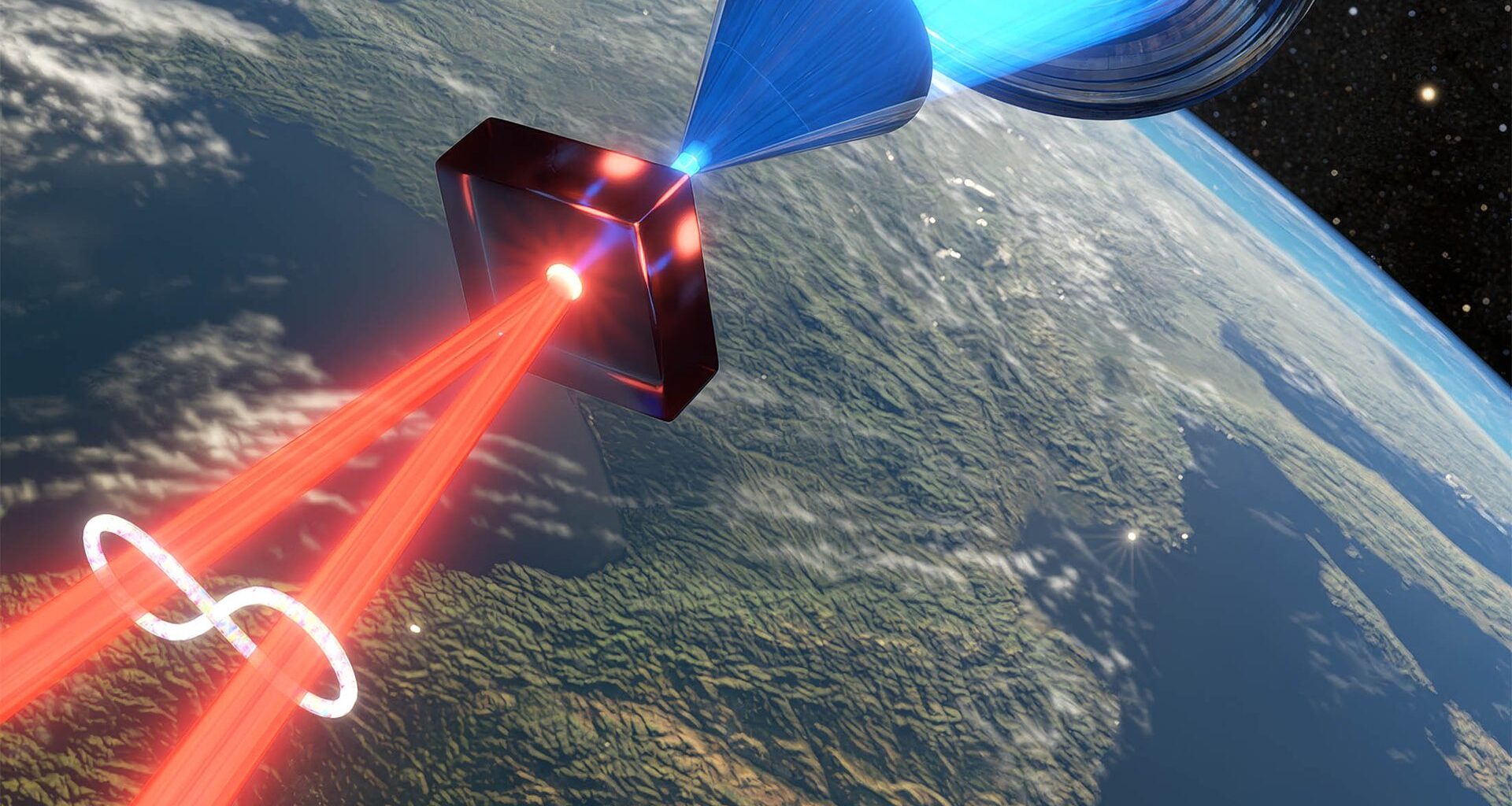
Physicists thought entangled photons could only come from a laser, but now they have pulled them from simple sunlight.
Inside a laser, light is orderly in every way at once: one color, one direction, peaks lined up with peaks. Physicists have long treated that order as the price of making a pair of entangled photons, and sunlight has none of it.
Working outdoors in Germany, a team pushed raw sunlight through a small crystal and got the entangled pairs anyway.
Order in the pump beam, it turns out, limits only the property that order belongs to.
Two entangled photons behave like a single object. Measure the polarization of one, meaning the direction its wave wiggles, and the other’s is settled at once.
Those pairs are the raw material of quantum encryption.
Cheng Li is a recent University of Ottawa graduate and one of the paper’s two lead authors.
From the beginning, said Li, “our idea has met with repeated doubt and pushback.”
Well-known physicists doubted that sunlight could yield any photons this way, Li said, let alone entangled ones.
Lasers require a lot of power
A commercial laser pulls several watts out of the wall and delivers milliwatts of light.
Lasers spend much of the difference holding their color and temperature steady, and shed the rest as heat.
Engineers are drawing up orbital data centers and solar power stations in space, where sunlight is free and a laser diode is one more part radiation can damage.
Not all light behaves the same way
Light can be orderly in more than one way at a time: the waves can share a color, travel in one direction, and rise and fall together. Physicists call each kind coherence, and a laser has all three.
Inside certain crystals, a photon of the pump beam occasionally splits into two photons of lower energy, and they come out linked. Down-conversion, as it’s called, is how most entangled pairs get made.
The rule tying coherence to entanglement is narrower than it looks. Physicists worked out that a pump’s order in one property caps the entanglement in that property alone.
Robert Boyd’s group had already tested that with an LED, whose light is a jumble of colors going every which way, and got pairs entangled in polarization.
Sunlight is the harder case. Another team reported correlated photon pairs from sunlight earlier this year, without testing whether the pairs were entangled.
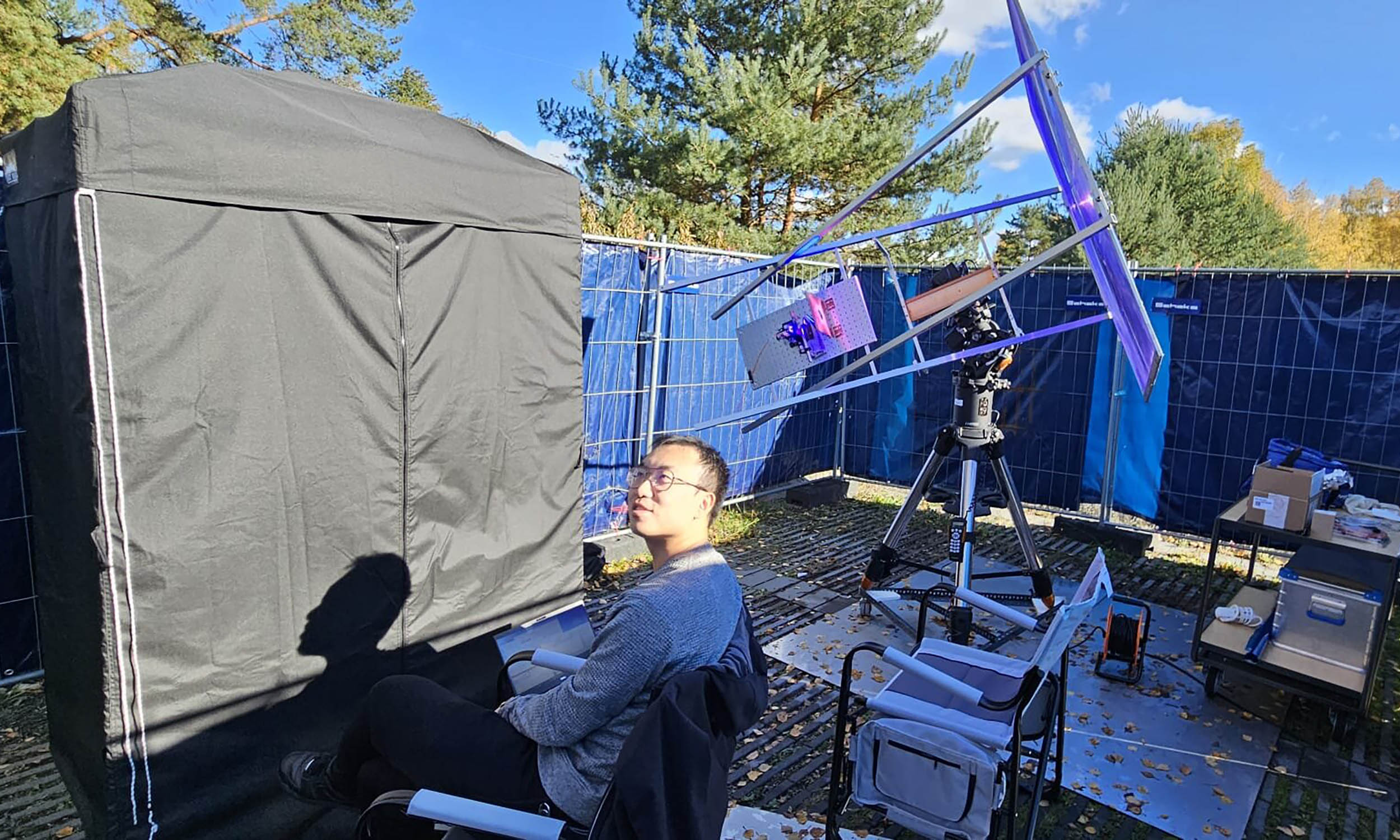 Cheng Li is shown with the outdoor experimental setup. The sunlight concentration module, including the Fresnel lens and the solar concentrator, is mounted on a solar-tracking motor to ensure stable power delivery. The entanglement generation and detection setup, including the nonlinear crystal and the single-photon detectors, are shielded in an optical enclosure placed inside a blackout tent. Credit: Jasvinder Brar, Max Planck Institute for the Science of Light. Click image to enlarge.Turning sunlight into entangled photons
A Fresnel lens, a flat sheet of grooves that bends light like a much thicker curved lens, gathered sunlight outside.
Filters cut the beam to the colors the crystal could use, and a cone of glass narrowed what was left until it fit into an optical fiber.
The fiber carried the light into a loop of two mirrors, a beam splitter and the crystal. Light travels that loop in both directions at once, so a pair coming out can’t be traced to either path.
That is what makes the two photons entangled rather than merely correlated.
Everything ran outdoors at the Max Planck Institute for the Science of Light in Erlangen, Germany, where Hanieh Fattahi’s group built the concentrator. Fencing around the area kept wind off the optics.
The team worked in a tent, with the optics inside a light-tight box, so the only light reaching the detectors came out of the fiber.
Sunlight produced photon pairs
Both photons of a real pair leave the crystal together, so both should reach the detectors together.
Nearly every coincidence turned up inside one narrow spike, offset 2.25 nanoseconds by electrical delays in the counter rather than by anything the photons did.
Past 5 nanoseconds the counts dropped to almost nothing, so almost none were chance pairings of unrelated photons.
With around 100 nanowatts of sunlight reaching the crystal, the detectors logged about 10 pairs a minute, or roughly 1,600 pairs per second for every milliwatt of pump power.
The group’s own LED pump had produced the same yield, and laser-pumped sources produce a comparable one once both are corrected for bandwidth.
Sunlight arrives as a wide spread of colors, and the crystal converts only a narrow slice.
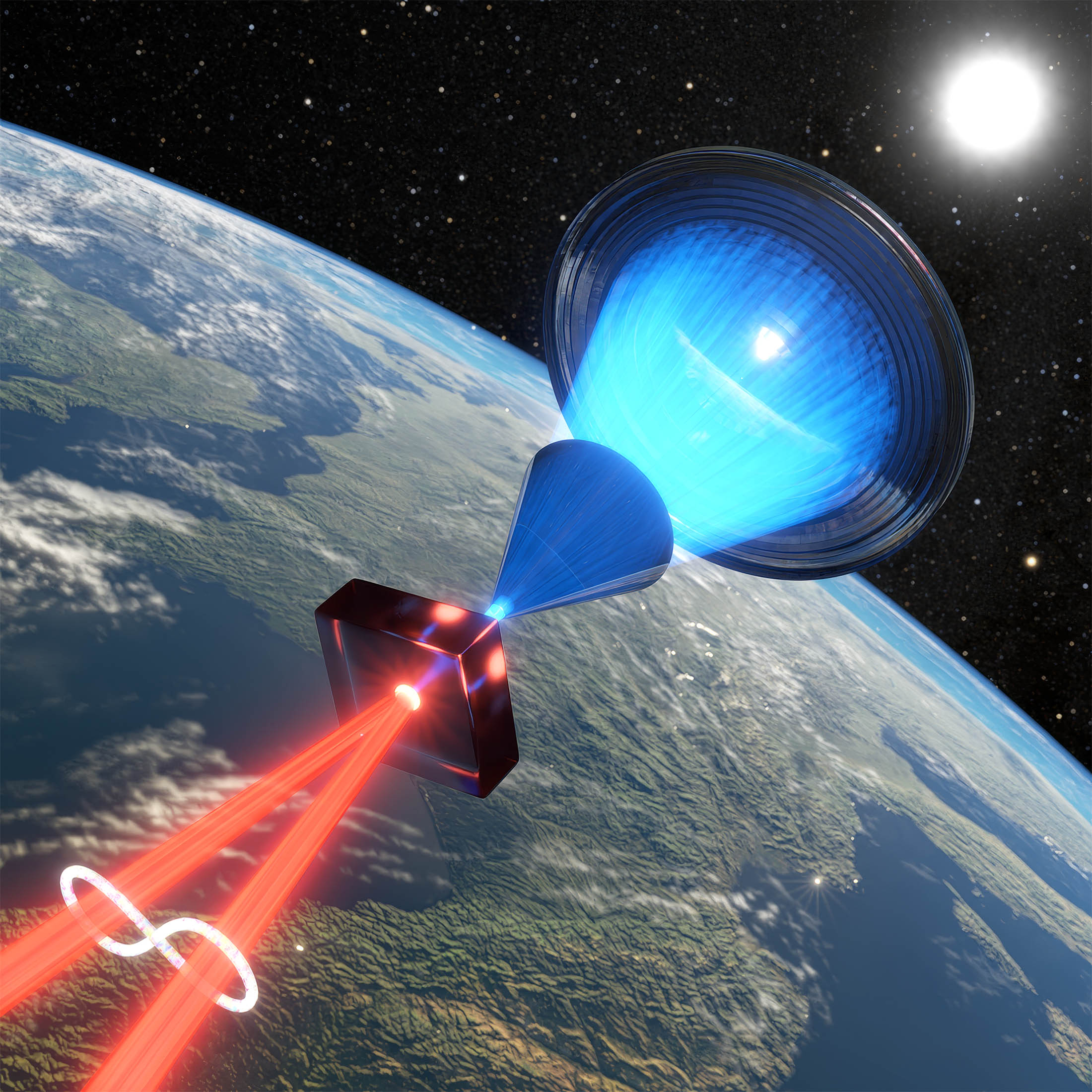 Using a new cone-shaped solar concentrator, researchers showed that sunlight can be used to create entangled photons. This could one day enable satellites to create secure encryption keys using the sunlight already abundant in space. Credit: Florian Sterl. Click image to enlarge.Proving the photons were entangled
Counting pairs shows the photons arrived together. It doesn’t show they were entangled.
So across three days, the team measured the pairs 16 ways, turning the filters in front of each detector to fresh angles, two minutes per setting.
Out of those counts came a full description of the state, which matched the target 94% of the way. On a scale where 0 means no entanglement and 1 means as much as physics permits, the pairs came in at 0.905.
The harder question is whether the photons carried fixed answers all along, decided at the crystal and read off later.
Physicists call the check for that a Bell test, and no such theory can push a certain combination of measurements above 2. These pairs reached 2.5408, give or take 0.2171, a margin 2.49 times the uncertainty.
The gap is modest, and the result stands.
A Bell violation can also be used to certify security in quantum communication, which is why the number matters to anyone building quantum networks.
Clouds made the experiment harder
The team points to several reasons for the modest margin. Few pairs arrived each minute and the entanglement was strong but not perfect.
Furthermore, seasonal conditions brought weak sunlight and passing clouds during the experiments.
For the imperfect entanglement, the authors blame the optics rather than the sunlight.
An uneven surface on the beam splitter would delay one path slightly more than the other, leaving the paths partly distinguishable. Better optics should recover it.
Nor is the setup fully solar. An electric unit holds the crystal at temperature, and electric motors aim the collector at the sun. This is an optical table under a tent, not a device anyone can deploy yet.
What nobody has shown is whether concentrated sunlight can get bright enough, inside the crystal’s narrow band of colors, to compete with today’s laser diodes.
A satellite in a Sun-synchronous orbit maintains a nearly fixed angle to the sun, so its collector would need far less tracking.
If the team can make the system brighter and more efficient, sunlight itself could one day help power secure quantum communication in space.
The full study was published in the journal Optica.
—–
Like what you read? Subscribe to our newsletter for engaging articles, exclusive content, and the latest updates.
Check us out on EarthSnap, a free app brought to you by Eric Ralls and Earth.com.
—–